Department of Surgery, Cancer Centre, University Medical Centre Utrecht, PO Box 85500, 3508 GA, Utrecht, The Netherlands.
Department of Surgery, St. Antonius Hospital, Nieuwegein, The Netherlands.
J Robot Surg. 2022 Apr;16(2):265-272. doi: 10.1007/s11701-021-01265-w. Epub 2021 Jun 14.
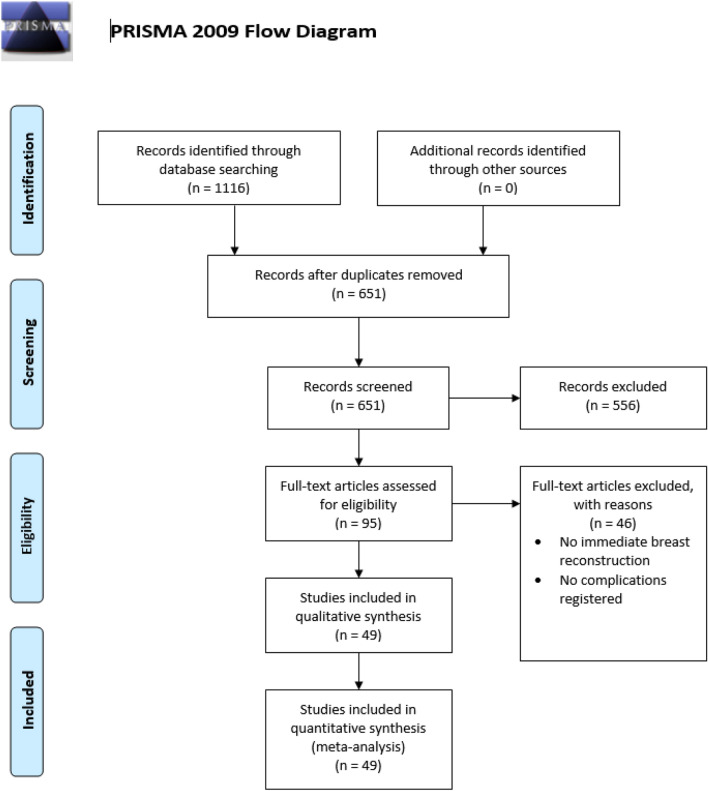
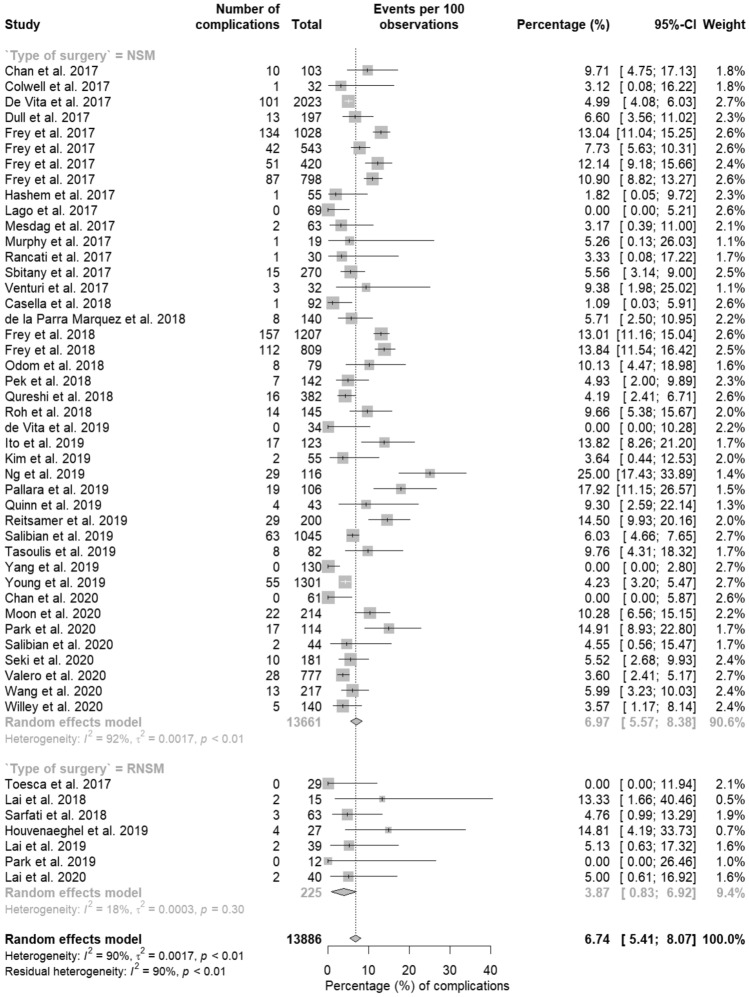
Breast cancer is worldwide the most common cause of cancer in women and causes the second most common cancer-related death. Nipple-sparing mastectomy (NSM) is commonly used in therapeutic and prophylactic settings. Furthermore, (preventive) mastectomies are, besides complications, also associated with psychological and cosmetic consequences. Robotic NSM (RNSM) allows for better visualization of the planes and reducing the invasiveness. The aim of this study was to compare the postoperative complication rate of RNSM to NSM. A systematic search was performed on all (R)NSM articles. The primary outcome was determining the overall postoperative complication rate of traditional NSM and RNSM. Secondary outcomes were comparing the specific postoperative complication rates: implant loss, hematoma, (flap)necrosis, infection, and seroma. Forty-nine studies containing 13,886 cases of (R)NSM were included. No statistically significant differences were found regarding postoperative complications (RNSM 3.9%, NSM 7.0%, p = 0.070), postoperative implant loss (RNSM 4.1%, NSM 3.2%, p = 0.523), hematomas (RNSM 4.3%, NSM 2.0%, p = 0.059), necrosis (RNSM 4.3%, NSM 7.4%, p = 0.230), infection (RNSM 8.3%, NSM 4.0%, p = 0.054) or seromas (RNSM 3.0%, NSM 2.0%, p = 0.421). Overall, there are no statistically significant differences in complication rates between NSM and RNSM.
乳腺癌是全世界女性最常见的癌症病因,也是导致癌症相关死亡的第二大常见原因。保乳乳房切除术(NSM)在治疗和预防环境中通常被使用。此外,(预防性)乳房切除术除了并发症外,还与心理和美容后果有关。机器人辅助保乳乳房切除术(RNSM)可更好地显示平面并减少侵袭性。本研究旨在比较 RNSM 和 NSM 的术后并发症发生率。对所有(R)NSM 文章进行了系统搜索。主要结果是确定传统 NSM 和 RNSM 的总体术后并发症发生率。次要结果是比较特定的术后并发症发生率:假体丢失、血肿、(皮瓣)坏死、感染和血清肿。纳入了 49 项包含 13886 例(R)NSM 的研究。在术后并发症(RNSM 3.9%,NSM 7.0%,p=0.070)、术后假体丢失(RNSM 4.1%,NSM 3.2%,p=0.523)、血肿(RNSM 4.3%,NSM 2.0%,p=0.059)、坏死(RNSM 4.3%,NSM 7.4%,p=0.230)、感染(RNSM 8.3%,NSM 4.0%,p=0.054)或血清肿(RNSM 3.0%,NSM 2.0%,p=0.421)方面,两组间均无统计学显著差异。总体而言,NSM 和 RNSM 的并发症发生率无统计学显著差异。