Department of Endodontics, Affiliated Stomatology Hospital of Guangzhou Medical University, Guangzhou Key Laboratory of Basic and Applied Research of Oral Regenerative Medical, Guangzhou, 510182, Guangdong, China.
Division of Endodontics, Faculty of Dentistry, The University of British Columbia (UBC), 2199 Wesbrook Mall, Vancouver, V6T 1Z3, Canada.
BMC Oral Health. 2021 Jun 15;21(1):307. doi: 10.1186/s12903-021-01671-4.
This study aimed to compare the use of photon-initiated photoacoustic streaming (PIPS) and conventional needle irrigation (CNI) in conjunction with different concentrations of sodium hypochlorite (NaOCl) to remove Enterococcus faecalis (E. faecalis) suspended bacteria and biofilms from root canal systems with different diameters or tapers.
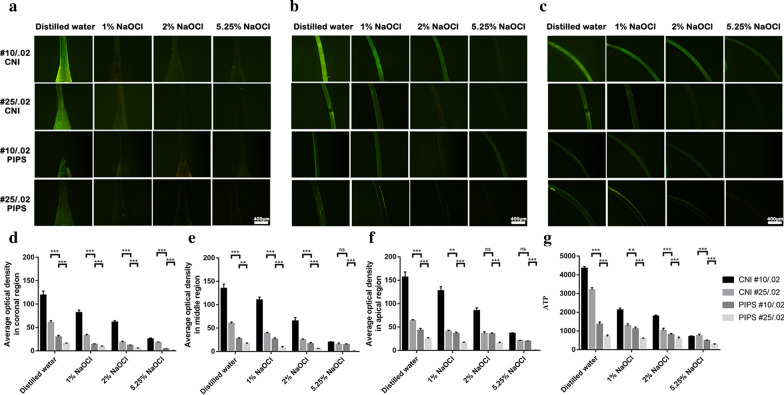
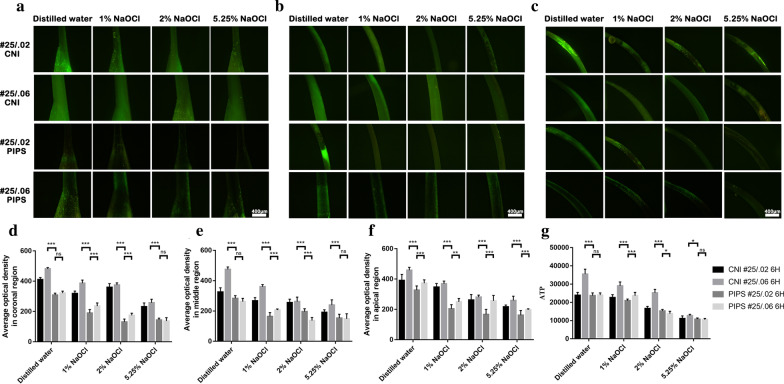
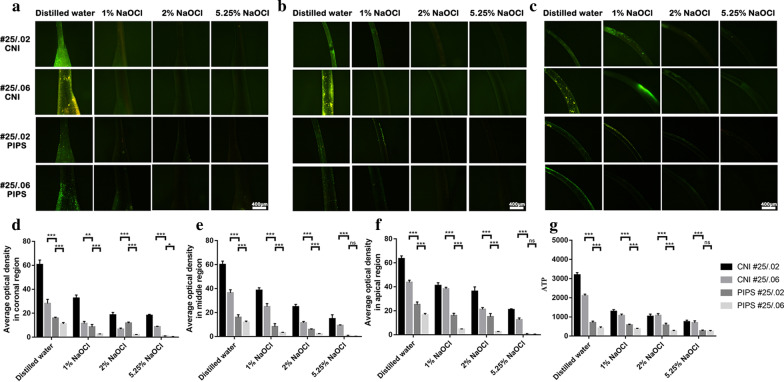
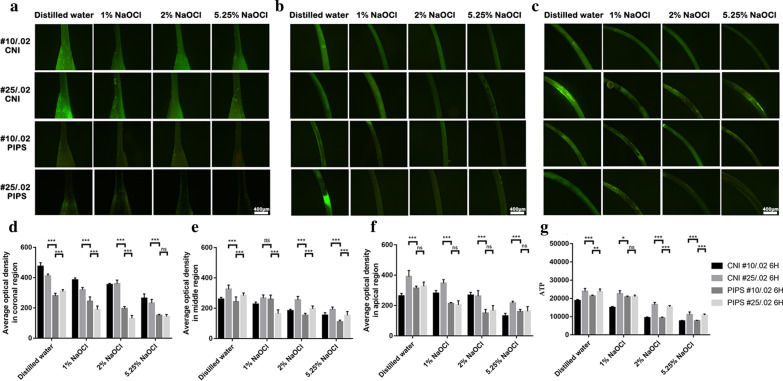
Artificial root canal samples (n = 480) were randomly divided into three groups (n = 160/group). The canals were prepared to fit file sizes #10/.02, #25/.02, or #25/.06. The size #10/.02 group was incubated for seven days. The size #25/.02 or #25/.06 group was incubated for 2 days. A stable biological model of E. faecalis infection was established. The root canals were washed with distilled water or with 1%, 2%, or 5.25% NaOCl combined with CNI or PIPS. Bacterial suspensions and biofilms were assessed using an ATP assay kit and fluorescence microscopy. Image-Pro Plus was used to analyse the average fluorescence intensity to determine the most suitable root canal irrigation solution.
In the CNI and PIPS groups, the ATP value of the 5.25% NaOCl subgroup was the lowest, followed by that of the 2% and 1% NaOCl subgroups. The ATP value of the distilled water subgroup was the highest (P < 0.05). When the root canal taper was 0.02, the ATP value of the #10/.02 + PIPS group was significantly lower than that of the #25/.02 + CNI group (P < 0.05). The average fluorescence intensity of the #10/.02 + PIPS group was lower than that of the #25/.02 + CNI group (P < 0.05). When the apical diameter was #25, the ATP value of the 0.02 taper in the PIPS group was lower than that of the 0.06 taper in the CNI group (P < 0.05), and the average fluorescence intensity of the 0.02 taper + PIPS group was lower than that of the 0.06 taper + CNI group (P < 0.05). PIPS combined with 2% and 5.25% NaOCl effectively improved the long-term antibacterial effect after irrigation and re-culture for 6 h.
Compared with CNI, PIPS has greater ability to remove bacteria in root canals with a small preparation diameter and a small taper. PIPS with 2% and 5.25% NaOCl exhibited superior antibacterial and bacteriostatic effects.
本研究旨在比较光启动光声流(PIPS)和传统的针管冲洗(CNI)联合不同浓度次氯酸钠(NaOCl)在不同直径或锥度的根管系统中去除粪肠球菌(E. faecalis)悬浮细菌和生物膜的效果。
将人工根管样本(n=480)随机分为三组(n=160/组)。根管准备适配 #10/.02、#25/.02 或 #25/.06 锉。#10/.02 组培养 7 天,#25/.02 或 #25/.06 组培养 2 天。建立粪肠球菌稳定生物感染模型。用蒸馏水或 1%、2%或 5.25% NaOCl 联合 CNI 或 PIPS 冲洗根管。使用 ATP 检测试剂盒和荧光显微镜评估细菌悬液和生物膜。使用 Image-Pro Plus 分析平均荧光强度,以确定最适合根管冲洗液。
在 CNI 和 PIPS 组中,5.25% NaOCl 亚组的 ATP 值最低,其次是 2%和 1% NaOCl 亚组。蒸馏水亚组的 ATP 值最高(P<0.05)。当根管锥度为 0.02 时,#10/.02+PIPS 组的 ATP 值明显低于#25/.02+CNI 组(P<0.05)。#10/.02+PIPS 组的平均荧光强度低于#25/.02+CNI 组(P<0.05)。当根尖直径为#25 时,PIPS 组 0.02 锥度的 ATP 值低于 CNI 组 0.06 锥度(P<0.05),PIPS 组 0.02 锥度的平均荧光强度低于 CNI 组 0.06 锥度(P<0.05)。PIPS 联合 2%和 5.25% NaOCl 可有效提高冲洗后再培养 6 小时的长期抗菌效果。
与 CNI 相比,PIPS 对小直径和小锥度根管的细菌有更强的清除能力。PIPS 联合 2%和 5.25% NaOCl 具有较好的抗菌和抑菌效果。