Siddique Rabia, Zahoor Ameer Fawad, Ahmad Hamad, Zahid Faisal Maqbool, Karrar Emad
Department of Chemistry Government College University Faisalabad Pakistan.
Department of Chemistry University of Management and Technology Lahore Lahore Pakistan.
Food Sci Nutr. 2021 May 3;9(6):3219-3227. doi: 10.1002/fsn3.2284. eCollection 2021 Jun.
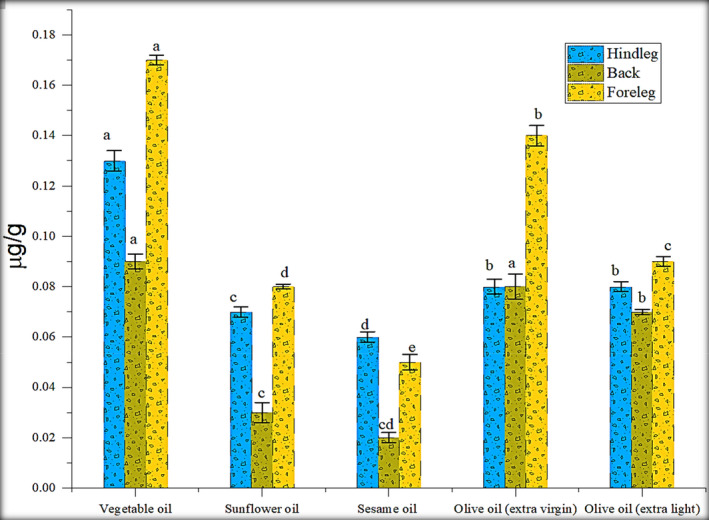
The influence of a variety of cooking methods (poaching, boiling, grilling (charcoal or gas)), frying (pan, deep frying, and stir frying) with a variety of oils (vegetable oil, extra virgin olive oil, sesame oil, extra light olive oil, and sunflower oil), microwaving, and oven roasting on polycyclic aromatic hydrocarbons (PAHs) formation in rabbit meat samples was investigated. Meat samples (including three replicates) were prepared without additives or spices. PAHs extraction was carried out by saponification method with potassium hydroxide in methanol which was followed by a silica gel column technique and the samples were quantified by using gas chromatography with mass spectrometry (GC-MS). PAHs standards, fluorene, naphthalene, anthracene, phenanthrene, pyrene, acenaphthalene, fluoranthene, and benzopyrene, were used for this study. The other PAHs except fluorene were not observed (detection limit-0.009 µg/g) in all the samples. Among traditional processing techniques, higher PAH contents were observed as a result of frying. Frying with vegetable oil produced higher fluorene content (0.06-0.13 µg/g) in the deep-fried sample, although sesame oil is the best oil which produces lowest PAH contents in fried samples. Among all the processing techniques, lower fluorene (0.01-0.02 µg/g) content was noticed in poaching. Benzo(a)pyrene was not observed in all the investigated samples which is viewed as a reliable strategy of the cooking process for human consumption. After processing, the cooking loss was determined and oven roasting and grilling exhibited greater moisture loss.
研究了多种烹饪方法(水煮、煮沸、烧烤(木炭或燃气))、使用多种油(植物油、特级初榨橄榄油、芝麻油、特轻橄榄油和葵花籽油)进行油炸(平底锅煎、油炸和炒菜)、微波加热以及烤箱烘焙对兔肉样品中多环芳烃(PAHs)形成的影响。制备肉样(包括三个重复样)时不添加添加剂或香料。采用在甲醇中用氢氧化钾皂化的方法进行PAHs提取,随后采用硅胶柱技术,并使用气相色谱 - 质谱联用仪(GC - MS)对样品进行定量。本研究使用了PAHs标准品,芴、萘、蒽、菲、芘、苊、荧蒽和苯并[a]芘。在所有样品中均未检测到除芴以外的其他PAHs(检测限为0.009 μg/g)。在传统加工技术中,油炸会导致更高的PAH含量。用植物油油炸时,油炸样品中的芴含量较高(0.06 - 0.13 μg/g),尽管芝麻油是油炸样品中产生PAH含量最低的最佳油。在所有加工技术中,水煮时芴含量较低(0.01 - 0.02 μg/g)。在所有调查样品中均未检测到苯并[a]芘,这被视为烹饪过程中可供人类食用的可靠策略。加工后,测定了烹饪损失,烤箱烘焙和烧烤的水分损失更大。