Catalá Rafael, López-Cobollo Rosa, Berbís M Álvaro, Jiménez-Barbero Jesús, Salinas Julio
Departamento de Biotecnología Microbiana y de Plantas, Centro de Investigaciones Biológicas Margarita Salas-CSIC, Madrid 28040, Spain.
Departamento de Biología Estructural y Química, Centro de Investigaciones Biológicas Margarita Salas-CSIC, Madrid 28040, Spain.
Sci Adv. 2021 May 19;7(21). doi: 10.1126/sciadv.abd9296. Print 2021 May.
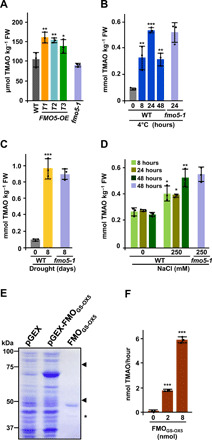
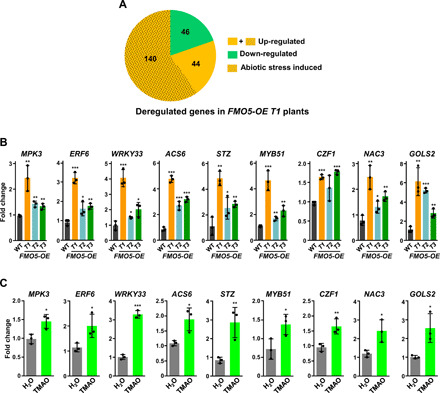
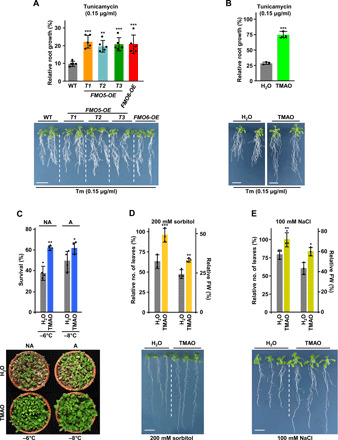
Trimethylamine -oxide (TMAO) is a well-known naturally occurring osmolyte in animals that counteracts the effect of different denaturants related to environmental stress and has recently been associated with severe human chronic diseases. In plants, however, the presence of TMAO has not yet been reported. In this study, we demonstrate that plants contain endogenous levels of TMAO, that it is synthesized by flavin-containing monooxygenases, and that its levels increase in response to abiotic stress conditions. In addition, our results reveal that TMAO operates as a protective osmolyte in plants, promoting appropriate protein folding and as an activator of abiotic stress-induced gene expression. Consistent with these functions, we show that TMAO enhances plant adaptation to low temperatures, drought, and high salt. We have thus uncovered a previously unidentified plant molecule that positively regulates abiotic stress tolerance.
氧化三甲胺(TMAO)是动物体内一种著名的天然渗透溶质,它能抵消与环境应激相关的不同变性剂的影响,最近还与严重的人类慢性疾病有关。然而,在植物中,尚未有TMAO存在的报道。在本研究中,我们证明植物含有内源性水平的TMAO,它由含黄素单加氧酶合成,并且其水平会响应非生物胁迫条件而增加。此外,我们的结果表明,TMAO在植物中作为一种保护性渗透溶质发挥作用,促进适当的蛋白质折叠,并作为非生物胁迫诱导基因表达的激活剂。与这些功能一致,我们表明TMAO增强了植物对低温、干旱和高盐的适应性。因此,我们发现了一种以前未被识别的植物分子,它能正向调节植物对非生物胁迫的耐受性。