Department of Microbiology and Molecular Medicine, University of Geneva, Geneva, Switzerland.
Institute of Parasitology, University of Zurich, Zurich, Switzerland.
Nat Commun. 2021 Jun 18;12(1):3788. doi: 10.1038/s41467-021-24083-y.
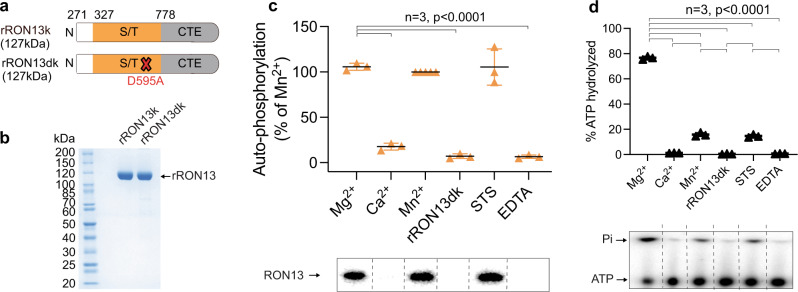
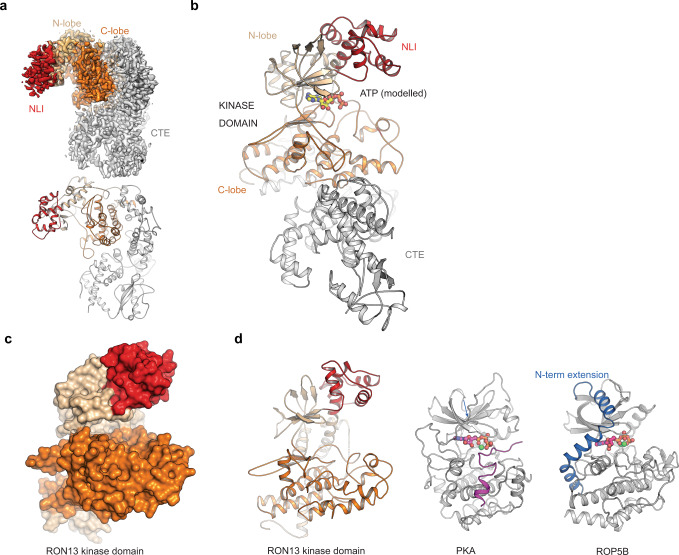
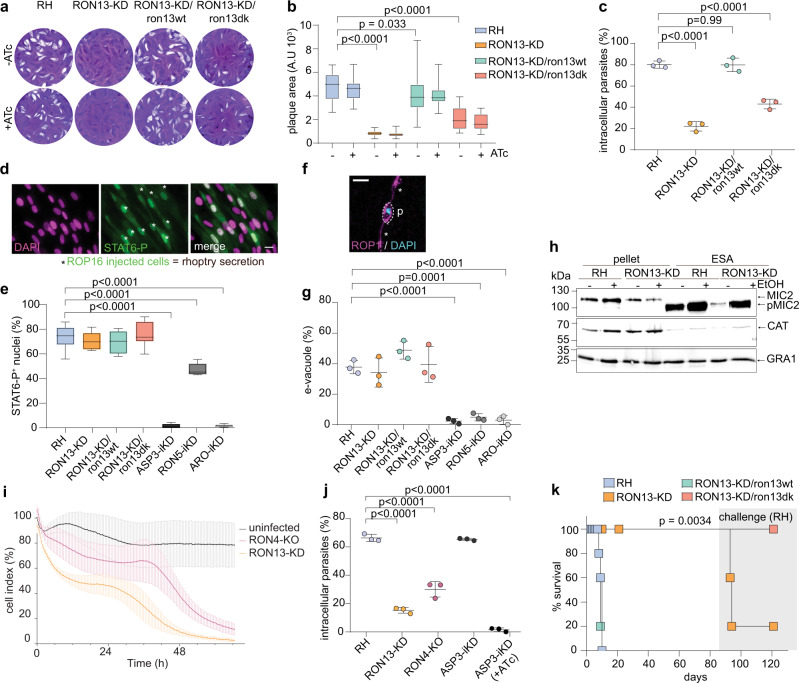
Active host cell invasion by the obligate intracellular apicomplexan parasites relies on the formation of a moving junction, which connects parasite and host cell plasma membranes during entry. Invading Toxoplasma gondii tachyzoites secrete their rhoptry content and insert a complex of RON proteins on the cytoplasmic side of the host cell membrane providing an anchor to which the parasite tethers. Here we show that a rhoptry-resident kinase RON13 is a key virulence factor that plays a crucial role in host cell entry. Cryo-EM, kinase assays, phosphoproteomics and cellular analyses reveal that RON13 is a secretory pathway kinase of atypical structure that phosphorylates rhoptry proteins including the components of the RON complex. Ultimately, RON13 kinase activity controls host cell invasion by anchoring the moving junction at the parasite-host cell interface.
刚地弓形虫等专性细胞内顶复门寄生虫的活性宿主细胞入侵依赖于形成一个移动连接,该连接在进入时连接寄生虫和宿主细胞膜。入侵的刚地弓形虫速殖子分泌它们的棒状体内容物,并将 RON 蛋白复合物插入宿主细胞膜的细胞质侧,为寄生虫提供一个固定点。在这里,我们表明,棒状体驻留激酶 RON13 是一种关键的毒力因子,在宿主细胞进入中起着至关重要的作用。冷冻电镜、激酶测定、磷酸蛋白质组学和细胞分析表明,RON13 是一种结构非典型的分泌途径激酶,可磷酸化棒状体蛋白,包括 RON 复合物的组成部分。最终,RON13 激酶活性通过将移动连接锚定在寄生虫-宿主细胞界面来控制宿主细胞入侵。