
1600-1870 年英国城市的死亡率、迁移和流行病学变化。
Mortality, migration and epidemiological change in English cities, 1600-1870.
机构信息
Cambridge Group for the History of Population and Social Structure, Department of Geography, University of Cambridge, CB2 3EN, Cambridge, UK.
出版信息
Int J Paleopathol. 2021 Sep;34:37-49. doi: 10.1016/j.ijpp.2021.05.009. Epub 2021 Jun 17.
OBJECTIVE
This study tests the argument that industrialisation was accompanied by a dramatic worsening of urban health in England.
MATERIALS
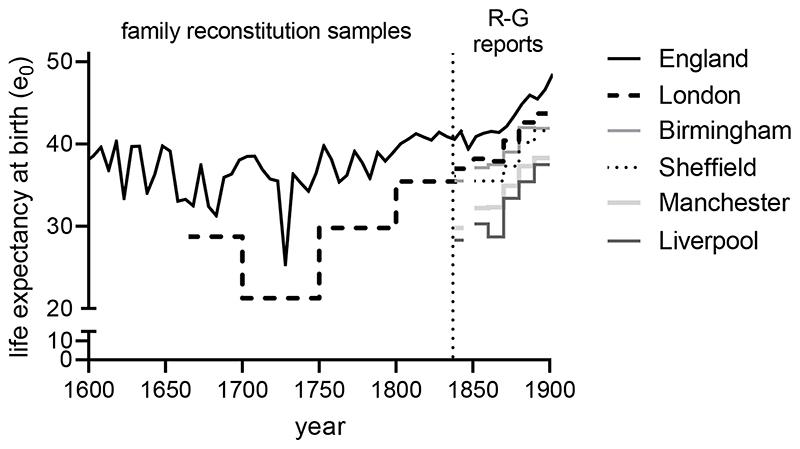
Family reconstitutions derived from baptism, marriage and burial records for the period before 1837, and from civil registration of deaths and census populations between 1837 and 1900.
METHODS
Age-specific mortality rates are used as indicators of population health.
RESULTS
The available evidence indicates a decline in urban mortality in the period c.1750-1820, especially amongst infants and (probably) rural-urban migrants. Mortality at ages 1-4 years demonstrated a more complex pattern, falling between 1750 and 1830 before rising abruptly in the mid-nineteenth century.
CONCLUSIONS
These patterns are better explained by changes in breastfeeding practices and the prevalence or virulence of particular pathogens than by changes in sanitary conditions or poverty. Mortality patterns amongst young adult migrants were affected by a shift from acute to chronic infectious diseases over the period.
SIGNIFICANCE
Pathogen evolution, infant care and migration exerted major influences on mortality trends and should be given greater attention in studies of the health impacts of British industrialisation.
LIMITATIONS
Evidence of urban mortality rates is very limited before 1837 and may not be fully representative of industrialising populations. Mortality also provides only a partial picture of the health of urban populations and may be distorted by migration patterns.
FURTHER RESEARCH
There is enormous scope for collaboration between archaeologists and historians to investigate the health of industrial populations, through the triangulation and contextualisation of diverse sources of evidence.
目的
本研究检验了工业化伴随着英国城市卫生状况急剧恶化的论点。
材料
家庭重建来自于 1837 年前洗礼、婚姻和葬礼记录,以及 1837 年至 1900 年之间的死亡和人口普查的民事登记。
方法
年龄特定的死亡率用作人口健康的指标。
结果
现有证据表明,1750 年至 1820 年间,城市死亡率下降,特别是婴儿和(可能)农村-城市移民的死亡率下降。1 至 4 岁年龄组的死亡率表现出更为复杂的模式,在 1750 年至 1830 年期间下降,然后在 19 世纪中叶突然上升。
结论
这些模式更可以通过母乳喂养实践的变化以及特定病原体的流行或毒力来解释,而不是通过卫生条件或贫困的变化来解释。在这一时期,年轻成年移民的死亡率模式受到从急性传染病向慢性传染病的转变的影响。
意义
病原体进化、婴儿护理和移民对死亡率趋势产生了重大影响,在研究英国工业化对健康的影响时,应该给予更多关注。
局限性
1837 年前城市死亡率的证据非常有限,可能不完全代表工业化人口。死亡率也只是城市人口健康的一个部分写照,可能会因移民模式而扭曲。
进一步研究
通过对不同来源证据的三角测量和背景化,考古学家和历史学家在研究工业人口的健康方面有很大的合作空间。




 Zotero 插件