Xiao Baohua, Li Dongdong, Liao Baolin, Zheng Huina, Yang Xiaodong, Xie Yongqi, Xie Ziqiang, Li Chengyong
Shenzhen Institute of Guangdong Ocean University, Shenzhen, China.
Southern Marine Science and Engineering Guangdong Laboratory, School of Chemistry and Environment, Guangdong Ocean University, Zhanjiang, China.
Front Microbiol. 2021 Jun 4;12:666100. doi: 10.3389/fmicb.2021.666100. eCollection 2021.
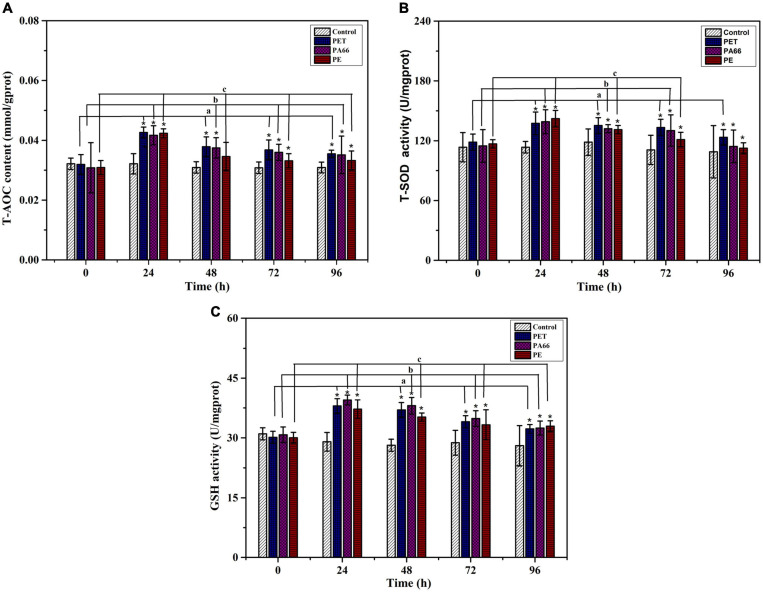
Microplastic pollution in marine environments has increased rapidly in recent years, with negative influences on the health of marine organisms. Scleractinian coral, one of the most important species in the coral ecosystems, is highly sensitive to microplastic. However, whether microplastic causes physiological disruption of the coral, oxidative stress, immunity, and energy metabolism, is unclear. In the present study, the physiological responses of the coral sp. were determined after exposure to polyethylene terephthalate (PET), polyamide 66 (PA66), and polyethylene (PE) microplastic for 96 h. The results showed that there were approximately 4-22 items/nubbin on the surface of the coral skeleton and 2-10 items/nubbin on the inside of the skeleton in the MPs exposure groups. The density of endosymbiont decreased (1.12 × 10-1.24 × 10 cell/cm) in MPs exposure groups compared with the control group. Meanwhile, the chlorophyll content was reduced (0.11-0.76 μg/cm) after MPs exposure. Further analysis revealed that the antioxidant enzymes in coral tissues were up-regulated (Total antioxidant capacity T-AOC 2.35 × 10-1.05 × 10 mmol/mg prot, Total superoxide dismutase T-SOD 3.71-28.67 U/mg prot, glutathione GSH 10.21-10.51 U/mg prot). The alkaline phosphatase (AKP) was inhibited (1.44-4.29 U/mg prot), while nitric oxide (NO) increased (0.69-2.26 μmol/g prot) for cell signal. Moreover, lactate dehydrogenase (LDH) was down-regulated in the whole experiment period (0.19-0.22 U/mg prot), and Glucose-6-phosphate dehydrogenase (G6PDH) for cell the phosphate pentoses pathway was also reduced (0.01-0.04 U/mg port). Results showed that the endosymbiont was released and chlorophyll was decreased. In addition, a disruption could occur under MPs exposure, which was related to anti-oxidant, immune, and energy metabolism.
近年来,海洋环境中的微塑料污染迅速增加,对海洋生物的健康产生负面影响。造礁珊瑚是珊瑚生态系统中最重要的物种之一,对微塑料高度敏感。然而,微塑料是否会导致珊瑚的生理紊乱、氧化应激、免疫和能量代谢尚不清楚。在本研究中,珊瑚物种在暴露于聚对苯二甲酸乙二酯(PET)、聚酰胺66(PA66)和聚乙烯(PE)微塑料96小时后的生理反应得以确定。结果表明,在微塑料暴露组中,珊瑚骨骼表面每小块约有4 - 22个颗粒,骨骼内部每小块有2 - 10个颗粒。与对照组相比,微塑料暴露组中内共生体的密度降低(1.12×10 - 1.24×10个细胞/平方厘米)。同时,微塑料暴露后叶绿素含量降低(0.11 - 0.76微克/平方厘米)。进一步分析表明,珊瑚组织中的抗氧化酶上调(总抗氧化能力T - AOC 2.35×10 - 1.05×10毫摩尔/毫克蛋白,总超氧化物歧化酶T - SOD 3.71 - 28.67单位/毫克蛋白,谷胱甘肽GSH 10.21 - 10.51单位/毫克蛋白)。碱性磷酸酶(AKP)受到抑制(1.44 - 4.29单位/毫克蛋白),而作为细胞信号的一氧化氮(NO)增加(0.69 - 2.26微摩尔/克蛋白)。此外,在整个实验期间乳酸脱氢酶(LDH)下调(0.19 - 0.22单位/毫克蛋白),参与磷酸戊糖途径的葡萄糖 - 6 - 磷酸脱氢酶(G6PDH)也降低(0.01 - 0.04单位/毫克蛋白)。结果表明内共生体释放且叶绿素减少。此外,在微塑料暴露下可能会发生紊乱,这与抗氧化、免疫和能量代谢有关。