Brough H A, Gourgey R, Radulovic S, Caubet J C, Lack G, Anagnostou A
Paediatric Allergy Group, Department Women and Children's Health, School of Life Course Sciences, King's College London, London, UK.
Paediatric Allergy Group, School of Immunology and Microbial Sciences, King's College London, London, UK.
Curr Treat Options Allergy. 2021;8(2):97-110. doi: 10.1007/s40521-021-00290-2. Epub 2021 Jun 15.
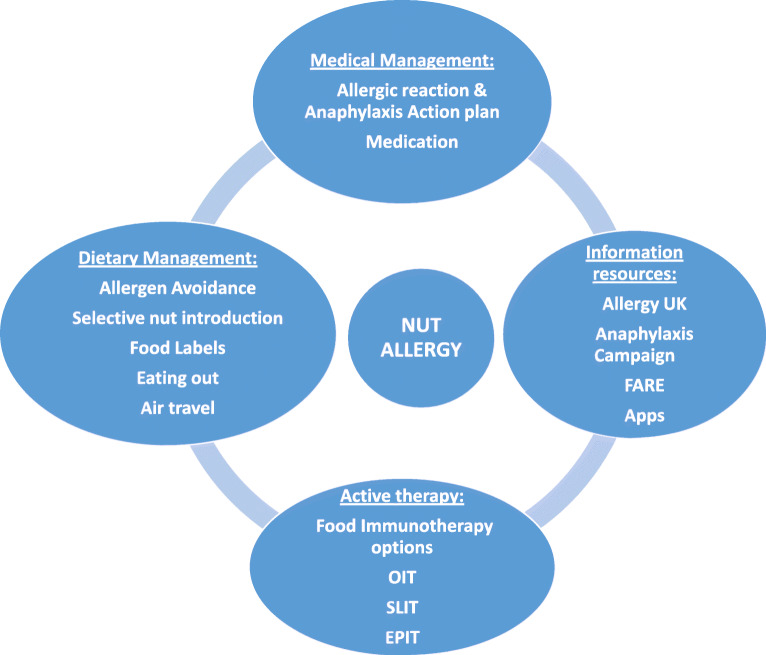
In this review, we sought to describe the most recent advances in the dietary and medical management of peanut and tree nut allergy, including selective introduction and immunotherapy.
Dietary updates include changes to labeling laws, improved information sources, and new apps for buying foods in shops and overseas to better protect individuals with nut allergies. There are still issues in the management of nut allergies in schools, such as parents having to resort to packed lunches instead of school meals and patients experiencing bullying. Air travel also poses concern, but additional resources are now available to travelers, and recent evidence suggest limited airborne exposure to nuts. The medical management of anaphylaxis is use of epinephrine; however, this remains underutilized. Needle length and administration devices have been recently debated considering the risk of bone penetration vs subcutaneous administration, and autoinjectors seem to deliver higher peak concentrations than syringes. Selective nut introduction has gained momentum in the last 5 years, demonstrating improved quality of life but with the need for motivated parents for continued consumption and available resources for challenges. Immunotherapy to nuts is also a rapidly developing field, with the balance of efficacy and safety being important considerations in the differing modes of administration.
The management of nut allergies is a rapidly developing field, and dietary and medical management have progressed significantly in the last 5 years. Future research directions include improving safety and efficacy of food immunotherapy and examining patients' goals for therapy and treatment outcomes.
在本综述中,我们试图描述花生和坚果过敏的饮食及医学管理方面的最新进展,包括选择性引入和免疫疗法。
饮食方面的更新包括标签法规的变化、信息来源的改善以及用于在商店和海外购买食品的新应用程序,以更好地保护坚果过敏患者。学校中坚果过敏的管理仍存在问题,例如家长不得不求助于自带午餐而非学校餐食,以及患者遭受欺凌。航空旅行也令人担忧,但现在旅行者有了更多资源,而且最近的证据表明通过空气传播接触坚果的情况有限。过敏反应的医学管理是使用肾上腺素;然而,其使用仍未得到充分利用。考虑到骨穿透与皮下注射的风险,最近对针头长度和给药装置进行了讨论,自动注射器似乎比注射器能提供更高的峰值浓度。在过去5年中,选择性引入坚果的做法得到了更多支持,显示出生活质量有所改善,但需要有积极性的家长持续让孩子食用,并具备应对挑战的可用资源。针对坚果的免疫疗法也是一个快速发展的领域,在不同给药方式中,疗效和安全性的平衡是重要的考虑因素。
坚果过敏的管理是一个快速发展的领域,饮食和医学管理在过去5年中取得了显著进展。未来的研究方向包括提高食物免疫疗法的安全性和疗效,以及研究患者的治疗目标和治疗结果。