Gibbs Nicole H, Michalski Hannah, Promislow Daniel E L, Kaeberlein Matt, Creevy Kate E
Department of Small Animal Clinical Sciences, College of Veterinary Medicine and Biomedical Sciences, Texas A&M University, College Station, TX, United States.
Department of Laboratory Medicine & Pathology, University of Washington School of Medicine, Seattle, WA, United States.
Front Vet Sci. 2021 Jun 2;8:651698. doi: 10.3389/fvets.2021.651698. eCollection 2021.
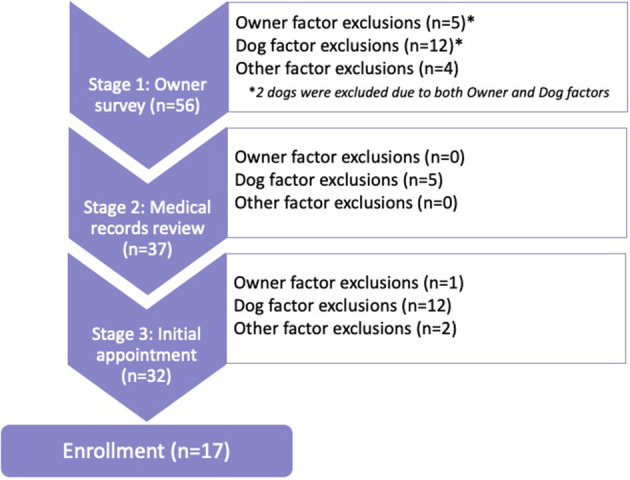
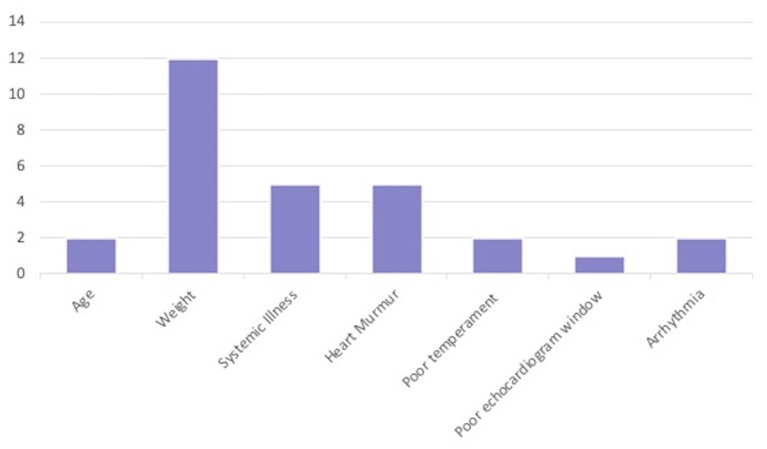
Interventional clinical trials intended to maintain health in aging dogs are unusual and require particular attention to exclusion criteria. To describe reasons for exclusion when a mature adult and senior canine population with normal health status was sought. Fifty six companion dogs nominated for a randomized controlled trial (RCT). Exclusions occurred within Stage 1 (S1): owner-provided survey information; Stage 2 (S2): medical records review; and Stage 3 (S3): screening examination and within Owner, Dog, or Other factor categories. Of 56 nominated dogs, 39 were excluded at S1 ( = 19), S2 ( = 5), and S3 ( = 15), respectively. Dogs were excluded for Owner ( = 4), Dog ( = 27), Other ( = 6), and concurrent (Owner + Dog; = 2) factors. The most common exclusion period was S1 ( = 19), with weight outside the target range being the most common exclusion factor in that stage ( = 10). Heart murmurs were the second most common exclusion factor (S1: = 1; S3: = 5); suspected or confirmed systemic illness was third most common (S1: = 2; S2: = 3; S3: = 2). Among dogs who passed S1 and S2 screening ( = 32), 15 dogs (48%) were excluded at S3, for heart murmur > grade II/VI ( = 5), cardiac arrhythmias ( = 2), and clinicopathologic abnormalities ( = 2). Dogs nominated for a clinical trial for healthy mature adult and senior dogs were excluded for size, previous diagnoses, and newly discovered cardiac abnormalities. For future interventions in mature adult and senior dogs of normal health status, it is important to define expected age-related abnormalities to ensure that meaningful exclusion criteria are used.
旨在维持老龄犬健康的介入性临床试验并不常见,需要特别关注排除标准。描述在寻求健康状况正常的成年和老年犬群体时的排除原因。56只伴侣犬被提名参加一项随机对照试验(RCT)。排除发生在第1阶段(S1):主人提供的调查信息;第2阶段(S2):病历审查;以及第3阶段(S3):筛查检查,且在主人、犬或其他因素类别中。在56只被提名的犬中,分别有39只在S1(n = 19)、S2(n = 5)和S3(n = 15)被排除。犬因主人(n = 4)、犬(n = 27)、其他(n = 6)和并发因素(主人 + 犬;n = 2)被排除。最常见的排除阶段是S1(n = 19),该阶段体重超出目标范围是最常见的排除因素(n = 10)。心脏杂音是第二常见的排除因素(S1:n = 1;S3:n = 5);疑似或确诊的全身性疾病是第三常见的(S1:n = 2;S2:n = 3;S3:n = 2)。在通过S1和S2筛查的犬(n = 32)中,15只犬(48%)在S3被排除,原因是心脏杂音>II/VI级(n = 5)、心律失常(n = 2)和临床病理异常(n = 2)。被提名参加健康成年和老年犬临床试验的犬因体型、既往诊断和新发现的心脏异常而被排除。对于未来对健康状况正常的成年和老年犬的干预措施,定义预期的年龄相关异常以确保使用有意义的排除标准很重要。