
基于 T1 加权 MRI 图像和基于学习的方法检测新生儿急性胆红素脑病。
Detecting neonatal acute bilirubin encephalopathy based on T1-weighted MRI images and learning-based approaches.
机构信息
Key Laboratory for Biomedical Engineering of Ministry of Education, College of Biomedical Engineering and Instrumental Science, Zhejiang University, Hangzhou, 310027, China.
State Key Laboratory of Pathogenesis, Prevention and Treatment of High Incidence Diseases in Central Asia, College of Medical Engineering and Technology, Xinjiang Medical University, Urumqi, 830011, China.
出版信息
BMC Med Imaging. 2021 Jun 22;21(1):103. doi: 10.1186/s12880-021-00634-z.
BACKGROUND
Neonatal hyperbilirubinemia is a common clinical condition that requires medical attention in newborns, which may develop into acute bilirubin encephalopathy with a significant risk of long-term neurological deficits. The current clinical challenge lies in the separation of acute bilirubin encephalopathy and non-acute bilirubin encephalopathy neonates both with hyperbilirubinemia condition since both of them demonstrated similar T1 hyperintensity and lead to difficulties in clinical diagnosis based on the conventional radiological reading. This study aims to investigate the utility of T1-weighted MRI images for differentiating acute bilirubin encephalopathy and non-acute bilirubin encephalopathy neonates with hyperbilirubinemia.
METHODS
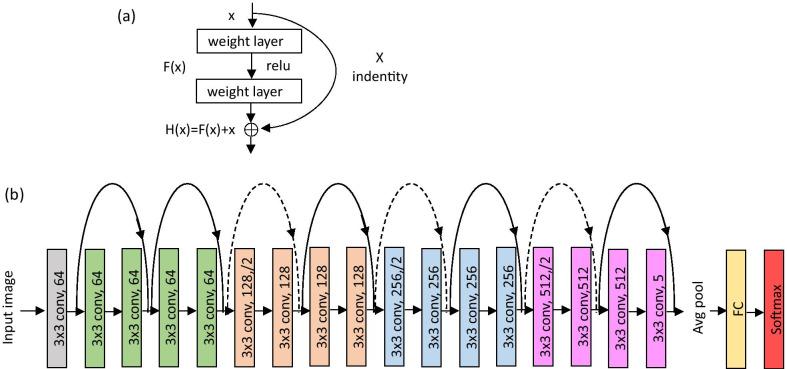
3 diagnostic approaches, including a visual inspection, a semi-quantitative method based on normalized the T1-weighted intensities of the globus pallidus and subthalamic nuclei, and a deep learning method with ResNet18 framework were applied to classify 47 acute bilirubin encephalopathy neonates and 32 non-acute bilirubin encephalopathy neonates with hyperbilirubinemia based on T1-weighted images. Chi-squared test and t-test were used to test the significant difference of clinical features between the 2 groups.
RESULTS
The visual inspection got a poor diagnostic accuracy of 53.58 ± 5.71% indicating the difficulty of the challenge in real clinical practice. However, the semi-quantitative approach and ResNet18 achieved a classification accuracy of 62.11 ± 8.03% and 72.15%, respectively, which outperformed visual inspection significantly.
CONCLUSION
Our study indicates that it is not sufficient to only use T1-weighted MRI images to detect neonates with acute bilirubin encephalopathy. Other more MRI multimodal images combined with T1-weighted MRI images are expected to use to improve the accuracy in future work. However, this study demonstrates that the semi-quantitative measurement based on T1-weighted MRI images is a simple and compromised way to discriminate acute bilirubin encephalopathy and non-acute bilirubin encephalopathy neonates with hyperbilirubinemia, which may be helpful in improving the current manual diagnosis.
背景
新生儿高胆红素血症是一种常见的临床病症,需要引起新生儿的重视,否则可能发展为急性胆红素脑病,存在严重的长期神经功能缺陷风险。目前的临床挑战在于区分具有高胆红素血症的急性胆红素脑病和非急性胆红素脑病新生儿,因为它们都表现出类似的 T1 高信号,导致基于常规影像学阅读的临床诊断困难。本研究旨在探讨 T1 加权 MRI 图像在区分具有高胆红素血症的急性胆红素脑病和非急性胆红素脑病新生儿中的作用。
方法
本研究应用三种诊断方法,包括视觉检查、基于苍白球和丘脑底核 T1 加权强度归一化的半定量方法以及基于 ResNet18 框架的深度学习方法,对 47 例急性胆红素脑病新生儿和 32 例非急性胆红素脑病新生儿的 T1 加权图像进行分类。卡方检验和 t 检验用于检验两组之间临床特征的显著性差异。
结果
视觉检查的诊断准确率较差,为 53.58±5.71%,表明在实际临床实践中存在挑战。然而,半定量方法和 ResNet18 的分类准确率分别为 62.11±8.03%和 72.15%,明显优于视觉检查。
结论
本研究表明,仅使用 T1 加权 MRI 图像不足以检测急性胆红素脑病新生儿。未来的工作有望结合其他更多的 MRI 多模态图像和 T1 加权 MRI 图像来提高准确性。然而,本研究表明,基于 T1 加权 MRI 图像的半定量测量是区分具有高胆红素血症的急性胆红素脑病和非急性胆红素脑病新生儿的一种简单而有效的方法,可能有助于改善当前的手动诊断。




 Zotero 插件