Department of Hematology, National Cancer Center Hospital, Tokyo, Japan.
Department of Hematology and Oncology, Tokai University School of Medicine, Isehara, Japan.
Cancer Sci. 2021 Sep;112(9):3627-3635. doi: 10.1111/cas.15040. Epub 2021 Jul 14.
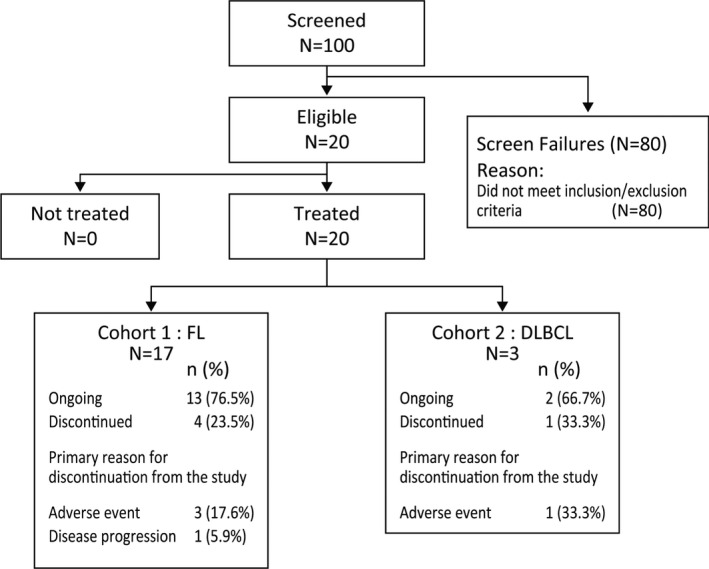
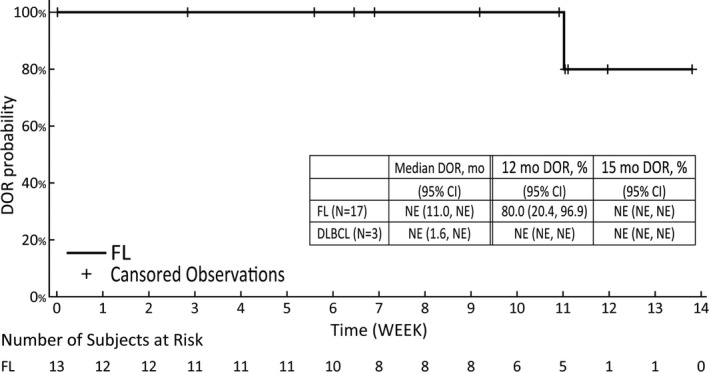
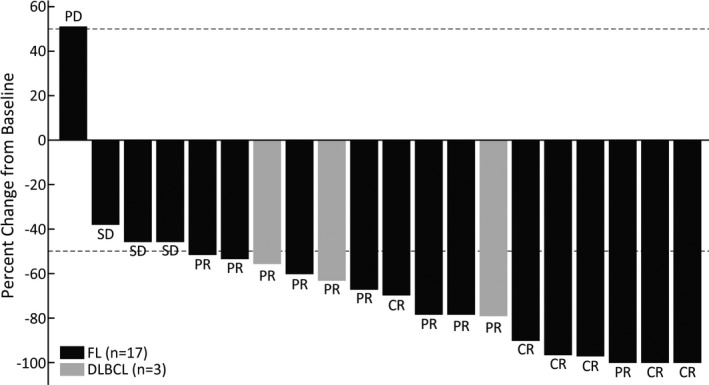
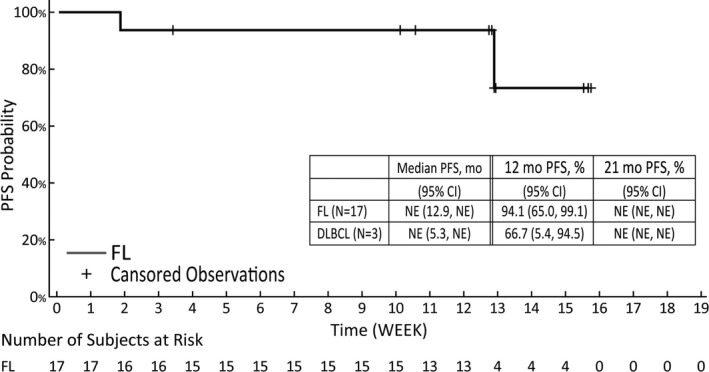
Tazemetostat is a selective, reversible, small-molecule inhibitor of the histone methyltransferase enzyme, enhancer of zest homolog 2 (EZH2). In this multicenter, open-label, phase II study, we assessed the efficacy and safety of tazemetostat in Japanese patients with relapsed or refractory (R/R) B-cell non-Hodgkin lymphoma harboring the EZH2 mutation. Tazemetostat (800 mg twice daily) was given orally (28-day cycle) until disease progression or unacceptable toxicity. Among the 20 eligible patients, 17 were enrolled in cohort 1 (follicular lymphoma [FL]), and three were enrolled in cohort 2 (diffuse large B-cell lymphoma). At data cut-off, the objective response rate in cohort 1 was 76.5%, including six patients (35.3%) with complete response and seven patients (41.2%) with partial response (PR). All three patients in cohort 2 achieved PR. In cohort 1, median progression-free survival (PFS) was not reached at the median follow-up of 12.9 months. The estimated PFS rate at 12 and 15 months was 94.1% and 73.2%, respectively. The most common grade 3 treatment-emergent adverse event (TEAE) was lymphopenia (n = 2). Grade 4 TEAEs included hypertriglyceridemia and pneumonia aspiration (n = 1 each), which were not related to tazemetostat. Treatment-emergent adverse events leading to study drug discontinuation were reported in four of the 20 patients, indicating that the safety profile of tazemetostat was acceptable and manageable. Tazemetostat 800 mg twice daily showed encouraging efficacy in patients with R/R EZH2 mutation-positive FL with a manageable safety profile in the overall population. Thus, tazemetostat could be a potential treatment for R/R EZH2 mutation-positive FL.
他泽司他丁是一种组蛋白甲基转移酶酶,增强子结合锌指蛋白 2(EZH2)的选择性、可逆、小分子抑制剂。在这项多中心、开放标签、二期研究中,我们评估了他泽司他丁在携带 EZH2 突变的复发性或难治性(R/R)B 细胞非霍奇金淋巴瘤日本患者中的疗效和安全性。他泽司他丁(800mg,每日两次)口服给药(28 天周期),直至疾病进展或不可接受的毒性。在 20 名合格患者中,17 名入组队列 1(滤泡性淋巴瘤[FL]),3 名入组队列 2(弥漫性大 B 细胞淋巴瘤)。在数据截止时,队列 1 的客观缓解率为 76.5%,包括 6 名(35.3%)完全缓解和 7 名(41.2%)部分缓解(PR)。队列 2 的所有 3 名患者均获得 PR。在队列 1 中,中位无进展生存期(PFS)在中位随访 12.9 个月时未达到。12 个月和 15 个月时的估计 PFS 率分别为 94.1%和 73.2%。最常见的 3 级治疗相关不良事件(TEAE)是淋巴细胞减少症(n=2)。4 级 TEAE 包括高甘油三酯血症和肺炎吸入(n=1),均与他泽司他丁无关。由于治疗相关不良事件而停止研究药物的有 20 名患者中的 4 名,表明他泽司他丁的安全性特征是可以接受和可控的。在 EZH2 突变阳性的 R/R FL 患者中,他泽司他丁 800mg,每日两次的疗效令人鼓舞,在总体人群中具有可管理的安全性。因此,他泽司他丁可能是治疗 EZH2 突变阳性的 R/R FL 的一种潜在治疗方法。