Department of Neuroscience, The Scripps Research Institute, La Jolla, CA, USA.
Department of Psychiatry, University of California, 9500 Gilman Drive, San Diego, La Jolla, CA, 92093, USA.
Psychopharmacology (Berl). 2022 May;239(5):1321-1335. doi: 10.1007/s00213-021-05904-w. Epub 2021 Jun 23.
Opioids are effective medications, but they have several key limitations including the development of tolerance, establishment of dependence, diversion for non-medical use, and the development of addiction. Therefore, any drugs which act in an additive or synergistic fashion with opioids to address medical applications have the potential to reduce opioid-related harms.
To determine if heroin and Δ-tetrahydrocannabinol (THC) interact in an additive or independent manner to alter nociception, body temperature, and spontaneous locomotor activity when inhaled or injected.
Groups of female and male rats, implanted with radiotelemetry transmitters, were exposed to vapor generated from heroin (50 mg/mL in propylene glycol vehicle; PG), THC (50 mg/mL), or the combination for assessment of effects on temperature and activity. Thermal nociception was assessed with a warm water tail-withdrawal assay.
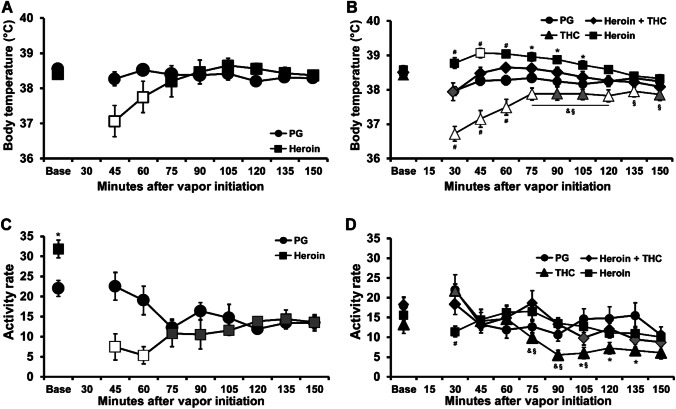
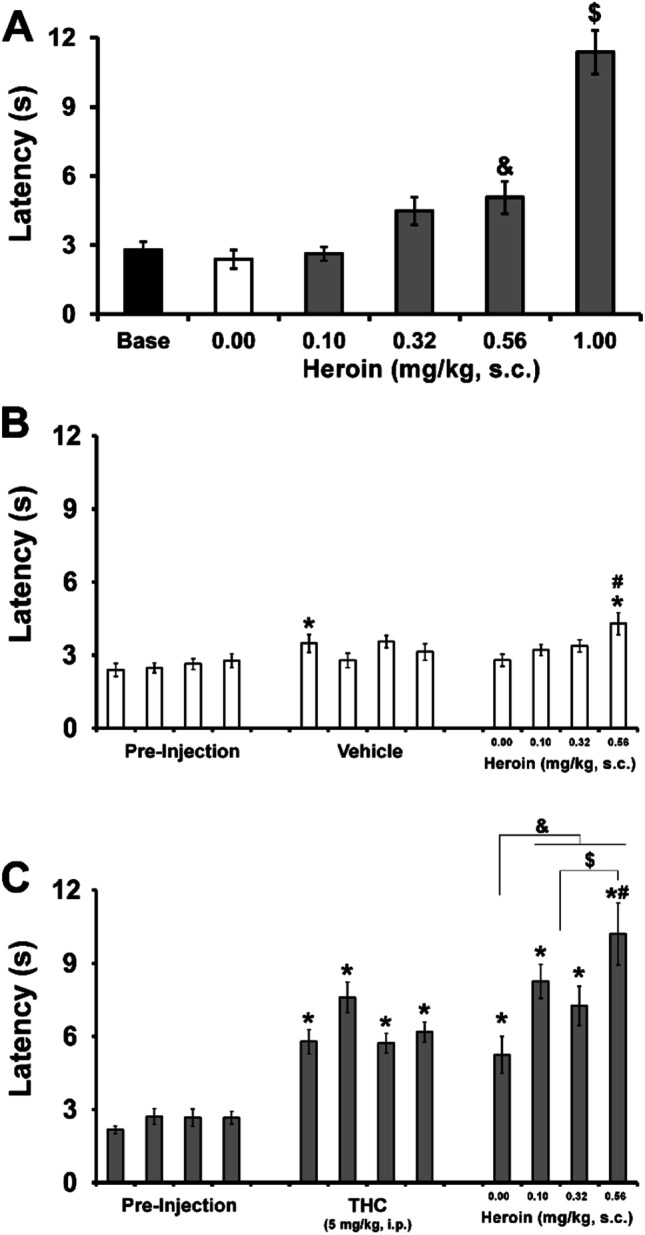
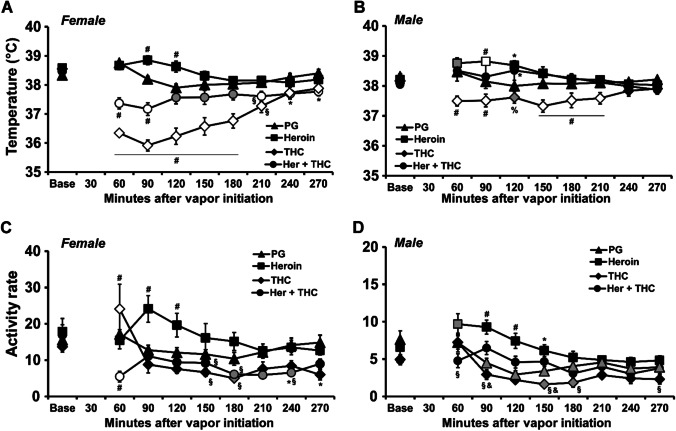
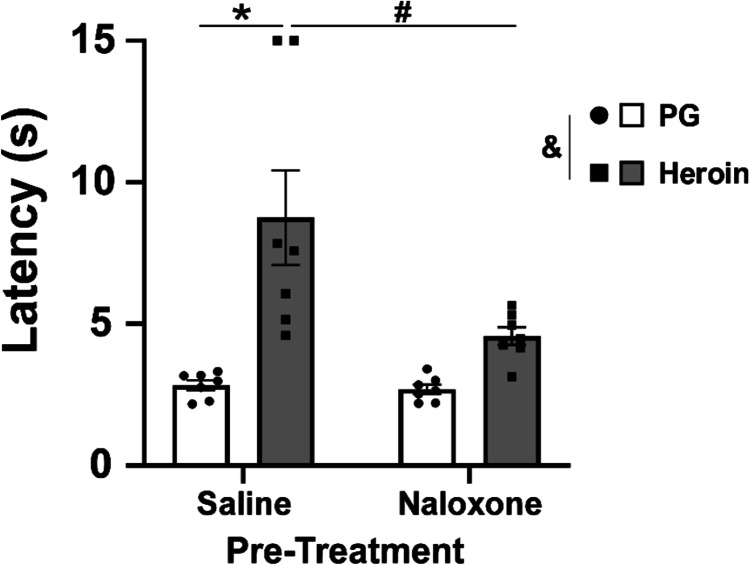
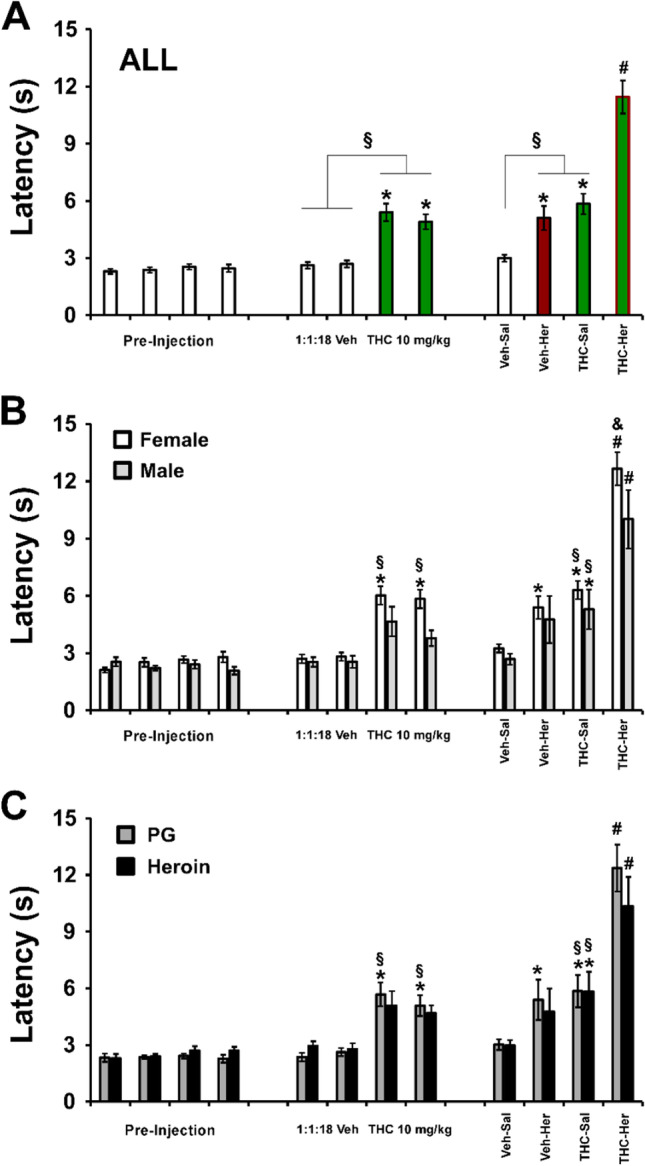
Heroin inhalation increased temperature and activity whereas THC inhalation decreased temperature and activity in both female and male Sprague-Dawley rats. Effects of combined inhalation were in opposition, and additional experiments found the same outcome for the injection of heroin (0.5 mg/kg, s.c.) and THC (10 mg/kg, i.p.) alone and in combination. In contrast, the co-administration of heroin and THC by either inhalation or injection produced additive effects on thermal nociception in both male and female Sprague-Dawley and Wistar rats.
This study shows that additive effects of THC with an opioid on a medical endpoint such as analgesia may not generalize to other behavioral or physiological effects, which may be a positive outcome for unwanted side effects.
阿片类药物是有效的药物,但它们有几个关键的局限性,包括耐受性的发展、依赖性的建立、非医疗用途的转移和成瘾的发展。因此,任何与阿片类药物以附加或协同方式作用以解决医疗应用的药物都有可能减少与阿片类药物相关的危害。
确定海洛因和 Δ-四氢大麻酚(THC)在吸入或注射时是否以相加或独立的方式相互作用,从而改变痛觉、体温和自发运动活动。
将植入无线电遥测发射器的雌性和雄性大鼠暴露于海洛因(50mg/mL 在丙二醇载体中;PG)、THC(50mg/mL)或组合产生的蒸气中,以评估对温度和活动的影响。使用温水尾巴撤退测定法评估热痛觉。
海洛因吸入增加了体温和活动,而 THC 吸入则降低了雌性和雄性 Sprague-Dawley 大鼠的体温和活动。联合吸入的效果相反,额外的实验发现海洛因(0.5mg/kg,皮下注射)和 THC(10mg/kg,腹腔注射)单独和联合注射也有同样的结果。相比之下,海洛因和 THC 的联合给予无论是通过吸入还是注射,在雄性和雌性 Sprague-Dawley 和 Wistar 大鼠中对热痛觉都产生了相加的作用。
本研究表明,THC 与阿片类药物在医学终点(如镇痛)上的相加作用可能不会推广到其他行为或生理效应,这可能是对不良副作用的积极结果。