Kawamata Yasushi, Sugawara Norio, Ishioka Masamichi, Kubo Kazutoshi, Suzuki Katsuji, Fujii Akira, Furukori Hanako, Nakagami Taku, Yasui-Furukori Norio, Shimoda Kazutaka
Department of Psychiatry, Dokkyo Medical University School of Medicine, Mibu, Japan.
Department of Neuropsychiatry, Hirosaki University Graduate School of Medicine, Hirosaki, Japan.
Neuropsychiatr Dis Treat. 2021 Jun 15;17:1927-1936. doi: 10.2147/NDT.S314440. eCollection 2021.
Concern regarding the benefit/risk ratio of the long-term use of benzodiazepines (BDZs) and Z-drugs is increasing. To prevent the risk of dependence in BDZ long-term use, it is essential to understand the attitudes of patients and psychiatrists toward BDZ treatment. The aims of this investigation were to 1) obtain information on patients' attitudes with long-term BDZ use and their referring psychiatrists' attitudes toward BDZ treatment, including their perception of the difficulty of reducing the dose of BDZs, and 2) identify discrepancies between patients' and psychiatrists' perceptions.
A brief questionnaire was constructed to investigate the attitudes of patients receiving BDZ treatment and their referring psychiatrists. Our sample comprised 155 patients who received BDZ treatment for more than one year and their referring eight psychiatrists. Both the patients and their psychiatrists completed our questionnaire between August 2017 and December 2017.
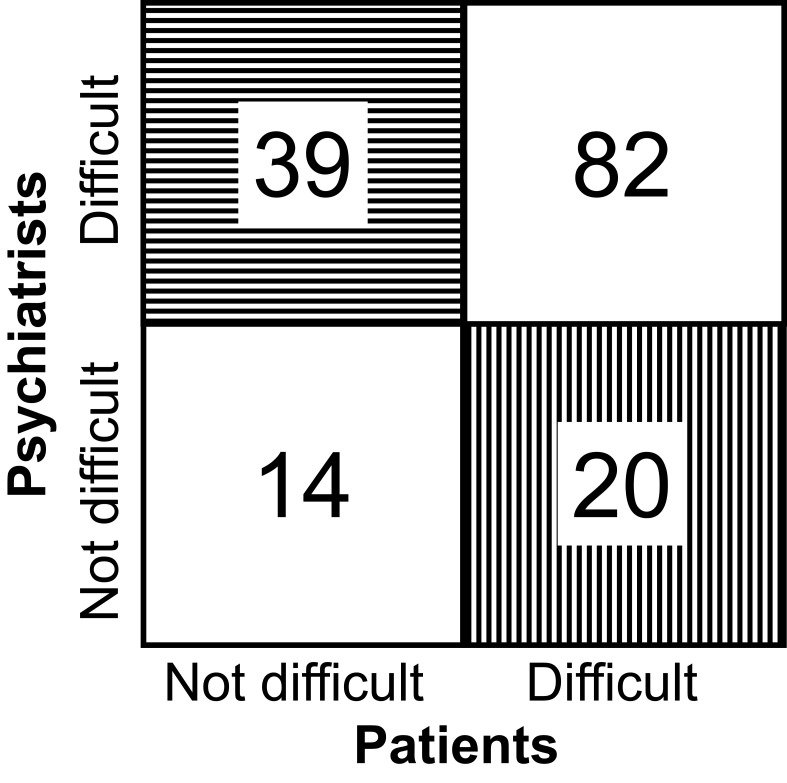
Of the patients, 13% felt that it was more difficult to reduce the dose of BDZs than their referring psychiatrists (type A discrepancy), while 25% felt that it was less difficult (type B discrepancy). In the multivariate logistic regression analysis, the female sex and both the patients' ("psychotherapy plus BDZs was necessary" and "it was necessary to increase the dose of BDZs") and psychiatrists' beliefs ("short-term prescription was justified") were associated with type A discrepancies. Type B discrepancies were associated with psychiatrists' beliefs that the patient's wishes justified the use of BDZs and that the cessation of treatment with BDZs would lead to the deterioration of their rapport with their patients.
To overcome the discrepancies in the attitudes of patients and psychiatrists toward the cessation of BDZ treatment, it is necessary to promote patient-centered care involving patient psychoeducation and practice guidelines for the decision-making process. Further studies investigating the promotion of patient-centered care to reduce BDZ use are needed.
人们对长期使用苯二氮䓬类药物(BDZs)和Z类药物的获益/风险比日益关注。为预防长期使用BDZs导致的依赖风险,了解患者和精神科医生对BDZ治疗的态度至关重要。本研究的目的是:1)获取长期使用BDZs患者及其转诊精神科医生对BDZ治疗的态度信息,包括他们对降低BDZs剂量难度的认知;2)识别患者和精神科医生认知之间的差异。
构建一份简短问卷,以调查接受BDZ治疗的患者及其转诊精神科医生的态度。我们的样本包括155名接受BDZ治疗超过一年的患者及其转诊的8名精神科医生。患者及其精神科医生均在2017年8月至2017年12月期间完成了我们的问卷。
在患者中,13%认为降低BDZs剂量比其转诊的精神科医生认为的更困难(A型差异),而25%认为难度较小(B型差异)。在多因素逻辑回归分析中,女性以及患者(“心理治疗加BDZs是必要的”和“有必要增加BDZs剂量”)和精神科医生的信念(“短期处方是合理的”)与A型差异相关。B型差异与精神科医生的信念相关,即患者的意愿证明使用BDZs是合理的,并且停止BDZs治疗会导致他们与患者的关系恶化。
为克服患者和精神科医生对停止BDZ治疗态度上的差异,有必要促进以患者为中心的护理,包括患者心理教育和决策过程的实践指南。需要进一步研究调查如何促进以患者为中心的护理以减少BDZ的使用。