Lin Da-Wei, Jiang Feng, Wu Chen, Li Yi-Gang, Zhang Xi, Wang Yao-Sheng
Department of Cardiology, Xinhua Hospital Affiliated to Shanghai Jiao Tong University School of Medicine, Shanghai, China.
Chongming Branch, Clinical Research & Innovation Unit, Xinhua Hospital Affiliated to Shanghai Jiao Tong University School of Medicine, Shanghai, China.
Ann Transl Med. 2021 May;9(10):855. doi: 10.21037/atm-21-1792.
Atrial fibrillation (AF) induced by artificial pacing is directly related to atrial remodeling. Previous basic research has shown that furosemide aggravates pathologic myocardial remodeling while hydrochlorothiazide alleviates it. However, whether furosemide or hydrochlorothiazide plays a role in developing AF after pacemaker implantation remains unknown. The study aims to investigate the association between oral furosemide or hydrochlorothiazide and the risk of developing AF after pacemaker implantation.
After a review of electronic medical records, elderly patients with pacemaker implantation and without a known baseline history of AF were included and information on their use of daily oral furosemide or hydrochlorothiazide was extracted. New incident AF cases were confirmed via the records of outpatient visits. A Cox proportional-hazards model was used to evaluate the association between daily oral furosemide or hydrochlorothiazide and risk of developing AF after pacemaker implantation, after adjustment for potential confounders.
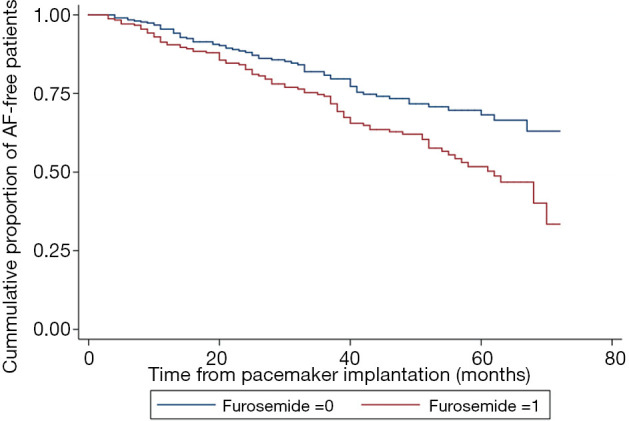
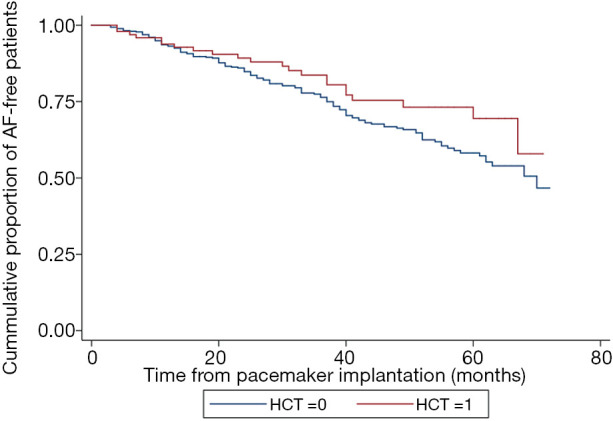
Among a total of 551 patients aged more than 65 years, 157 AF cases were identified after pacemaker implantation during a maximum follow up of 3.0±1.6 years. Of these, 242 had used furosemide and 97 had used hydrochlorothiazide therapy. Patients taking daily oral furosemide had a relatively higher risk of AF after pacemaker implantation [hazard ratio (HR): 1.507, 95% confidence interval (CI): 1.036-2.192; P=0.032] after being adjusted for related disease and prescribed medications, while oral taking of hydrochlorothiazide was shown to be a non-effective factor (HR: 0.666, 95% CI: 0.413-1.074), which had no statistical significance.
Daily oral furosemide might increase the risk of developing AF after pacemaker implantation in elderly patients, while hydrochlorothiazide has no detrimental effect.
人工起搏诱发的心房颤动(AF)与心房重构直接相关。先前的基础研究表明,呋塞米会加重病理性心肌重构,而氢氯噻嗪则可减轻这种重构。然而,呋塞米或氢氯噻嗪在起搏器植入后发生AF过程中是否起作用仍不清楚。本研究旨在探讨口服呋塞米或氢氯噻嗪与起搏器植入后发生AF风险之间的关联。
在查阅电子病历后,纳入植入起搏器且无已知AF基线病史的老年患者,并提取其每日口服呋塞米或氢氯噻嗪的使用信息。通过门诊记录确诊新发AF病例。采用Cox比例风险模型评估每日口服呋塞米或氢氯噻嗪与起搏器植入后发生AF风险之间的关联,并对潜在混杂因素进行校正。
在总共551例年龄超过65岁的患者中,在最长3.0±1.6年的随访期间,起搏器植入后确诊157例AF病例。其中,242例使用过呋塞米,97例使用过氢氯噻嗪治疗。在对相关疾病和所开药物进行校正后,每日口服呋塞米的患者在起搏器植入后发生AF的风险相对较高[风险比(HR):1.507,95%置信区间(CI):1.036 - 2.192;P = 0.032],而口服氢氯噻嗪显示为非有效因素(HR:0.666,95% CI:0.413 - 1.074),无统计学意义。
每日口服呋塞米可能会增加老年患者起搏器植入后发生AF的风险,而氢氯噻嗪无有害影响。