Department of Surgery and Cancer, Imperial College London, London, UK.
Department of Orthopaedics, Imperial College NHS Trust, UK.
Am J Sports Med. 2021 Jul;49(9):2341-2350. doi: 10.1177/03635465211021652. Epub 2021 Jun 24.
All-inside meniscal repair is an increasingly common technique for the surgical treatment of meniscal tears. There are currently no standardized techniques for training residents in this procedure. Cognitive task analysis (CTA) is a method of analyzing and standardizing key steps in a procedure that allows training to be conducted in a validated and reproducible manner.
(1) To design a digital CTA teaching tool for a standardized all-inside meniscal repair. (2) To evaluate whether CTA-trained residents would perform better in a meniscal repair task compared with a control group who underwent traditional apprenticeship methods of training.
Controlled laboratory study.
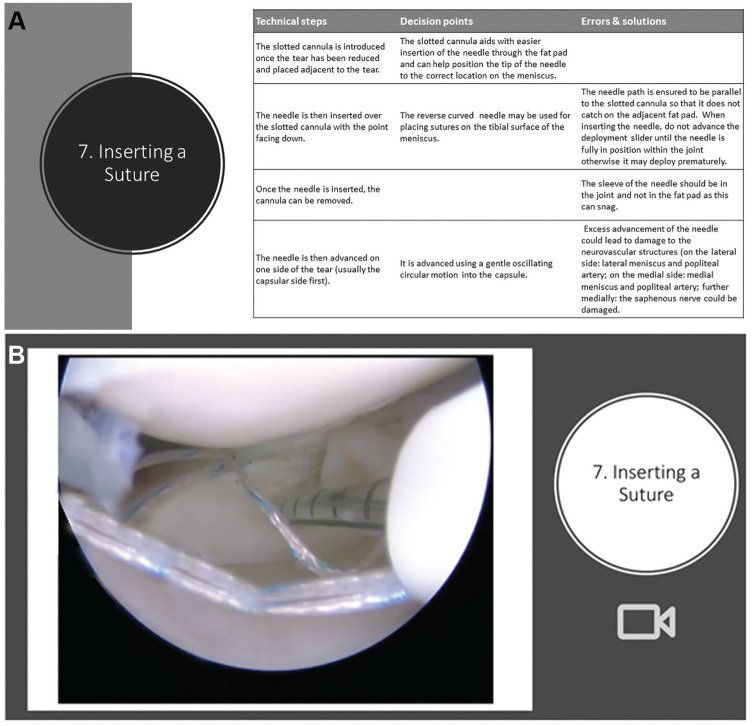
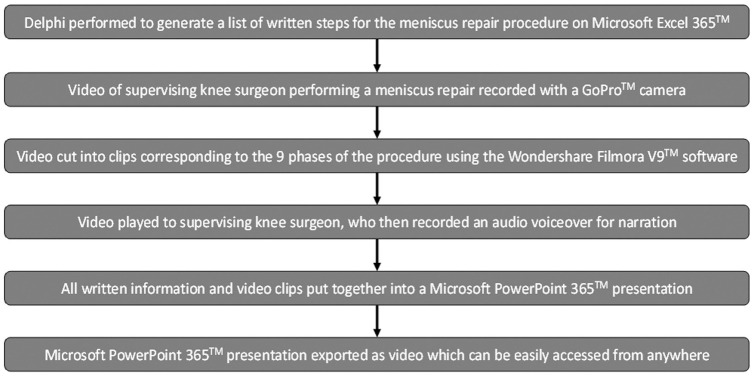
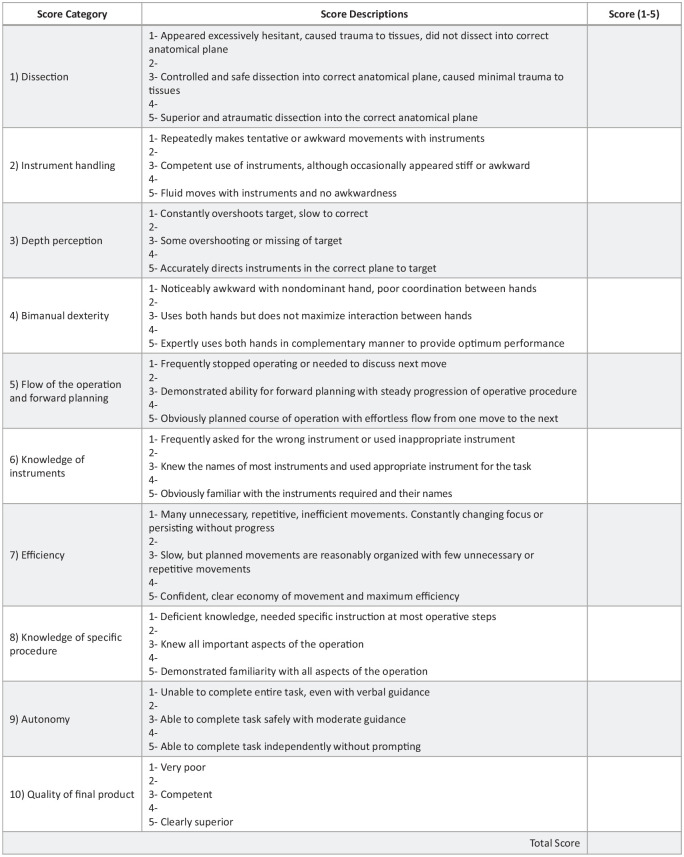
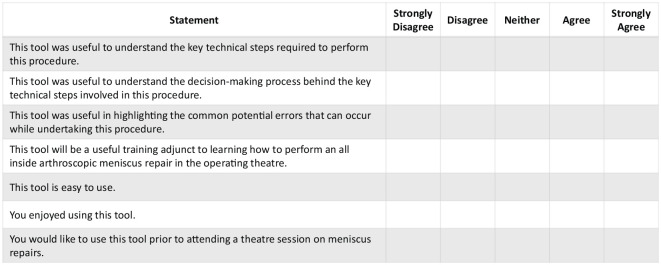
Three expert knee surgeons were interviewed using a modified Delphi method to generate a consensus among the ideal technical steps, cognitive decision points, and common errors and solutions for an all-inside meniscal repair. This written information was then combined with visual and audio components and integrated onto a digital platform to create the Imperial College London/University College London Meniscus Repair Cognitive Task Analysis (IUMeRCTA) tool. Eighteen novice residents were randomized into an intervention group (digital CTA tool) and control group (equipment instruction manual). Both groups performed an all-inside meniscal repair on high-fidelity, phantom knee models and were assessed by expert surgeons, blinded to the interventions, using a validated global rating scale (GRS). After a power calculation, median GRS scores were compared between groups using the Mann-Whitney test; significance was set at < .05.
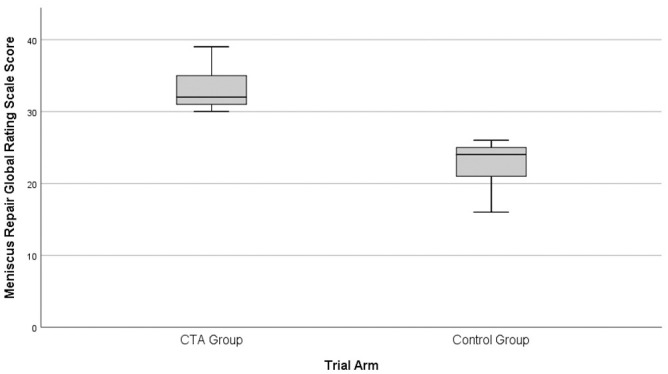
For the IUMeRCTA tool design, the procedure was divided into 55 steps across 9 phases: (1) preoperative planning, (2) theater and patient setup, (3) portal placement, (4) meniscal examination, (5) tear reduction, (6) suture planning, (7) suture insertion, (8) repair completion, and (9) postoperative care and rehabilitation. For the trial, the intervention group (mean ± SD GRS, 32 ± 2.9) performed significantly better than did the control group (GRS, 24 ± 3.3; < .001).
This is the first CTA tool to demonstrate objective benefits in training novices to perform an arthroscopic all-inside meniscal repair.
The IUMeRCTA tool is an easily accessible and effective adjunct to traditional teaching that enhances learning the all-inside meniscal repair for novice surgeons.
全内视镜半月板修复术是一种越来越常见的半月板撕裂手术治疗方法。目前还没有标准化的技术来培训住院医师进行该手术。认知任务分析(CTA)是一种分析和标准化程序中关键步骤的方法,它允许以经过验证和可重复的方式进行培训。
(1)设计一种标准化全内视镜半月板修复的数字 CTA 教学工具。(2)评估 CTA 培训的住院医师是否在半月板修复任务中表现优于接受传统学徒方法培训的对照组。
对照实验室研究。
对 3 名膝关节专家进行访谈,采用改良 Delphi 法对全内视镜半月板修复的理想技术步骤、认知决策点以及常见错误和解决方案达成共识。将这些书面信息与视觉和音频组件相结合,并整合到一个数字平台上,创建伦敦帝国理工学院/伦敦大学学院半月板修复认知任务分析(IUMeRCTA)工具。18 名新手住院医师被随机分为干预组(数字 CTA 工具)和对照组(设备操作手册)。两组均在高保真、幻影膝关节模型上进行全内视镜半月板修复,并由专家外科医生进行评估,评估人员对干预措施不知情,使用经过验证的综合评分量表(GRS)进行评估。经过计算,使用 Mann-Whitney U 检验比较两组的中位数 GRS 评分;显著性水平设置为<.05。
对于 IUMeRCTA 工具设计,该过程分为 9 个阶段的 55 个步骤:(1)术前计划,(2)手术室和患者设置,(3)入路部位放置,(4)半月板检查,(5)撕裂减少,(6)缝线规划,(7)缝线插入,(8)修复完成,(9)术后护理和康复。在试验中,干预组(GRS,32 ± 2.9)的表现明显优于对照组(GRS,24 ± 3.3;<.001)。
这是第一个 CTA 工具,证明在培训新手进行关节镜全内视镜半月板修复方面具有客观优势。
IUMeRCTA 工具是传统教学的一种易于获取且有效的辅助手段,可增强新手外科医生进行全内视镜半月板修复的学习能力。