Department of Intensive Care Medicine, Leiden University Medical Centre, Leiden, The Netherlands.
Department of Medical Informatics, Amsterdam Public Health Research Institute, Amsterdam University Medical Centre Amsterdam location AMC, Amsterdam, The Netherlands.
Crit Care Med. 2021 Dec 1;49(12):2070-2079. doi: 10.1097/CCM.0000000000005173.
In critically ill patients, dysnatremia is common, and in these patients, in-hospital mortality is higher. It remains unknown whether changes of serum sodium after ICU admission affect mortality, especially whether normalization of mild hyponatremia improves survival.
Retrospective cohort study.
Ten Dutch ICUs between January 2011 and April 2017.
Adult patients were included if at least one serum sodium measurement within 24 hours of ICU admission and at least one serum sodium measurement 24-48 hours after ICU admission were available.
None.
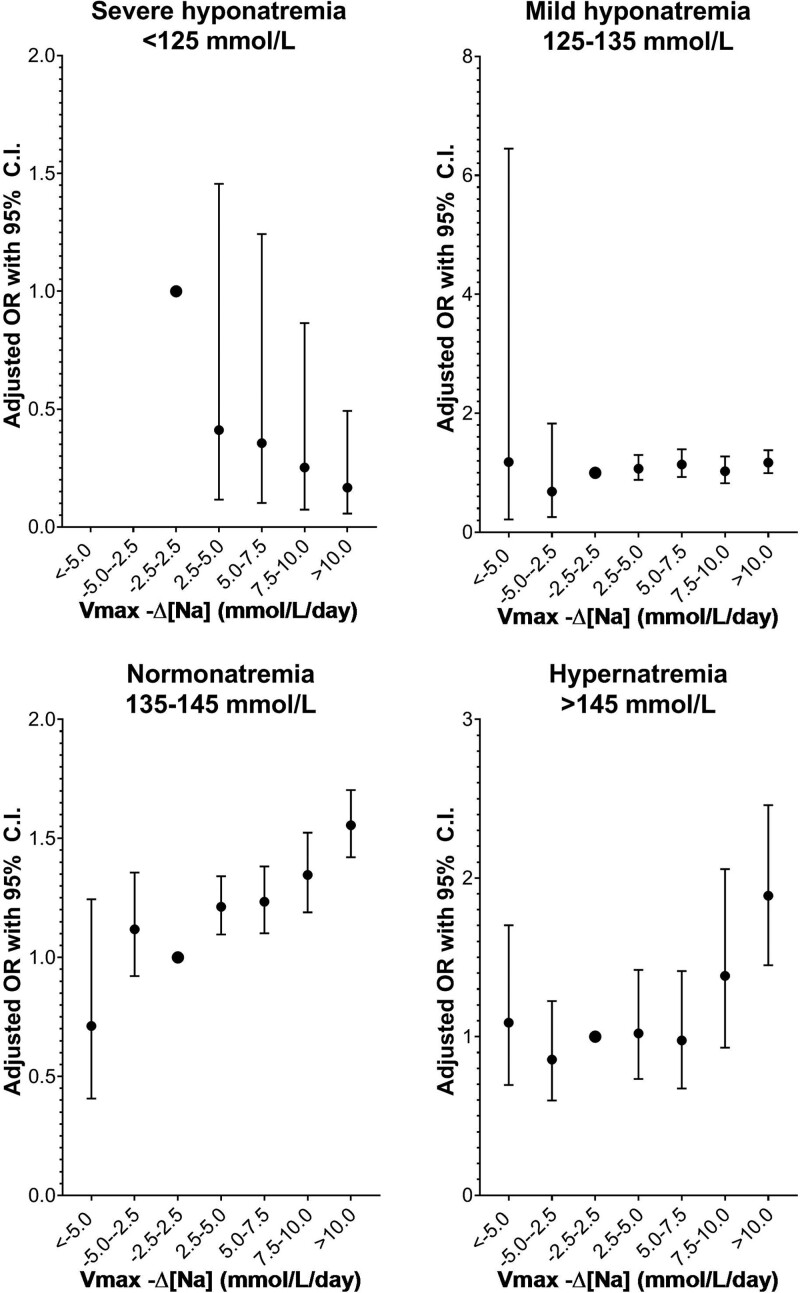
A logistic regression model adjusted for age, sex, and Acute Physiology and Chronic Health Evaluation-IV-predicted mortality was used to assess the difference between mean of sodium measurements 24-48 hours after ICU admission and first serum sodium measurement at ICU admission (Δ48 hr-[Na]) and in-hospital mortality. In total, 36,660 patients were included for analysis. An increase in serum sodium was independently associated with a higher risk of in-hospital mortality in patients admitted with normonatremia (Δ48 hr-[Na] 5-10 mmol/L odds ratio: 1.61 [1.44-1.79], Δ48 hr-[Na] > 10 mmol/L odds ratio: 4.10 [3.20-5.24]) and hypernatremia (Δ48 hr-[Na] 5-10 mmol/L odds ratio: 1.47 [1.02-2.14], Δ48 hr-[Na] > 10 mmol/L odds ratio: 8.46 [3.31-21.64]). In patients admitted with mild hyponatremia and Δ48 hr-[Na] greater than 5 mmol/L, no significant difference in hospital mortality was found (odds ratio, 1.11 [0.99-1.25]).
An increase in serum sodium in the first 48 hours of ICU admission was associated with higher in-hospital mortality in patients admitted with normonatremia and in patients admitted with hypernatremia.
在危重症患者中,电解质紊乱很常见,此类患者的院内死亡率较高。目前尚不清楚入住 ICU 后血清钠的变化是否会影响死亡率,特别是轻度低钠血症的纠正是否会改善生存率。
回顾性队列研究。
2011 年 1 月至 2017 年 4 月期间,荷兰的 10 家 ICU。
纳入标准为至少在 ICU 入住后 24 小时内有一次血清钠测量值,并且在 ICU 入住后 24-48 小时内至少有一次血清钠测量值。
无。
采用调整年龄、性别和急性生理学和慢性健康评估-IV 预测死亡率的逻辑回归模型,评估 ICU 入住后 24-48 小时内平均钠测量值与 ICU 入住时首次血清钠测量值(Δ48hr-[Na])之间的差异与院内死亡率的关系。共纳入 36660 例患者进行分析。在入院时为正常钠血症的患者中,血清钠升高与院内死亡率升高独立相关(Δ48hr-[Na] 5-10mmol/L 的优势比:1.61[1.44-1.79],Δ48hr-[Na]>10mmol/L 的优势比:4.10[3.20-5.24])和高钠血症(Δ48hr-[Na] 5-10mmol/L 的优势比:1.47[1.02-2.14],Δ48hr-[Na]>10mmol/L 的优势比:8.46[3.31-21.64])。在入院时为轻度低钠血症且Δ48hr-[Na]大于 5mmol/L 的患者中,未发现住院死亡率有显著差异(优势比,1.11[0.99-1.25])。
入住 ICU 后前 48 小时内血清钠升高与入院时正常钠血症和高钠血症患者的院内死亡率升高相关。