Følling Ivar, Wennerstrøm Anna B, Eide Tor J, Nilsen Hilde Loge
Department of Endocrinology, Akershus University Hospital, Lørenskog, Norway.
Institute of Clinical Medicine, University of Oslo, Oslo, Norway.
Endocr Connect. 2021 Jul 26;10(8):815-824. doi: 10.1530/EC-21-0269.
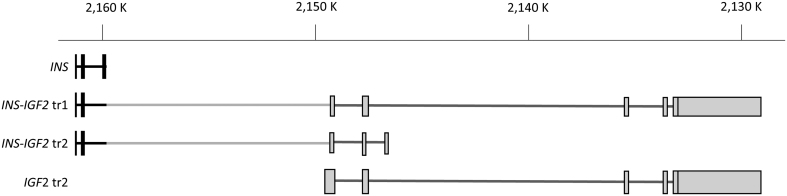
Phaeochromocytomas are tumours originating in the medulla of the adrenal gland. They produce catecholamines, and some tumours also produce ectopic hormones. Two types of glucose imbalances occur in phaeochromocytoma patients, hyperglycaemia and hypoglycaemic attacks. Therefore, we tested whether insulin transcript (INS), insulin, and a hybrid read-through transcript between exons from insulin and insulin-like growth factor 2 (INS-IGF2) were expressed in phaeochromocytomas.
We measured the expression of insulin using immunohistochemistry. The expression of INS-IGF2 was determined by qRT-PCR in formalin-fixed and paraffin-embedded tissue from 20 phaeochromocytomas. The expression of INS and INS-IGF2 transcriptswas also analysed in 182 phaeochromocytomas and paragangliomas using publicly available datasets in The Cancer Genome Atlas (TCGA) Database.
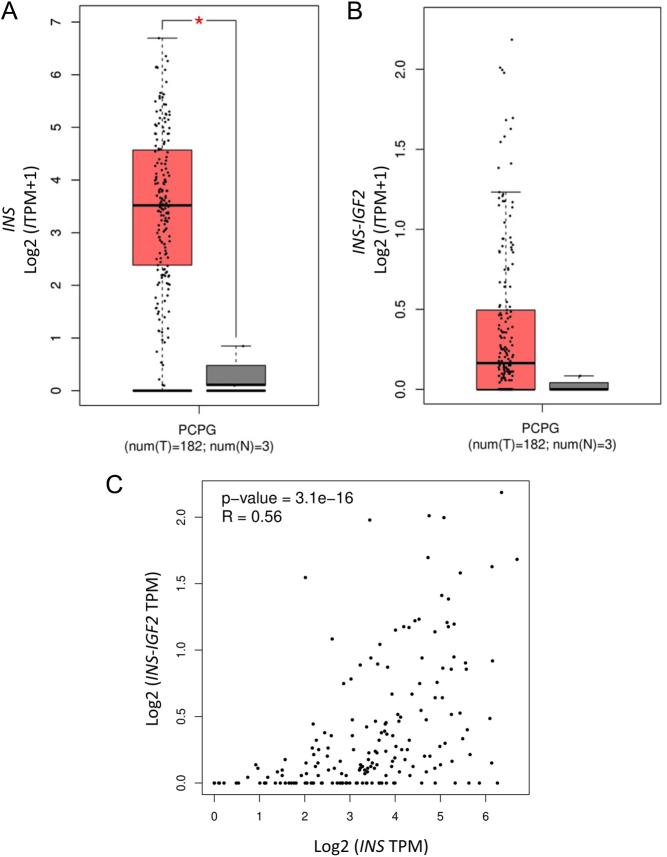
Of 20 phaeochromocytomas, 16 stained positive for insulin. The distribution of positive cells was mostly scattered, with some focal expression indicating clonal expansion. Nineteen tumours expressed high levels of INS and INS-IGF2 transcripts. The expression of the two transcripts corresponded closely. In the TCGA dataset, phaeochromocytoma expresses higher levels of INS and INS-IGF2 transcripts compared to the normal non-tumour adrenal glands. Thus, the expression of INS and INS-IGF2 seems to be a general phenomenon in phaeochromocytoma.
Most phaeochromocytomas contain cells that overexpress INS and INS-IGF2 transcripts. Most tumours also display heterogeneous expression of polypeptides immunoreactive to monoclonal anti-insulin antibodies. Clinically this may relate to both hyperglycaemia and hypoglycaemic attacks seen in patients with phaeochromocytoma as well as autocrine tumour growth.
嗜铬细胞瘤是起源于肾上腺髓质的肿瘤。它们产生儿茶酚胺,一些肿瘤还产生异位激素。嗜铬细胞瘤患者会出现两种类型的葡萄糖失衡,即高血糖症和低血糖发作。因此,我们检测了胰岛素转录本(INS)、胰岛素以及胰岛素与胰岛素样生长因子2外显子之间的杂合通读转录本(INS-IGF2)在嗜铬细胞瘤中是否表达。
我们使用免疫组织化学法检测胰岛素的表达。通过qRT-PCR测定20例嗜铬细胞瘤福尔马林固定石蜡包埋组织中INS-IGF2的表达。还使用癌症基因组图谱(TCGA)数据库中的公开数据集分析了182例嗜铬细胞瘤和副神经节瘤中INS和INS-IGF2转录本的表达。
在20例嗜铬细胞瘤中,16例胰岛素染色呈阳性。阳性细胞分布大多分散,一些局灶性表达表明存在克隆性扩增。19个肿瘤表达高水平的INS和INS-IGF2转录本。这两种转录本的表达密切相关。在TCGA数据集中,与正常非肿瘤肾上腺相比,嗜铬细胞瘤中INS和INS-IGF2转录本表达水平更高。因此,INS和INS-IGF2的表达似乎是嗜铬细胞瘤中的普遍现象。
大多数嗜铬细胞瘤含有过表达INS和INS-IGF2转录本的细胞。大多数肿瘤还显示对单克隆抗胰岛素抗体有免疫反应的多肽的异质性表达。在临床上,这可能与嗜铬细胞瘤患者出现的高血糖症和低血糖发作以及肿瘤的自分泌生长有关。