Department of Public Health Sciences, University of Rochester, Rochester, New York, United States of America.
College of Social Work, The Ohio State University, Columbus, Ohio, United States of America.
PLoS One. 2021 Jun 25;16(6):e0253734. doi: 10.1371/journal.pone.0253734. eCollection 2021.
Worldwide mandates for social distancing and home-quarantine have contributed to loneliness and social isolation. We conducted a systematic scoping review to identify network-building interventions that address loneliness and isolation, describe their components and impact on network structure, and consider their application in the wake of COVID19.
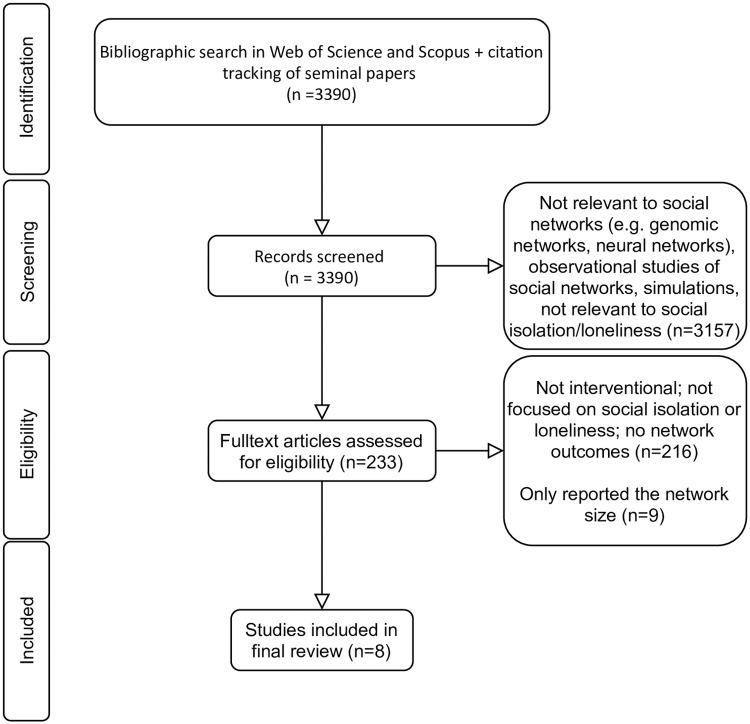
We performed forward and backward citation tracking of three seminal publications on network interventions and Bibliographic search of Web of Science and SCOPUS. We developed data charting tables and extracted and synthesized the characteristics of included studies, using an iteratively updating form.
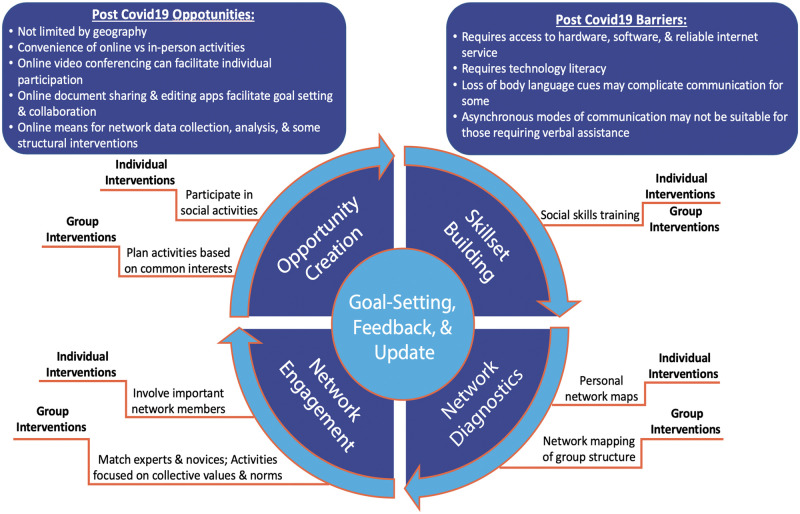
From 3390 retrieved titles and abstracts, we included 8 studies. These interventions focused on building networks at either individual- or group-levels. Key elements that were incorporated in the interventions at varying degrees included (a) creating opportunities to build networks; (b) improving social skills; (c) assessing network diagnostics (i.e. using network data or information to inform network strategies); (d) promoting engagement with influential actors; and (e) a process for goal-setting and feedback. The effect of interventions on network structures, or the moderating effect of structure on the intervention effectiveness was rarely assessed.
As many natural face-to-face opportunities for social connection are limited due to COVID19, groups already at risk for social isolation and loneliness are disproportionately impacted. Network-building interventions include multiple components that address both the structure of individuals' networks, and their skills and motivation for activating them. These intervention elements could be adapted for delivery via online platforms, and implemented by trained facilitators or novice volunteers, although more rigorous testing is needed.
全球范围内实施的社交距离和居家隔离措施导致人们倍感孤独和与社会脱节。本研究进行了系统的范围界定综述,旨在确定针对孤独和隔离问题的社交网络构建干预措施,描述其组成部分及其对网络结构的影响,并探讨这些干预措施在 COVID-19 疫情后的应用。
我们对三篇关于网络干预措施的开创性文献进行了前向和后向引文追踪,并在 Web of Science 和 SCOPUS 上进行了文献检索。我们制定了数据图表表格,并使用迭代更新的表格形式提取和综合纳入研究的特征。
从 3390 篇检索到的标题和摘要中,我们纳入了 8 项研究。这些干预措施主要集中在个体或群体层面上构建社交网络。干预措施中纳入了不同程度的以下关键要素:(a)创造构建网络的机会;(b)提高社交技能;(c)评估网络诊断(即使用网络数据或信息为网络策略提供信息);(d)促进与有影响力的参与者的互动;以及 (e)目标设定和反馈的过程。干预措施对网络结构的影响,或结构对干预效果的调节作用很少被评估。
由于 COVID-19 限制了许多自然的面对面社交机会,那些已经面临社交孤立和孤独风险的人群受到了不成比例的影响。社交网络构建干预措施包括多个组成部分,既可以解决个体网络的结构问题,又可以解决他们激活网络的技能和动力问题。这些干预措施的组成部分可以通过在线平台进行调整,并由经过培训的促进者或新手志愿者实施,尽管还需要更严格的测试。