U.S. Geological Survey, Fort Collins Science Center, 2150 Centre Ave. Building C, Fort Collins, CO, 80526-8118, USA.
Bureau of Land Management, Colorado State Office, 2850 Youngfield St, Lakewood, CO, 80215, USA.
Environ Manage. 2021 Sep;68(3):426-443. doi: 10.1007/s00267-021-01493-8. Epub 2021 Jun 26.
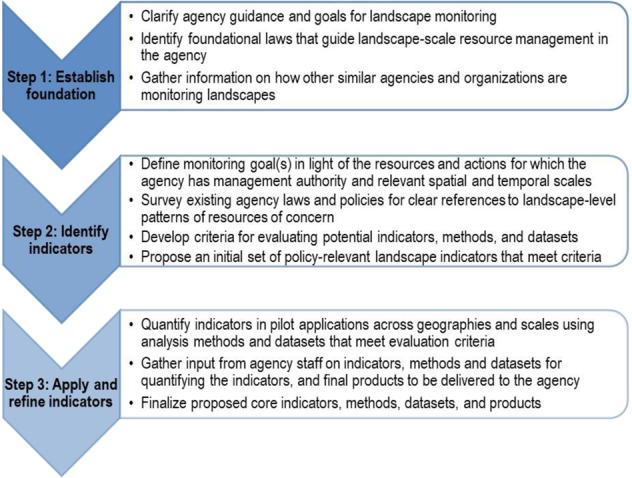
Understanding the structure and composition of landscapes can empower agencies to effectively manage public lands for multiple uses while sustaining land health. Many landscape metrics exist, but they are not often used in public land decision-making. Our objectives were to (1) develop and (2) apply a process for identifying a core set of indicators that public land managers can use to understand landscape-level resource patterns on and around public lands. We first developed a process for identifying indicators that are grounded in policy, feasible to quantify using existing data and resources, and useful for managers. We surveyed landscape monitoring efforts by other agencies, gathered science and agency input on monitoring goals, and quantified the prevalence of potential indicators in agency land health standards to identify five landscape indicators: amount, distribution, patch size, structural connectivity, and diversity of vegetation types. We then conducted pilot applications in four bureau of land management (BLM) field offices in Arizona, California, and Colorado to refine procedures for quantifying the indicators and assess the utility of the indicators for managers. Results highlighted the dominance of upland and the limited extent of riparian/wetland vegetation communities, moderate connectivity of priority vegetation patches, and lower diversity of native vegetation types on BLM compared to non-BLM lands. Agency staff can use the indicators to inform the development of quantitative resource management objectives in land use plans, evaluate progress in meeting those objectives, quantify potential impacts of proposed actions, and as a foundation for an all-lands approach to landscape-level management across public lands.
了解景观的结构和组成可以使机构能够有效地管理公共土地以实现多种用途,同时维持土地健康。有许多景观指标存在,但它们在公共土地决策中并不常用。我们的目标是(1)制定和(2)应用一种识别核心指标集的过程,公共土地管理者可以使用这些指标来了解公共土地及其周围的景观资源模式。我们首先制定了一个识别指标的过程,这些指标基于政策,使用现有数据和资源进行量化是可行的,并且对管理者有用。我们调查了其他机构的景观监测工作,收集了关于监测目标的科学和机构投入,并量化了潜在指标在机构土地健康标准中的出现频率,以确定五个景观指标:数量、分布、斑块大小、结构连接性和植被类型多样性。然后,我们在亚利桑那州、加利福尼亚州和科罗拉多州的四个土地管理局(BLM)实地办公室进行了试点应用,以完善量化指标的程序,并评估指标对管理者的实用性。结果突出了旱地的主导地位,以及滨水/湿地植被群落的有限范围,优先植被斑块的中等连接性,以及 BLM 土地上原生植被类型的多样性较低。机构工作人员可以使用这些指标来为土地利用规划中制定定量资源管理目标提供信息,评估在实现这些目标方面的进展,量化拟议行动的潜在影响,并为公共土地的全土地景观管理方法奠定基础。