Faculty of Health, Institute of Physiology, Pathophysiology and Toxicology and ZBAF (Centre for Biomedical Education and Research), School of Medicine, Witten/Herdecke University, Stockumer Str 12 (Thyssenhaus), 58453, Witten, Germany.
Department of Molecular Embryology, Faculty of Medicine, Institute of Anatomy and Cell Biology, University of Freiburg, Albertstr. 17, 79104, Freiburg, Germany.
Arch Toxicol. 2021 Aug;95(8):2719-2735. doi: 10.1007/s00204-021-03106-z. Epub 2021 Jun 28.
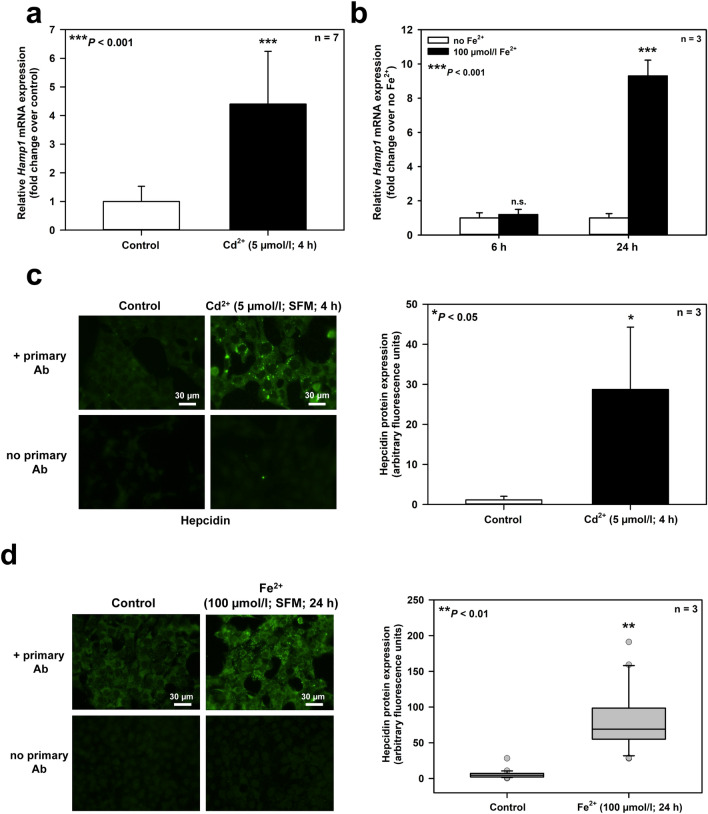
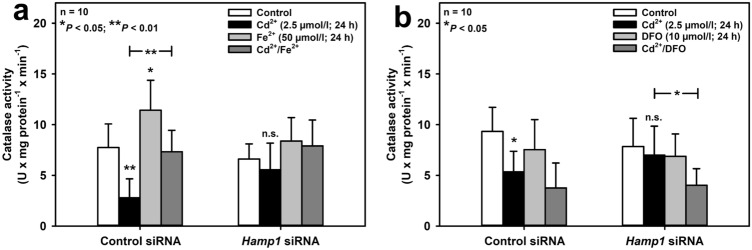
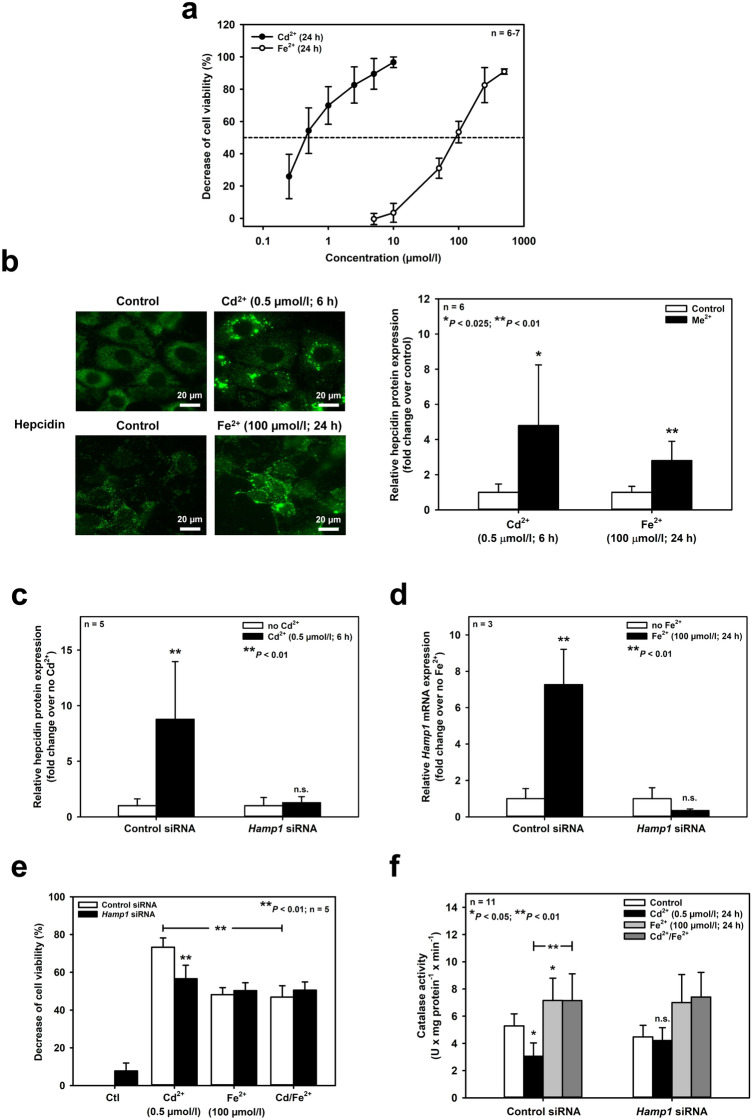
The liver hormone hepcidin regulates systemic iron homeostasis. Hepcidin is also expressed by the kidney, but exclusively in distal nephron segments. Several studies suggest hepcidin protects against kidney damage involving Fe overload. The nephrotoxic non-essential metal ion Cd can displace Fe from cellular biomolecules, causing oxidative stress and cell death. The role of hepcidin in Fe and Cd toxicity was assessed in mouse renal cortical [mCCD(cl.1)] and inner medullary [mIMCD] collecting duct cell lines. Cells were exposed to equipotent Cd (0.5-5 μmol/l) and/or Fe (50-100 μmol/l) for 4-24 h. Hepcidin (Hamp1) was transiently silenced by RNAi or overexpressed by plasmid transfection. Hepcidin or catalase expression were evaluated by RT-PCR, qPCR, immunoblotting or immunofluorescence microscopy, and cell fate by MTT, apoptosis and necrosis assays. Reactive oxygen species (ROS) were detected using CellROX™ Green and catalase activity by fluorometry. Hepcidin upregulation protected against Fe-induced mIMCD cell death by increasing catalase activity and reducing ROS, but exacerbated Cd-induced catalase dysfunction, increasing ROS and cell death. Opposite effects were observed with Hamp1 siRNA. Similar to Hamp1 silencing, increased intracellular Fe prevented Cd damage, ROS formation and catalase disruption whereas chelation of intracellular Fe with desferrioxamine augmented Cd damage, corresponding to hepcidin upregulation. Comparable effects were observed in mCCD(cl.1) cells, indicating equivalent functions of renal hepcidin in different collecting duct segments. In conclusion, hepcidin likely binds Fe, but not Cd. Because Fe and Cd compete for functional binding sites in proteins, hepcidin affects their free metal ion pools and differentially impacts downstream processes and cell fate.
肝脏激素铁调素调节全身铁稳态。铁调素也在肾脏中表达,但仅在远端肾单位段。几项研究表明,铁调素可防止涉及铁过载的肾损伤。非必需的有毒金属离子 Cd 可以从细胞生物分子中取代铁,导致氧化应激和细胞死亡。在小鼠肾皮质[mCCD(cl.1)]和髓质内[mIMCD]集合管细胞系中评估了铁调素在铁和 Cd 毒性中的作用。细胞暴露于等效力的 Cd(0.5-5 μmol/l)和/或 Fe(50-100 μmol/l)4-24 小时。用 RNAi 瞬时沉默铁调素(Hamp1)或用质粒转染过表达铁调素。通过 RT-PCR、qPCR、免疫印迹或免疫荧光显微镜评估铁调素或过氧化氢酶的表达,并通过 MTT、凋亡和坏死测定评估细胞命运。使用 CellROX™ Green 检测活性氧(ROS),使用荧光法检测过氧化氢酶活性。铁调素的上调通过增加过氧化氢酶活性和减少 ROS 来保护 mIMCD 细胞免受 Fe 诱导的死亡,但加剧了 Cd 诱导的过氧化氢酶功能障碍,增加了 ROS 和细胞死亡。Hamp1 siRNA 观察到相反的效果。与 Hamp1 沉默相似,增加细胞内铁可防止 Cd 损伤、ROS 形成和过氧化氢酶破坏,而用去铁胺螯合细胞内铁则增强了 Cd 损伤,对应于铁调素的上调。在 mCCD(cl.1)细胞中观察到类似的效果,表明肾脏铁调素在不同的集合管段中具有相同的功能。总之,铁调素可能结合铁而不是 Cd。由于铁和 Cd 竞争蛋白质中的功能性结合位点,铁调素影响它们的游离金属离子池,并对下游过程和细胞命运产生不同的影响。