Mackay Lindsay, Bach Paxton, Milloy M-J, Cui Zishan, Kerr Thomas, Hayashi Kanna
British Columbia Centre on Substance Use, 400-1045 Howe Street, Vancouver, BC, V6Z 2A9, Canada; Department of Medicine, University of British Columbia, St. Paul's Hospital, 608-1081 Burrard Street, Vancouver, BC, V6Z 1Y6, Canada.
British Columbia Centre on Substance Use, 400-1045 Howe Street, Vancouver, BC, V6Z 2A9, Canada; School of Population and Public Health, University of British Columbia, 2206all, Vancouver, British Columbia, V6T 1Z3, Canada.
Drug Alcohol Depend. 2021 Aug 1;225:108844. doi: 10.1016/j.drugalcdep.2021.108844. Epub 2021 Jun 24.
The efficacy of methadone in reducing morbidity and mortality associated with opioid use disorder is supported by a wealth of evidence, yet methadone retention is often poor. While crystal methamphetamine (methamphetamine) use has been recently increasing in many countries, the effect of frequency of methamphetamine use on methadone discontinuation has not been investigated. We aimed to examine whether frequency of methamphetamine use is associated with increased rates of methadone discontinuation among individuals on methadone.
Two harmonized ongoing open prospective cohort studies of community-recruited people who use illicit drugs with semi-annual follow-ups between 2014 and 2018.
Vancouver, Canada.
A community recruited sample of people who use drugs.
A time-varying variable of self-reported methamphetamine use frequency within the past six months.
The primary outcome was time to discontinuation of methadone, defined as reporting not being on methadone at the time of a follow-up interview during the study period. We employed multivariable extended Cox regression analysis to examine the relationship between frequency of methamphetamine use and time to methadone discontinuation after adjusting for potential confounders.
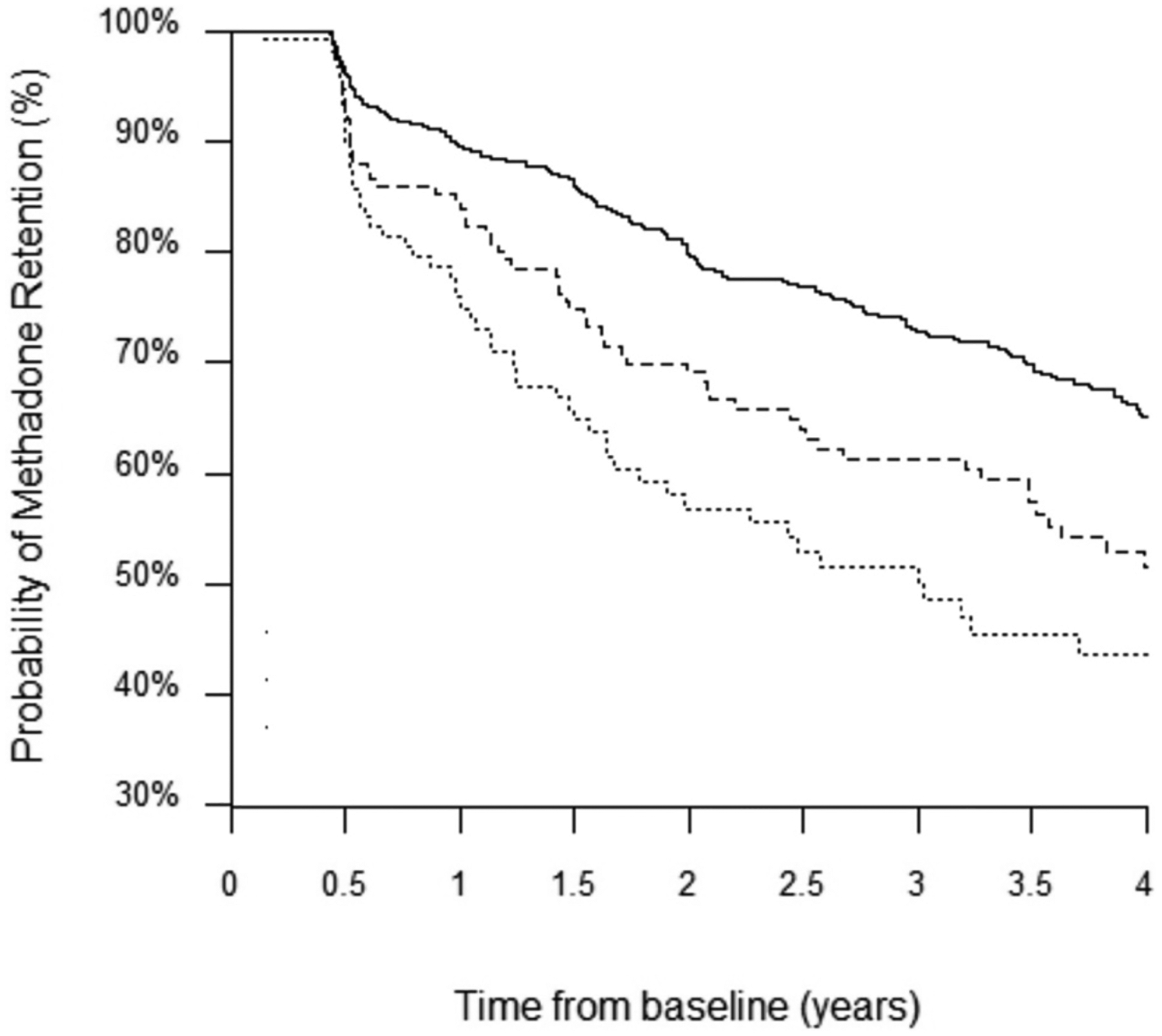
Of 875 eligible participants who contributed 2319 person-years of follow-up, 284 (32.5 %) discontinued methadone at least once during follow-up and 135 (15.4 %) reported more than weekly methamphetamine use at study baseline. In a multivariate analysis, in comparison to no use, ≥weekly use of methamphetamine remained independently associated with methadone discontinuation (adjusted hazard ratio [aHR] = 1.38, 95 % CI = 1.03-1.85).
A significant proportion of participants on methadone in this study reported more than weekly crystal methamphetamine use, which was associated with an increased risk of methadone discontinuation. Closer follow up, education, and treatment of methamphetamine use may be needed for this group to improve methadone retention.
大量证据支持美沙酮在降低与阿片类物质使用障碍相关的发病率和死亡率方面的疗效,但美沙酮维持治疗的留存率往往较低。虽然近年来许多国家冰毒(甲基苯丙胺)的使用呈上升趋势,但甲基苯丙胺使用频率对美沙酮停药的影响尚未得到研究。我们旨在探讨甲基苯丙胺的使用频率是否与接受美沙酮治疗的个体中更高的美沙酮停药率相关。
两项正在进行的开放式前瞻性队列研究,对社区招募的使用非法药物的人群进行了2014年至2018年的半年一次随访。
加拿大温哥华。
社区招募的吸毒人群样本。
过去六个月内自我报告的甲基苯丙胺使用频率这一随时间变化的变量。
主要结局是美沙酮停药时间,定义为在研究期间的随访访谈时报告未服用美沙酮。我们采用多变量扩展Cox回归分析,在调整潜在混杂因素后,研究甲基苯丙胺使用频率与美沙酮停药时间之间的关系。
在875名符合条件的参与者中,共随访了2319人年,其中284人(32.5%)在随访期间至少有一次停用美沙酮,135人(1