Department of Thoracic Oncology, Thoraxklinik at University Hospital of Heidelberg, Röntgenstraße 1, 69126, Heidelberg, Germany.
Translational Lung Research Center Heidelberg TLRCH, Member of the German Center for Lung Research DZL, Im Neuenheimer Feld 156, 69120, Heidelberg, Germany.
BMC Cancer. 2021 Jun 28;21(1):743. doi: 10.1186/s12885-021-08460-w.
Availability of potent anaplastic lymphoma kinase (ALK) tyrosine kinase inhibitors (TKI) has pushed the median survival of ALK non-smallcell lung cancer (NSCLC) patients to over five years. In particular, second-generation ALK TKI have demonstrated superiority compared to the first-generation compound crizotinib and are meanwhile standard first-line treatment. However, clinical courses of individual patients vary widely, with secondary development of drug resistance and intracranial progression remaining important problems. While these limitations highlight the need for better disease monitoring and additional therapeutic tools, molecular tumor features are increasingly recognized as crucial determinants of clinical outcome. This trial aims to optimize management of ALK NSCLC by analyzing the efficacy of second-generation ALK inhibitors in conjunction with deep longitudinal phenotyping across two treatment lines.
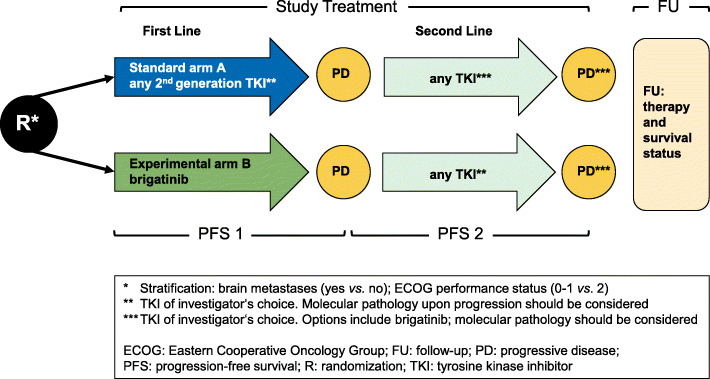
METHODS/DESIGN: In this exploratory prospective phase II clinical trial, newly diagnosed ALK NSCLC patients will be randomized into two treatment arms, stratified by presence of brain metastases and ECOG performance status: brigatinib (experimental arm) vs. any other approved second-generation ALK TKI. Tumor tissue and blood samples will be collected for biomarker analysis at the beginning and throughout the study period to investigate baseline molecular tumor properties and analyze the development of acquired drug resistance. In addition, participating investigators and patients will have the possibility of fast-track molecular tumor and ctDNA profiling at the time of disease progression using state-of-the-art next-generation sequencing (NGS), in order to support decisions regarding next-line therapy.
Besides supporting therapeutic decisions for enrolled patients, the ABP trial primarily aims to deepen the understanding of the underlying biology and facilitate development of a framework for individualized management of ALK NSCLC according to molecular features. Patients with low molecular risk and the perspective of a "chronic disease" will be distinguished from "high-risk" cases, molecular properties of which will be utilized to elaborate improved methods of non-invasive monitoring and novel preclinical models in order to advance therapeutic strategies.
Clinicaltrials.gov , NCT04318938. Registered March 182,020, https://www.clinicaltrials.gov/ct2/show/NCT04318938 Eudra-CT, 2019-001828-36. Registered September 302,019, https://www.clinicaltrialsregister.eu/ctr-search/search?query=2019-001828-36.
具有强效间变性淋巴瘤激酶(ALK)酪氨酸激酶抑制剂(TKI)的可用性将ALK 非小细胞肺癌(NSCLC)患者的中位生存期延长至五年以上。特别是,第二代 ALK TKI 已被证明优于第一代化合物克唑替尼,同时也是标准的一线治疗药物。然而,个体患者的临床过程差异很大,药物耐药性的继发发展和颅内进展仍然是重要问题。虽然这些局限性突出了更好的疾病监测和额外治疗工具的必要性,但分子肿瘤特征越来越被认为是临床结果的关键决定因素。本试验旨在通过分析两种治疗线中第二代 ALK 抑制剂的疗效,结合深度纵向表型分析来优化 ALK NSCLC 的管理。
方法/设计:在这项探索性的前瞻性 II 期临床试验中,新诊断的 ALK NSCLC 患者将按存在脑转移和 ECOG 表现状态随机分为两个治疗组:布加替尼(实验组)与任何其他批准的第二代 ALK TKI。在研究开始时和整个研究期间,将采集肿瘤组织和血液样本进行生物标志物分析,以研究基线分子肿瘤特性并分析获得性药物耐药性的发展。此外,参与研究的医生和患者将有可能在疾病进展时使用最先进的下一代测序(NGS)快速进行分子肿瘤和 ctDNA 分析,以支持关于下一线治疗的决策。
除了支持入组患者的治疗决策外,ABP 试验主要旨在加深对潜在生物学的理解,并根据分子特征为 ALK NSCLC 的个体化管理制定框架。具有低分子风险和“慢性病”前景的患者将与“高危”病例区分开来,将利用后者的分子特性来完善非侵入性监测的改进方法和新的临床前模型,以推进治疗策略。
Clinicaltrials.gov ,NCT04318938。于 2020 年 3 月 18 日注册,https://www.clinicaltrials.gov/ct2/show/NCT04318938。Eudra-CT,2019-001828-36。于 2019 年 9 月 30 日注册,https://www.clinicaltrialsregister.eu/ctr-search/search?query=2019-001828-36。