Department of Epidemiology, University of Groningen, Groningen, The Netherlands
Department of Public Health, Aksum University, Axum, Ethiopia.
BMJ Open. 2021 Jun 28;11(6):e043484. doi: 10.1136/bmjopen-2020-043484.
To assess a broad range of factors associated with pre-pregnancy nutritional status, a key step towards improving maternal and child health outcomes, in Ethiopia.
A baseline data analysis of a population-based prospective study.
Kilite-Awlaelo Health and Demographic Surveillance Site, eastern zone of Tigray regional state, northern Ethiopia.
We used weight measurements of all 17 500 women of reproductive age living in the surveillance site between August 2017 and October 2017 as a baseline. Subsequently, 991 women who became pregnant were included consecutively at an average of 14.8 weeks (SD: 1.9 weeks) of gestation between February 2018 and September 2018. Eligible women were married, aged 18 years or older, with a pre-pregnancy weight measurement performed, and a gestational age ≤20 weeks at inclusion.
The outcome measure was pre-pregnancy nutritional status assessed by body mass index (BMI) and mid-upper arm circumference (MUAC). Undernutrition was defined as BMI of <18.5 kg/m and/or MUAC of <21.0 cm. BMI was calculated using weight measured before pregnancy, and MUAC was measured at inclusion. Linear and spline regressions were used to identify factors associated with pre-pregnancy nutritional status as a continuous and Poisson regression with pre-pregnancy undernutrition as a dichotomous variable.
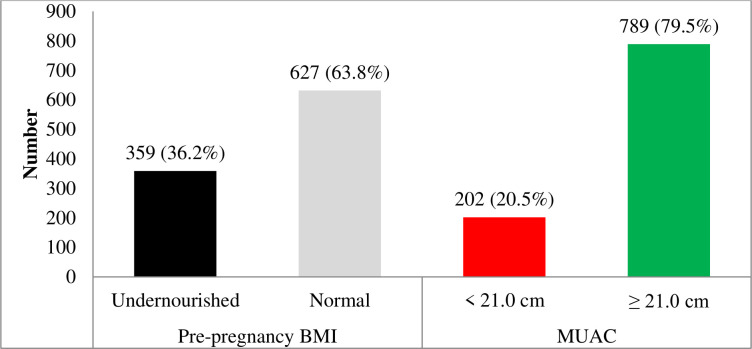
The mean pre-pregnancy BMI and MUAC were 19.7 kg/m (SD: 2.0 kg/m) and 22.6 cm (SD: 1.9 cm), respectively. Overall, the prevalence of pre-pregnancy undernutrition was 36.2% based on BMI and/or MUAC. Lower age, not being from a model household, lower values of women empowerment score, food insecurity, lower dietary diversity, regular fasting and low agrobiodiversity showed significant associations with lower BMI and/or MUAC.
The prevalence of pre-pregnancy undernutrition in our study population was very high. The pre-pregnancy nutritional status could be improved by advancing community awareness on dietary practice and gender equality, empowering females, raising agricultural productivity and strengthening health extension. Such changes require the coordinated efforts of concerned governmental bodies and religious leaders in the Ethiopian setting.
评估与埃塞俄比亚孕妇营养状况相关的广泛因素,这是改善母婴健康结果的关键一步。
基于人群的前瞻性研究的基线数据分析。
提格雷地区东区域的基利特-阿瓦莱洛健康和人口监测站点。
我们使用 2017 年 8 月至 10 月期间居住在监测点的所有 17500 名育龄妇女的体重测量值作为基线。随后,在 2018 年 2 月至 2018 年 9 月期间,在平均妊娠 14.8 周(标准差:1.9 周)时,连续纳入 991 名怀孕的妇女。合格的妇女为已婚,年龄在 18 岁及以上,进行过孕前体重测量,且在纳入时妊娠龄≤20 周。
结局指标为通过身体质量指数(BMI)和上臂中部周长(MUAC)评估的孕前营养状况。营养不良定义为 BMI<18.5kg/m 和/或 MUAC<21.0cm。BMI 是根据怀孕前测量的体重计算的,MUAC 是在纳入时测量的。线性和样条回归用于识别与孕前营养状况相关的因素,作为连续变量和 Poisson 回归作为孕前营养不良的二分类变量。
孕前 BMI 和 MUAC 的平均值分别为 19.7kg/m(标准差:2.0kg/m)和 22.6cm(标准差:1.9cm)。总体而言,基于 BMI 和/或 MUAC,孕前营养不良的患病率为 36.2%。年龄较小、非模范家庭出身、女性赋权评分较低、粮食不安全、膳食多样性较低、定期禁食和低农业生物多样性与较低的 BMI 和/或 MUAC 显著相关。
在我们的研究人群中,孕前营养不良的患病率非常高。通过提高社区对饮食实践和性别平等的认识、增强女性能力、提高农业生产力和加强卫生推广,可以改善孕前营养状况。这种变化需要埃塞俄比亚相关政府机构和宗教领袖的协调努力。