National Institute of Health, Islamabad, Pakistan.
World Health Organization, Islamabad, Pakistan.
PLoS One. 2021 Jun 29;16(6):e0249568. doi: 10.1371/journal.pone.0249568. eCollection 2021.
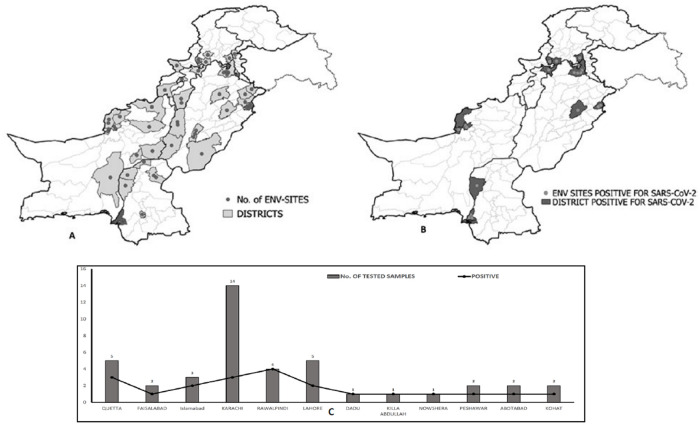
The ongoing COVID-19 pandemic is caused by SARs-CoV-2. The virus is transmitted from person to person through droplet infections i.e. when infected person is in close contact with another person. In January 2020, first report of detection of SARS-CoV-2 in faeces, has made it clear that human wastewater might contain this virus. This may illustrate the probability of environmentally facilitated transmission, mainly the sewage, however, environmental conditions that could facilitate faecal oral transmission is not yet clear. We used existing Pakistan polio environment surveillance network to investigate presence of SARs-CoV-2 using three commercially available kits and E-Gene detection published assay for surety and confirmatory of positivity. A Two-phase separation method is used for sample clarification and concentration. An additional high-speed centrifugation (14000Xg for 30 min) step was introduced, prior RNA extraction, to increase viral RNA yield resulting a decrease in Cq value. A total of 78 wastewater samples collected from 38 districts across Pakistan, 74 wastewater samples from existing polio environment surveillance sites, 3 from drains of COVID-19 infected areas and 1 from COVID 19 quarantine center drainage, were tested for presence of SARs-CoV-2. 21 wastewater samples (27%) from 13 districts turned to be positive on RT-qPCR. SARs-COV-2 RNA positive samples from areas with COVID 19 patients and quarantine center strengthen the findings and use of wastewater surveillance in future. Furthermore, sequence data of partial ORF 1a generated from COVID 19 patient quarantine center drainage sample also reinforce our findings that SARs-CoV-2 can be detected in wastewater. This study finding indicates that SARs-CoV-2 detection through wastewater surveillance has an epidemiologic potential that can be used as supplementary system to monitor viral tracking and circulation in cities with lower COVID-19 testing capacity or heavily populated areas where door-to-door tracing may not be possible. However, attention is needed on virus concentration and detection assay to increase the sensitivity. Development of highly sensitive assay will be an indicator for virus monitoring and to provide early warning signs.
持续的 COVID-19 大流行是由 SARS-CoV-2 引起的。该病毒通过飞沫感染在人与人之间传播,即当感染者与另一个人密切接触时。2020 年 1 月,首次报告在粪便中检测到 SARS-CoV-2,这表明人类废水可能含有这种病毒。这可能说明了环境促进传播的可能性,主要是污水,但促进粪便口腔传播的环境条件尚不清楚。我们利用现有的巴基斯坦脊髓灰质炎环境监测网络,使用三种市售试剂盒和 E-Gene 检测试剂盒,以及已发表的检测方法,调查了 SARS-CoV-2 的存在情况,以确保和确认阳性结果。采用两相分离法进行样品澄清和浓缩。在提取 RNA 之前,引入了额外的高速离心(14000xg 离心 30 分钟)步骤,以增加病毒 RNA 的产量,从而降低 Cq 值。共检测了来自巴基斯坦 38 个地区的 78 个废水样本、74 个现有脊髓灰质炎环境监测点的废水样本、3 个来自 COVID-19 感染地区的排水样本和 1 个来自 COVID-19 检疫中心的排水样本,以检测 SARS-CoV-2 的存在。在来自 13 个地区的 21 个废水样本(27%)上进行了 RT-qPCR 检测,结果呈阳性。来自 COVID-19 患者和检疫中心地区的 SARS-COV-2 RNA 阳性样本加强了废水监测在未来的使用。此外,从 COVID-19 患者检疫中心排水样本中生成的部分 ORF1a 序列数据也证实了我们的发现,即 SARS-CoV-2 可在废水中检测到。本研究结果表明,通过废水监测进行 SARS-CoV-2 检测具有流行病学潜力,可以作为补充系统,用于监测城市的病毒跟踪和循环,这些城市的 COVID-19 检测能力较低或人口稠密地区,在这些地区,可能无法进行逐户追踪。然而,需要注意病毒的浓缩和检测方法,以提高敏感性。开发高灵敏度的检测方法将是监测病毒和提供早期预警信号的指标。