Barton D J, Sawicki S G, Sawicki D L
Department of Microbiology, Medical College of Ohio, Toledo 43699.
J Virol. 1988 Oct;62(10):3597-602. doi: 10.1128/JVI.62.10.3597-3602.1988.
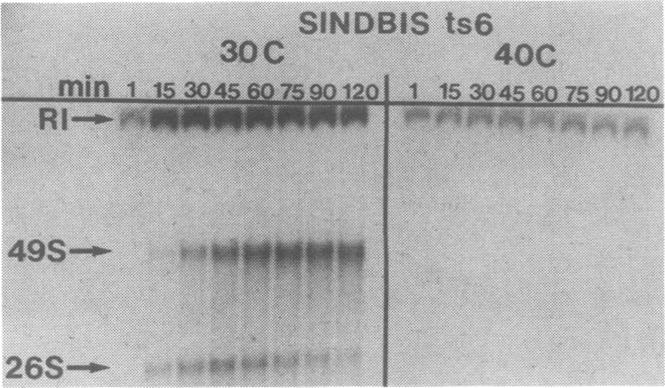
Characterization of conditionally lethal mutants of alphaviruses, Sindbis virus and Semliki Forest virus, has indicated that in almost all the RNA-negative mutants the temperature-sensitive (ts) defect prevents the formation of active transcription complexes at nonpermissive temperature (40 degrees C), but such complexes retain activity at 40 degrees C if formed first at permissive temperature (30 degrees C). Our recent results have extended the characterization of one exception to this finding: Sindbis ts6 transcription complexes, once formed at 30 degrees C, do not function at 40 degrees C. We used an in vitro assay for viral RNA synthesis to determine whether the ts defect was the result of dissociation of the complex or of a failure to elongate RNA chains in a stable complex. Our results indicated that the phenotype of ts6 observed in vivo was retained in vitro. In vivo incorporation into single-stranded 49S and 26S RNA was inhibited simultaneously with its incorporation into replicative intermediates upon shifting ts6-infected cells to 40 degrees C, which was compatible with a defect in elongation. Complexes formed at 30 degrees C and inactivated in vivo by shifting to 40 degrees C were reactivated by incubation in vitro at 30 degrees C but not at 40 degrees C. Thus, the transcription complexes were stable. Nascent RNA chains initiated in vivo and pulse-labeled in vitro were chased into single-stranded 49S and 26S RNA only when incubation was at 30 degrees C, indicating that the ts6 transcription complex was temperature sensitive in elongation. It should be possible to study in vitro other alphavirus RNA-negative mutants that demonstrate a change in viral RNA synthesis after shift to 40 degrees C. These would include ts mutants in the synthesis of subgenomic 26S mRNA and of minus-strand RNA.
对甲病毒、辛德毕斯病毒和塞姆利基森林病毒的条件致死突变体的特性研究表明,在几乎所有RNA阴性突变体中,温度敏感(ts)缺陷会阻止在非允许温度(40℃)下形成活性转录复合物,但如果这些复合物首先在允许温度(30℃)下形成,则在40℃时仍保留活性。我们最近的研究结果扩展了对这一发现的一个例外情况的特性描述:辛德毕斯ts6转录复合物一旦在30℃形成,在40℃时就不起作用。我们使用了一种体外病毒RNA合成检测方法,以确定ts缺陷是复合物解离的结果,还是在稳定复合物中无法延长RNA链的结果。我们的结果表明,在体内观察到的ts6表型在体外得以保留。当将ts6感染的细胞转移到40℃时,其体内掺入单链49S和26S RNA的过程与其掺入复制中间体的过程同时受到抑制,这与延长缺陷相符。在30℃形成并通过转移到40℃在体内失活的复合物,在体外于30℃孵育时可重新激活,但在40℃时则不能。因此,转录复合物是稳定的。仅当在30℃孵育时,体内起始并在体外脉冲标记的新生RNA链才会追踪到单链49S和26S RNA,这表明ts6转录复合物在延长过程中对温度敏感。应该有可能在体外研究其他甲病毒RNA阴性突变体,这些突变体在转移到40℃后会表现出病毒RNA合成的变化。这些突变体将包括在亚基因组26S mRNA和负链RNA合成中的ts突变体。