Department of Genetics and Computational Biology, QIMR Berghofer Medical Research Institute, Herston, Queensland, Australia
School of Biology & Environmental Science, Queensland University of Technology, Brisbane, Queensland, Australia.
Gut. 2022 Jun;71(6):1053-1061. doi: 10.1136/gutjnl-2020-323906. Epub 2021 Jun 29.
Gastro-oesophageal reflux disease (GERD) has heterogeneous aetiology primarily attributable to its symptom-based definitions. GERD genome-wide association studies (GWASs) have shown strong genetic overlaps with established risk factors such as obesity and depression. We hypothesised that the shared genetic architecture between GERD and these risk factors can be leveraged to (1) identify new GERD and Barrett's oesophagus (BE) risk loci and (2) explore potentially heterogeneous pathways leading to GERD and oesophageal complications.
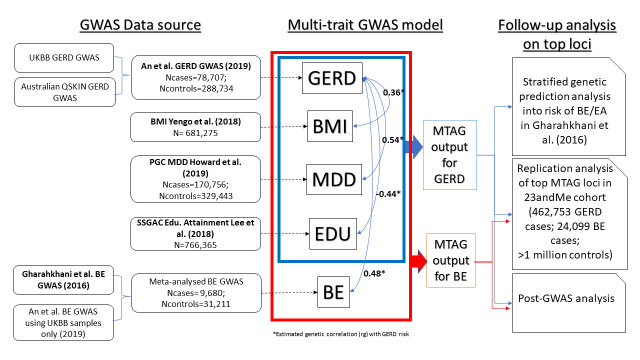
We applied multitrait GWAS models combining GERD (78 707 cases; 288 734 controls) and genetically correlated traits including education attainment, depression and body mass index. We also used multitrait analysis to identify BE risk loci. Top hits were replicated in 23andMe (462 753 GERD cases, 24 099 BE cases, 1 484 025 controls). We additionally dissected the GERD loci into obesity-driven and depression-driven subgroups. These subgroups were investigated to determine how they relate to tissue-specific gene expression and to risk of serious oesophageal disease (BE and/or oesophageal adenocarcinoma, EA).
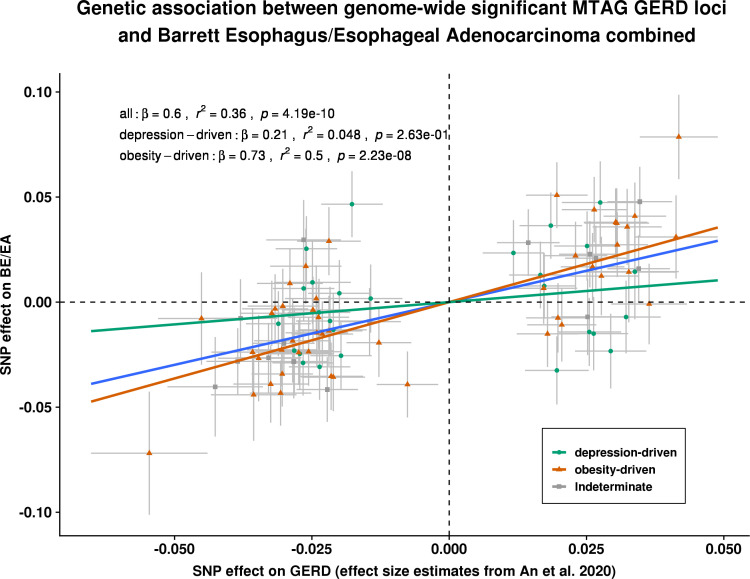
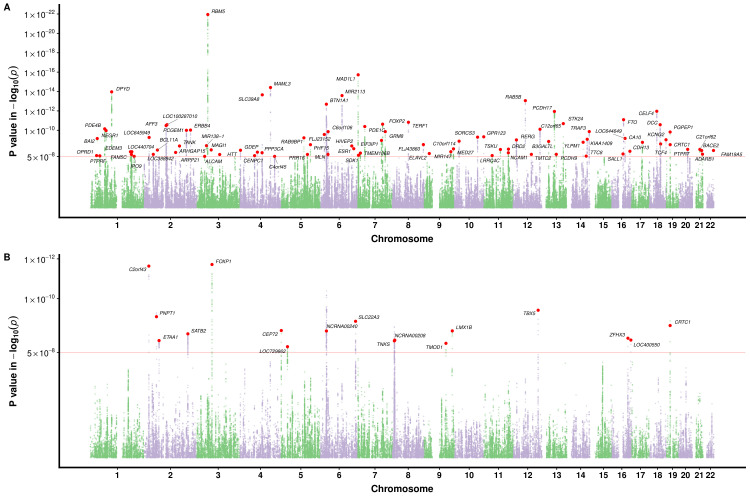
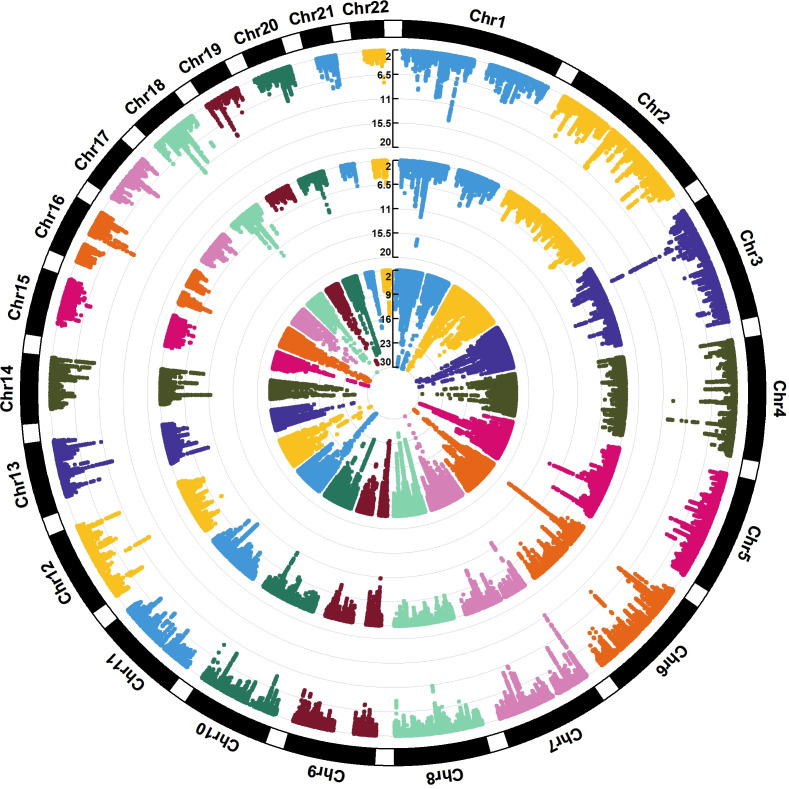
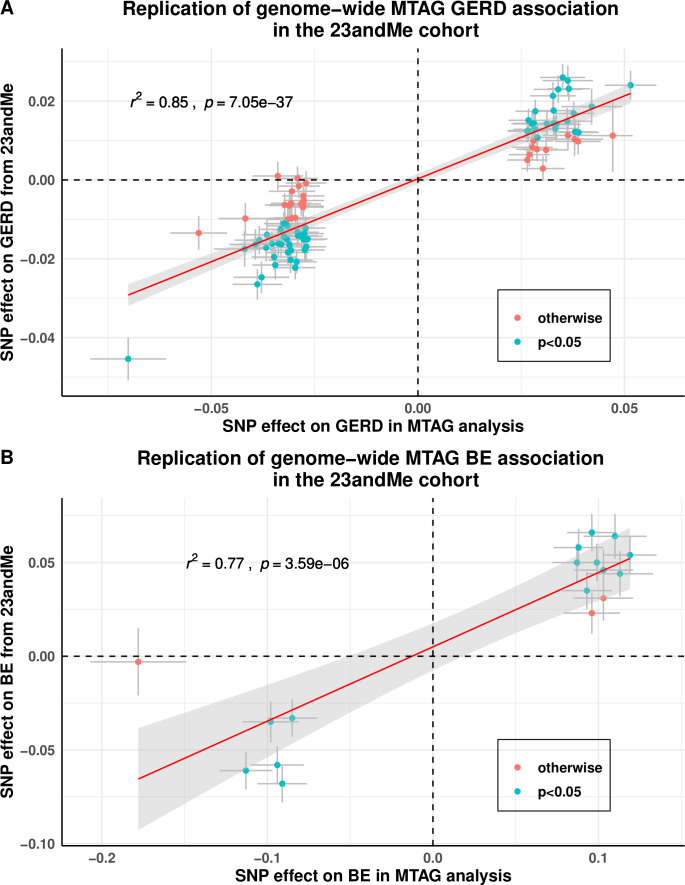
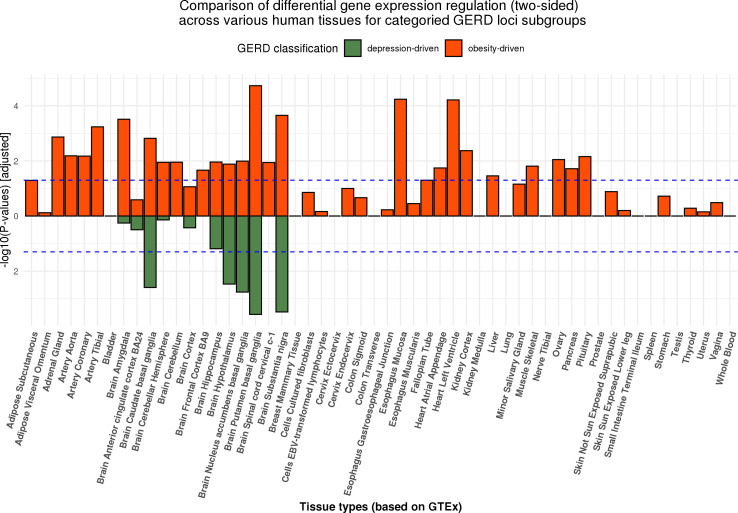
We identified 88 loci associated with GERD, with 59 replicating in 23andMe after multiple testing corrections. Our BE analysis identified seven novel loci. Additionally we showed that only the obesity-driven GERD loci (but not the depression-driven loci) were associated with genes enriched in oesophageal tissues and successfully predicted BE/EA.
Our multitrait model identified many novel risk loci for GERD and BE. We present strong evidence for a genetic underpinning of disease heterogeneity in GERD and show that GERD loci associated with depressive symptoms are not strong predictors of BE/EA relative to obesity-driven GERD loci.
胃食管反流病(GERD)具有异质性病因,主要归因于其基于症状的定义。GERD 的全基因组关联研究(GWAS)表明,与肥胖和抑郁等已确立的危险因素存在很强的遗传重叠。我们假设 GERD 和这些危险因素之间的共同遗传结构可以被利用来(1)识别新的 GERD 和 Barrett 食管(BE)风险基因座,(2)探索导致 GERD 和食管并发症的潜在异质途径。
我们应用多基因关联研究模型,结合 GERD(78707 例;288734 例对照)和遗传相关特征,包括教育程度、抑郁和体重指数。我们还使用多基因分析来识别 BE 风险基因座。前哨命中在 23andMe 中进行了复制(462753 例 GERD 病例,24099 例 BE 病例,1484025 例对照)。我们还将 GERD 基因座分解为肥胖驱动和抑郁驱动亚组。研究这些亚组以确定它们与组织特异性基因表达以及严重食管疾病(BE 和/或食管腺癌,EA)风险的关系。
我们确定了 88 个与 GERD 相关的基因座,其中 59 个在经过多次测试校正后在 23andMe 中复制。我们的 BE 分析确定了七个新的基因座。此外,我们表明,只有肥胖驱动的 GERD 基因座(而不是抑郁驱动的基因座)与富含食管组织的基因富集有关,并成功预测了 BE/EA。
我们的多基因模型确定了许多 GERD 和 BE 的新风险基因座。我们为 GERD 疾病异质性提供了强有力的遗传基础证据,并表明与抑郁症状相关的 GERD 基因座与肥胖驱动的 GERD 基因座相比,不是 BE/EA 的强有力预测因子。