Wang Lulu, Li Li, Chen Rongrong, Huang Xianbo, Ye Xiujin
Department of Hematology, The First Affiliated Hospital, College of Medicine, Zhejiang University, Hangzhou, People's Republic of China.
Program in Clinical Medicine, School of Medicine of Zhejiang University, Hangzhou, Zhejiang Province, People's Republic of China.
Cancer Manag Res. 2021 Jun 23;13:4987-5000. doi: 10.2147/CMAR.S314343. eCollection 2021.
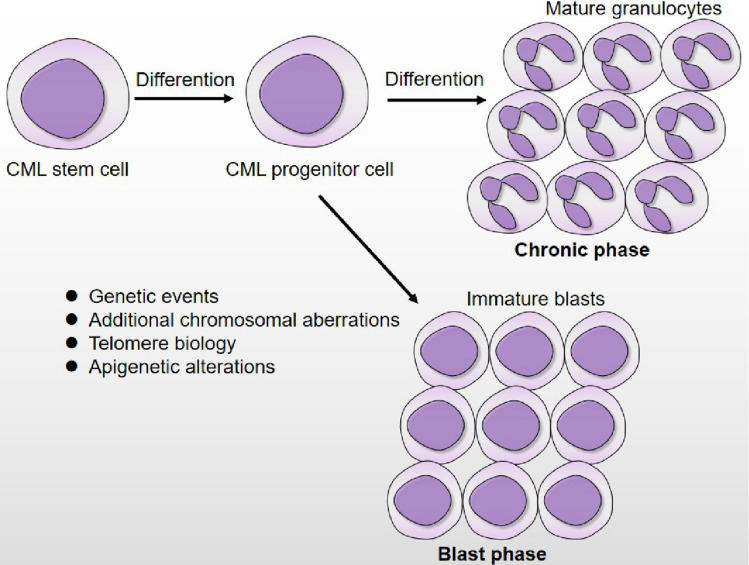
Chronic myeloid leukemia (CML) is triggered primarily by the t(9;22) (q34.13; q11.23) translocation. This reciprocal chromosomal translocation leads to the formation of the BCR-ABL fusion gene. Patients in the chronic phase (CP) experience a good curative effect with tyrosine kinase inhibitors. However, cases are treatment refractory, with a dismal prognosis, when the disease has progressed to the accelerated phase (AP) or blast phase (BP). Until now, few reports have provided a comprehensive description of the mechanisms involved at different molecular levels. Indeed, the underlying pathogenesis of CML evolution comprises genetic aberrations, chromosomal translocations (except for the Philadelphia chromosome), telomere biology, and epigenetic anomalies. Herein, we provide knowledge of the biology responsible for blast transformation of CML at several levels, such as genetics, telomere biology, and epigenetic anomalies. Because of the limited treatment options available and poor outcomes, only the therapeutic response is monitored regularly, which involves BCR-ABL transcript level assessment and immunologic surveillance, with the optimal treatment strategy for patients in CP adapted to evaluate disease recurrence or progression. Overall, selecting optimal treatment endpoints to predict survival and successful TFR improves the quality of life of patients. Thus, identifying risk factors and developing risk-adapted therapeutic options may contribute to a better outcome for advanced-phase patients.
慢性髓性白血病(CML)主要由t(9;22) (q34.13; q11.23)易位引发。这种相互的染色体易位导致BCR-ABL融合基因的形成。慢性期(CP)患者使用酪氨酸激酶抑制剂疗效良好。然而,当疾病进展到加速期(AP)或急变期(BP)时,病例治疗难治,预后不佳。到目前为止,很少有报告全面描述不同分子水平涉及的机制。事实上,CML进展的潜在发病机制包括基因畸变、染色体易位(除费城染色体外)、端粒生物学和表观遗传异常。在此,我们从遗传学、端粒生物学和表观遗传异常等多个层面提供了有关CML急变转化生物学的知识。由于可用的治疗选择有限且结果不佳,仅定期监测治疗反应,这涉及BCR-ABL转录水平评估和免疫监测,并调整CP期患者的最佳治疗策略以评估疾病复发或进展。总体而言,选择最佳治疗终点以预测生存和成功的无治疗缓解(TFR)可提高患者生活质量。因此,识别风险因素并制定适应风险的治疗选择可能有助于改善晚期患者的预后。