Lewandrowski Wolfgang, Stevens Jason C, Webber Bruce L, L Dalziell Emma, Trudgen Melinda S, Bateman Amber M, Erickson Todd E
Kings Park Science Department of Biodiversity, Conservation and Attractions Kings Park Western Australia Australia.
School of Biological Sciences The University of Western Australia Crawley Western Australia Australia.
Ecol Evol. 2021 May 11;11(12):8071-8084. doi: 10.1002/ece3.7638. eCollection 2021 Jun.
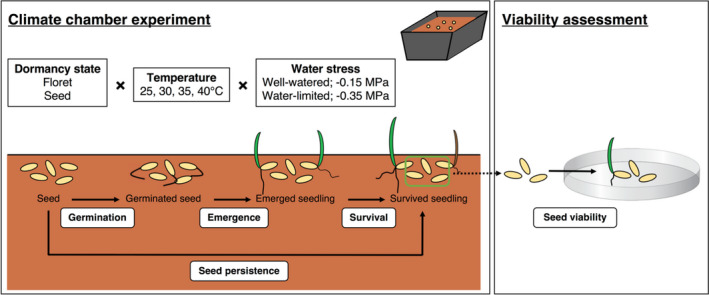
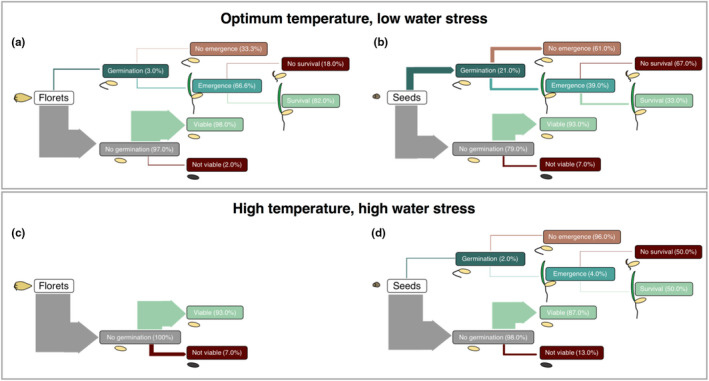
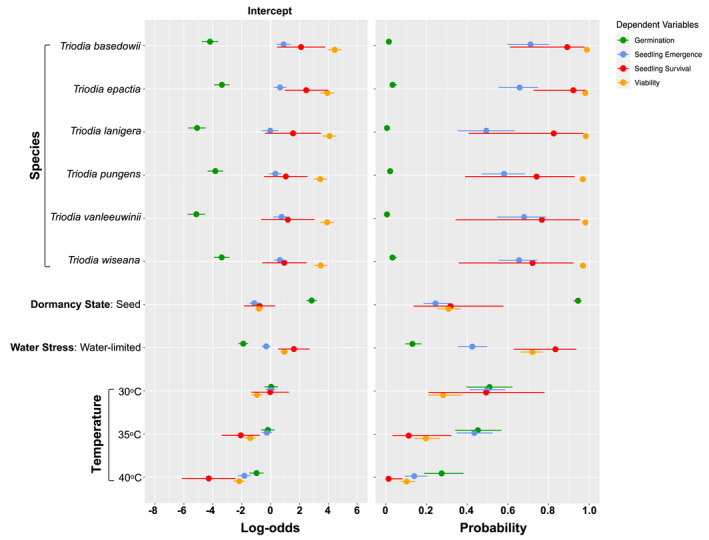
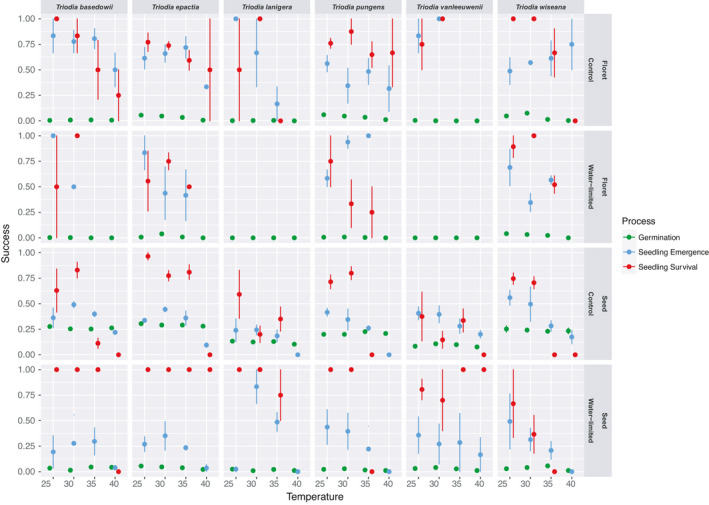
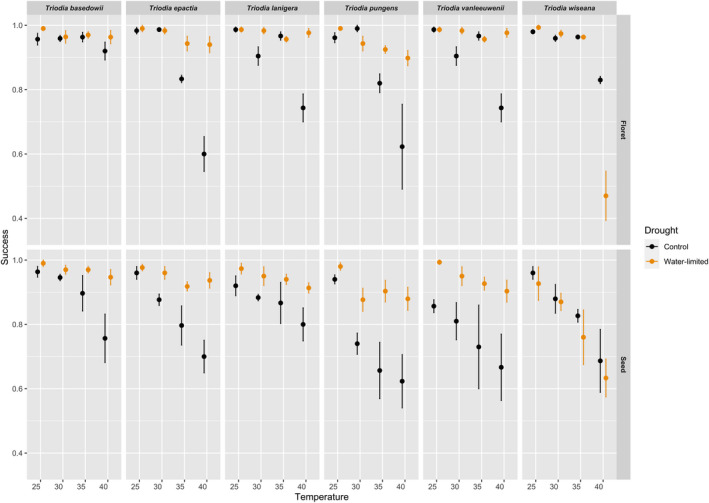
Recruitment for many arid-zone plant species is expected to be impacted by the projected increase in soil temperature and prolonged droughts associated with global climate change. As seed dormancy is considered a strategy to avoid unfavorable conditions, understanding the mechanisms underpinning vulnerability to these factors is critical for plant recruitment in intact communities, as well as for restoration efforts in arid ecosystems. This study determined the effects of temperature and water stress on recruitment processes in six grass species in the genus R.Br. from the Australian arid zone. Experiments in controlled environments were conducted on dormant and less-dormant seeds at constant temperatures of 25°C, 30°C, 35°C, and 40°C, under well-watered (Ψ = -0.15 MPa) and water-limited (Ψ = -0.35 MPa) conditions. Success at three key recruitment stages-seed germination, emergence, and survival-and final seed viability of ungerminated seeds was assessed. For all species, less-dormant seeds germinated to higher proportions under all conditions; however, subsequent seedling emergence and survival were higher in the more dormant seed treatment. An increase in temperature (35-40°C) under water-limited conditions caused 95%-100% recruitment failure, regardless of the dormancy state. Ungerminated seeds maintained viability in dry soil; however, when exposed to warm (30-40°C) and well-watered conditions, loss of viability was greater from the less-dormant seeds across all species. This work demonstrates that the transition from seed to established seedling is highly vulnerable to microclimatic constraints and represents a critical filter for plant recruitment in the arid zone. As we demonstrate temperature and water stress-driven mortality between seeds and established seedlings, understanding how these factors influence recruitment in other arid-zone species should be a high priority consideration for management actions to mitigate the impacts of global change on ecosystem resilience. The knowledge gained from these outcomes must be actively incorporated into restoration initiatives.
预计许多干旱地区植物物种的更新将受到土壤温度预计升高以及与全球气候变化相关的长期干旱的影响。由于种子休眠被认为是一种避免不利条件的策略,了解这些因素影响下的脆弱性机制对于完整群落中的植物更新以及干旱生态系统的恢复工作至关重要。本研究确定了温度和水分胁迫对澳大利亚干旱地区R.Br.属六种草本植物更新过程的影响。在可控环境中,对休眠和休眠程度较低的种子在25°C、30°C、35°C和40°C的恒定温度下,在水分充足(Ψ = -0.15 MPa)和水分受限(Ψ = -0.35 MPa)条件下进行了实验。评估了三个关键更新阶段——种子萌发、出土和存活——以及未萌发种子的最终种子活力。对于所有物种,休眠程度较低的种子在所有条件下萌发比例更高;然而,在种子休眠程度更高的处理中,随后的幼苗出土和存活情况更好。在水分受限条件下温度升高(35-40°C)导致95%-100%的更新失败,无论休眠状态如何。未萌发种子在干燥土壤中保持活力;然而,当暴露于温暖(30-40°C)和水分充足的条件下时,所有物种中休眠程度较低的种子活力丧失更大。这项工作表明,从种子到成苗的转变极易受到微气候限制的影响,并且是干旱地区植物更新的关键筛选环节。由于我们证明了种子和成苗之间温度和水分胁迫导致死亡,了解这些因素如何影响其他干旱地区物种的更新应该是管理行动减轻全球变化对生态系统恢复力影响的高度优先考虑事项。从这些结果中获得的知识必须积极纳入恢复计划中。