Jones George, Amoah Joe, Klein Eili Y, Leeman Hannah, Smith Aria, Levin Scott, Milstone Aaron M, Dzintars Kathryn, Cosgrove Sara E, Fabre Valeria
Department of Medicine, Division of Infectious Diseases, Johns Hopkins University School of Medicine, Baltimore, Maryland, USA.
Department of Pediatrics, Division of Infectious Diseases, Johns Hopkins University School of Medicine, Baltimore, Maryland, USA.
Open Forum Infect Dis. 2021 Jun 2;8(6):ofab291. doi: 10.1093/ofid/ofab291. eCollection 2021 Jun.
Community-acquired pneumonia (CAP) is a major driver of hospital antibiotic use. Efficient methods to identify patients treated for CAP in real time using the electronic health record (EHR) are needed. Automated identification of these patients could facilitate systematic tracking, intervention, and feedback on CAP-specific metrics such as appropriate antibiotic choice and duration.
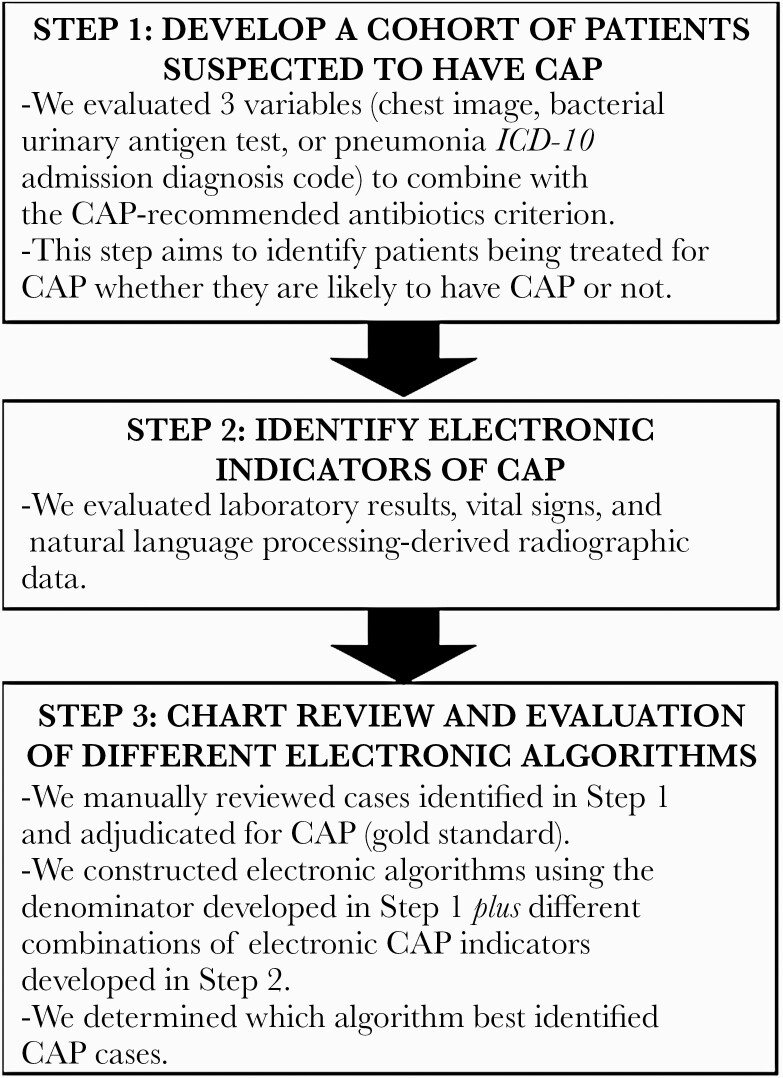
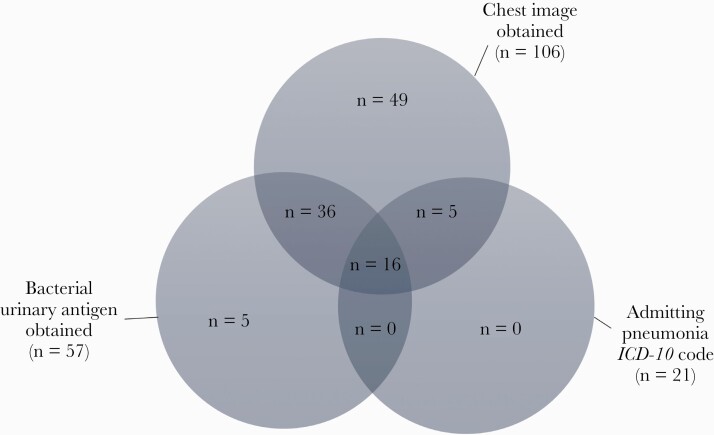
Using retrospective data, we identified suspected CAP cases by searching for patients who received CAP antibiotics AND had an admitting () code for pneumonia OR chest imaging within 24 hours OR bacterial urinary antigen testing within 48 hours of admission (denominator query). We subsequently explored different structured and natural language processing (NLP)-derived data from the EHR to identify CAP cases. We evaluated combinations of these electronic variables through receiver operating characteristic (ROC) curves to assess which best identified CAP cases compared to cases identified by manual chart review. Exclusion criteria were age <18 years, absolute neutrophil count <500 cells/mm, and admission to an oncology unit.
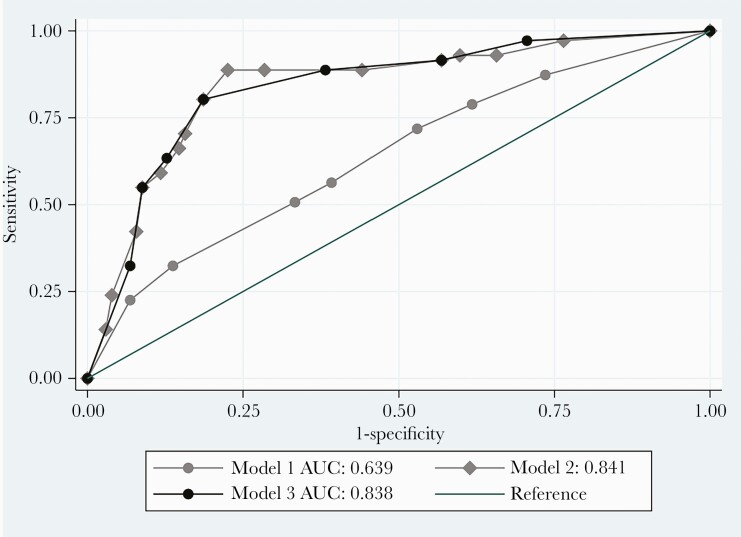
Compared to the gold standard of chart review, the area under the ROC curve to detect CAP was 0.63 (95% confidence interval [CI], .55-.72; .01) using structured data (ie, laboratory and vital signs) and 0.83 (95% CI, .77-.90; .01) when NLP-derived data from radiographic reports were included. The sensitivity and specificity of the latter model were 80% and 81%, respectively.
Creating an electronic tool that effectively identifies CAP cases in real time is possible, but its accuracy is dependent on NLP-derived radiographic data.
社区获得性肺炎(CAP)是医院抗生素使用的主要驱动因素。需要有效的方法利用电子健康记录(EHR)实时识别接受CAP治疗的患者。自动识别这些患者有助于对CAP特定指标(如适当的抗生素选择和疗程)进行系统跟踪、干预和反馈。
利用回顾性数据,我们通过搜索接受CAP抗生素治疗且在入院24小时内有肺炎或胸部影像学的入院()代码或入院48小时内进行细菌尿抗原检测的患者来识别疑似CAP病例(分母查询)。随后,我们探索了来自EHR的不同结构化和自然语言处理(NLP)衍生数据以识别CAP病例。我们通过受试者操作特征(ROC)曲线评估这些电子变量的组合,以评估与通过人工病历审查识别的病例相比,哪种组合能最好地识别CAP病例。排除标准为年龄<18岁、绝对中性粒细胞计数<500个细胞/mm以及入住肿瘤科。
与病历审查的金标准相比,使用结构化数据(即实验室检查和生命体征)检测CAP的ROC曲线下面积为0.63(95%置信区间[CI],0.55 - 0.72;P = 0.01),当纳入来自放射学报告的NLP衍生数据时为0.83(95%CI,0.77 - 0.90;P = 0.01)。后一种模型的敏感性和特异性分别为80%和81%。
创建一个能有效实时识别CAP病例的电子工具是可行的,但其准确性取决于NLP衍生的放射学数据。