Division of Child Health, Obstetrics and Gynaecology, School of Medicine, University of Nottingham, Nottingham, UK.
DREEAM: Department of Research and Education in Emergency Medicine, Acute Medicine and Major Trauma, Nottingham University Hospitals NHS Trust, Nottingham, UK.
BMJ Paediatr Open. 2021 Mar 15;5(1):e000967. doi: 10.1136/bmjpo-2020-000967. eCollection 2021.
The SARS-CoV-2 pandemic and initial public health response led to significant changes in health service delivery, access and utilisation. However, SARS-CoV-2 illness burden in children and young people (CYP) is low. To inform effective child public health interventions, we aimed to compare patterns of paediatric emergency department presentation during the initial pandemic response with a previous non-pandemic period.
Retrospective review of attendances (0-18 years) over the initial pandemic (2 March 2020-3 May 2020) compared with 2019. Outcome measures included number of attendances, referral source, presenting complaint, discharge diagnosis and disposal. Descriptive statistics with subgroup analysis by age/sex/ethnicity and pandemic time periods (pre-lockdown, lockdown weeks 1-3 and lockdown weeks 4-6) was performed.
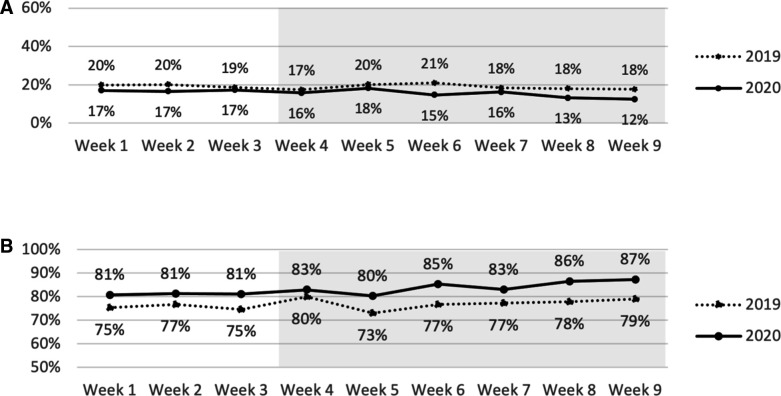
4417 attendances (57% illness and 43% injuries) occurred, compared with 8813 (57% illness and 43% injuries), a reduction of 50%, maximal in lockdown week 2 (-73%). Ranking of top three illness presentations changed across the pandemic weeks. Breathing difficulty dropped from first (300, 25%) to second (117, 21%) to third (59, 11%) (p<0.001). Abdominal pain rose from the third pre-lockdown (87, 7%) and lockdown weeks 1-3 (37, 7%) to second in weeks 4-6 (62, 12%; p=0.004). Fever ranked second (235, 19%) in pre-lockdown and first in weeks 1-3 (134, 24%) and weeks 4-6 (94, 18%; p=0.035).
Despite a 50% reduction, there was no significant change in acuity of illness. Rank of illness presentations changed, with abdominal pain ranking second and fever first, an important change from previous, which should prompt further research into causes. CYP-specific public health messaging and guidance for primary care are required in this second wave to ensure access to appropriate emergency services.
SARS-CoV-2 大流行和最初的公共卫生应对措施导致医疗服务的提供、可及性和使用方式发生了重大变化。然而,儿童和青少年(CYP)的 SARS-CoV-2 疾病负担较低。为了提供有效的儿童公共卫生干预措施,我们旨在比较大流行初期与之前非大流行期间儿科急诊就诊的模式。
回顾性分析 2020 年 3 月 2 日至 5 月 3 日大流行期间(2020 年 3 月 2 日至 5 月 3 日)与 2019 年相比的就诊情况(0-18 岁)。结果包括就诊人数、转诊来源、就诊主诉、出院诊断和处置。按年龄/性别/种族和大流行时间(封锁前、封锁第 1-3 周和封锁第 4-6 周)进行亚组分析,并进行描述性统计。
共发生 4417 例就诊(57%为疾病,43%为损伤),而 2019 年共发生 8813 例就诊(57%为疾病,43%为损伤),减少了 50%,封锁第 2 周最大(减少 73%)。大流行期间,前三种疾病的就诊率发生了变化。呼吸困难从第 1 位(300 例,25%)降至第 2 位(117 例,21%)和第 3 位(59 例,11%)(p<0.001)。腹痛从前封锁(87 例,7%)和封锁第 1-3 周(37 例,7%)升至封锁第 4-6 周(62 例,12%),差异有统计学意义(p=0.004)。发热位居第二(235 例,19%),封锁第 1-3 周(134 例,24%)和封锁第 4-6 周(94 例,18%)位居第一(p=0.035)。
尽管就诊人数减少了 50%,但疾病的严重程度并没有显著变化。疾病的就诊率发生了变化,腹痛排名第二,发热排名第一,这与之前的情况有很大不同,这应该促使我们进一步研究其原因。在这第二波疫情中,需要为 CYP 提供特定的公共卫生信息和初级保健指导,以确保他们能够获得适当的急诊服务。