Pediatric Gastroenterology and Cystic Fibrosis Unit, Department of Human Pathology in Adulthood and Childhood "G. Barresi", University of Messina, 98124 Messina, Italy.
Inflammatory Bowel Disease Unit, "Villa Sofia-Cervello" Hospital, 90146 Palermo, Italy.
Nutrients. 2021 Jun 4;13(6):1928. doi: 10.3390/nu13061928.
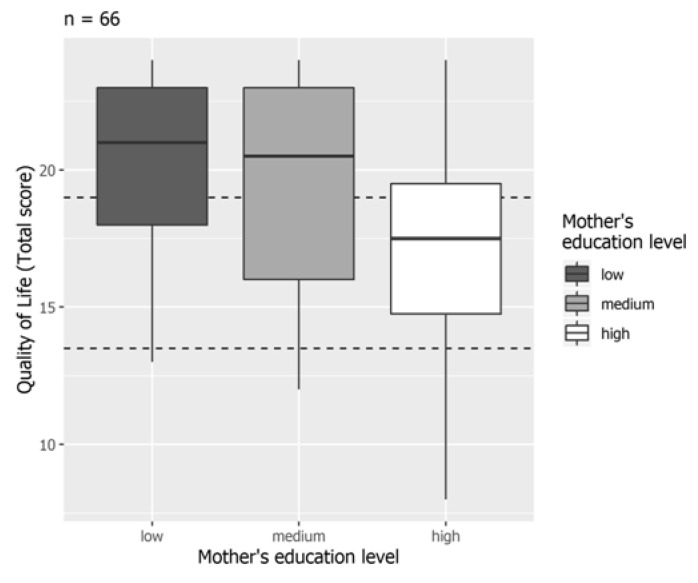
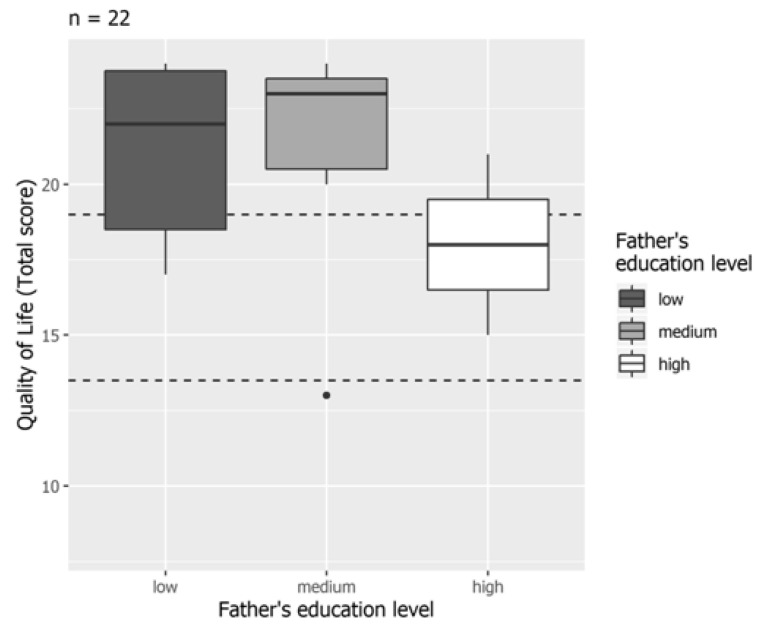
We aimed to investigate the association between caregiver social status and health-related quality of life (HRQoL) in children with neurological impairment (NI) on home enteral nutrition (HEN). This was an ancillary study of a multicenter, cross-sectional study which explored HRQoL in 75 NI children on HEN. All the caregivers from the original cohort were contacted, and data on education level, occupation and marital status were collected. The association between social status and HRQoL was investigated using a multiple Poisson Generalized Linear Model. In total, 93 caregivers were included, responsible for the care of 71 children. The caregivers of four children of the original cohort did not answer the questionnaire. Mothers with high-level education presented lower HRQoL in comparison to mothers with low-level (β: -5.97; 95% CI -11.51, -0.10; = 0.027) or medium-level education (β: 4.85; 95% CI -9.87, 0.53; = 0.044). The analysis of the subgroup of cases in which the main caregiver was represented by both parents gave similar findings, with education level of the father being negatively correlated with HRQoL. Our data showed that higher education level may negatively affect quality of life of caregivers of NI children. This could be helpful in identifying at-risk families and addressing supportive efforts.
我们旨在研究照顾者社会地位与接受家庭肠内营养(HEN)的神经发育障碍(NI)儿童健康相关生活质量(HRQoL)之间的关系。这是一项多中心、横断面研究的辅助研究,该研究探讨了 75 名接受 HEN 的 NI 儿童的 HRQoL。联系了原始队列中的所有照顾者,并收集了教育程度、职业和婚姻状况的数据。使用多泊松广义线性模型研究了社会地位与 HRQoL 之间的关系。共纳入 93 名照顾者,负责照顾 71 名儿童。原始队列中有 4 名儿童的母亲未回答问卷。与低水平(β:-5.97;95%CI-11.51,-0.10;P=0.027)或中等水平(β:4.85;95%CI-9.87,0.53;P=0.044)教育程度的母亲相比,高水平教育程度的母亲 HRQoL 较低。对主要照顾者由父母双方代表的病例亚组的分析得出了类似的结果,父亲的教育程度与 HRQoL 呈负相关。我们的数据表明,较高的教育程度可能会对 NI 儿童照顾者的生活质量产生负面影响。这有助于识别高危家庭并提供支持。