Shirai Yukari, Chow Christalle C T, Kambe Gouki, Suwa Tatsuya, Kobayashi Minoru, Takahashi Itsuki, Harada Hiroshi, Nam Jin-Min
Laboratory of Cancer Cell Biology, Graduate School of Biostudies, Kyoto University, Yoshida-Konoe-Cho, Sakyo-Ku, Kyoto 606-8501, Japan.
Department of Genome Repair Dynamics, Radiation Biology Center, Graduate School of Biostudies, Kyoto University, Yoshida-Konoe-Cho, Sakyo-Ku, Kyoto 606-8501, Japan.
Cancers (Basel). 2021 Jun 4;13(11):2813. doi: 10.3390/cancers13112813.
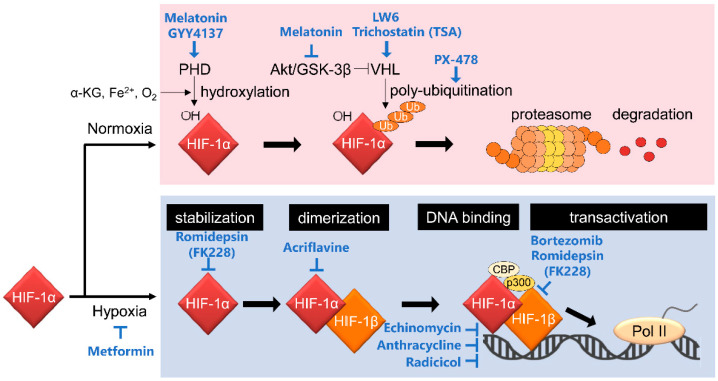
Hypoxia, a characteristic feature of solid tumors, is associated with the malignant phenotype and therapy resistance of cancers. Hypoxia-inducible factor 1 (HIF-1), which is responsible for the metazoan adaptive response to hypoxia, has been recognized as a rational target for cancer therapy due to its critical functions in hypoxic regions. In order to efficiently inhibit its activity, extensive efforts have been made to elucidate the molecular mechanism underlying the activation of HIF-1. Here, we provide an overview of relevant research, particularly on a series of HIF-1 activators identified so far and the development of anticancer drugs targeting them.
缺氧是实体瘤的一个特征性表现,与癌症的恶性表型和治疗抗性相关。缺氧诱导因子1(HIF-1)负责后生动物对缺氧的适应性反应,因其在缺氧区域的关键功能,已被公认为癌症治疗的合理靶点。为了有效抑制其活性,人们已付出大量努力来阐明HIF-1激活背后的分子机制。在此,我们提供相关研究的综述,特别是关于迄今已鉴定出的一系列HIF-1激活剂以及针对它们的抗癌药物的研发情况。