Brasher Mandy, Raffay Thomas M, Cunningham M Douglas, Abu Jawdeh Elie G
Department of Pediatrics/Neonatology, College of Medicine, University of Kentucky, Lexington, KY 40506, USA.
Department of Pediatrics/Neonatology, College of Medicine, Case Western Reserve University, Cleveland, OH 44106, USA.
Children (Basel). 2021 Jun 10;8(6):493. doi: 10.3390/children8060493.
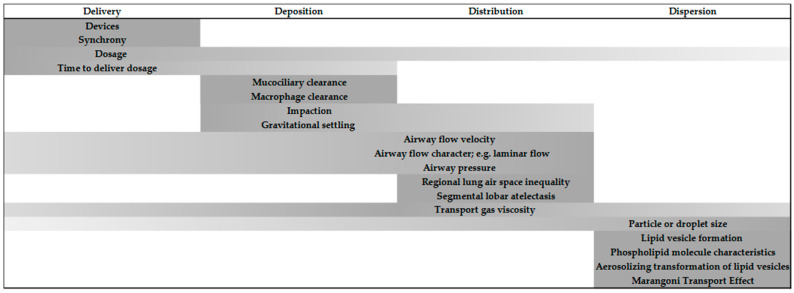
Currently, the administration of surfactant to preterm infants with respiratory distress syndrome (RDS) mainly relies on intratracheal instillation; however, there is increasing evidence of aerosolized surfactant being an effective non-invasive strategy. We present a historical narrative spanning sixty years of development of aerosolization systems. We also offer an overview of the pertinent mechanisms needed to create and manage the ideal aerosolization system, with a focus on delivery, distribution, deposition, and dispersion in the context of the human lung. More studies are needed to optimize treatment with aerosolized surfactants, including determination of ideal dosages, nebulizer types, non-invasive interfaces, and breath synchronization. However, the field is rapidly evolving, and widespread clinical use may be achieved in the near future.
目前,给患有呼吸窘迫综合征(RDS)的早产儿使用表面活性剂主要依靠气管内滴注;然而,越来越多的证据表明雾化表面活性剂是一种有效的非侵入性策略。我们呈现了一段跨越六十年的雾化系统发展历程。我们还概述了创建和管理理想雾化系统所需的相关机制,重点关注在人体肺部环境下的输送、分布、沉积和扩散。需要更多研究来优化雾化表面活性剂的治疗,包括确定理想剂量、雾化器类型、非侵入性接口和呼吸同步。然而,该领域正在迅速发展,在不久的将来可能会实现广泛的临床应用。