Henriksen Tove, Staines Harry
Department of Neurology, University Hospital of Bispebjerg, 2400 Copenhagen, Denmark.
Sigma Statistical Services, Balmullo KY16 0BD, UK.
J Pers Med. 2021 Jun 8;11(6):525. doi: 10.3390/jpm11060525.
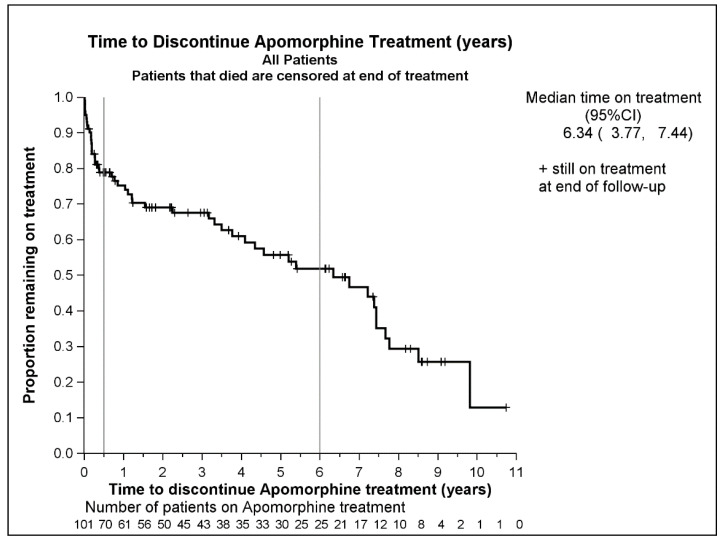
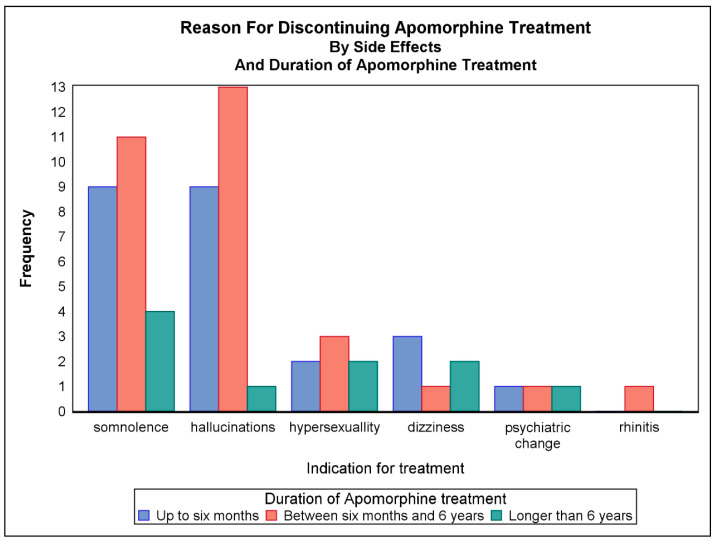
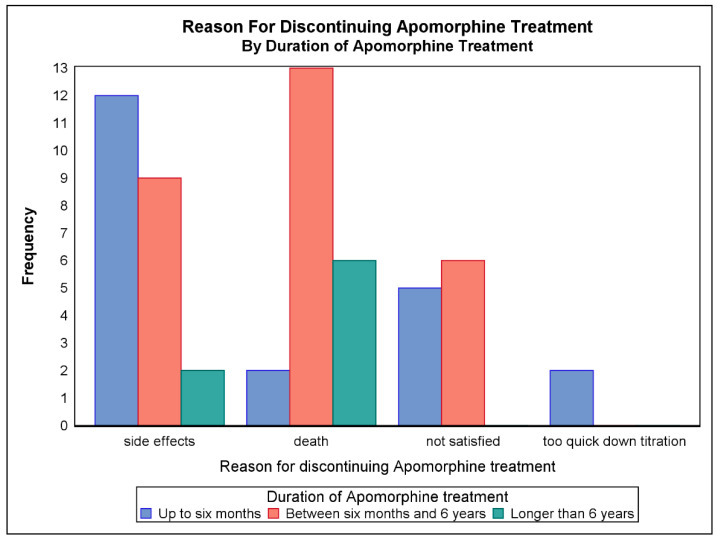
(1) Background: Subcutaneous apomorphine infusion (SCAI) is one of the three main treatment options for motor fluctuations in advanced Parkinson's disease (PD). The adherence to SCAI is generally considered to be low due to adverse events and because it is perceived as a treatment option to be used for a limited period only. We evaluated the reasons for discontinuation of SCAI in relation to when patients stopped treatment. (2) Methods: We reviewed the medical records of PD patients treated with SCAI at a single center, capturing patient demographics and the reasons for cessation of SCAI. (3) Results: 101 patients were included in the analysis, with a median time on treatment of 6.34 years. The main reasons for stopping SCAI were adverse events, death, and dissatisfaction with treatment. In the first 6 years of treatment, the predominant side effects leading to discontinuation were somnolence and hallucinations. (4) Conclusions: We suggest that SCAI can be an effective long-term treatment option for advanced PD, but it requires careful patient selection, a high level of communication with the patient and carer, and rigorous monitoring of the effects of treatment and for any adverse events so they can be promptly managed.
(1) 背景:皮下注射阿扑吗啡输注(SCAI)是晚期帕金森病(PD)运动波动的三种主要治疗选择之一。由于不良事件以及它被认为只是一种仅在有限时期使用的治疗选择,SCAI的依从性通常被认为较低。我们评估了与患者停止治疗时间相关的SCAI停药原因。(2) 方法:我们回顾了在单一中心接受SCAI治疗的PD患者的病历,记录患者人口统计学信息以及SCAI停药原因。(3) 结果:101例患者纳入分析,治疗时间中位数为6.34年。停止SCAI的主要原因是不良事件、死亡以及对治疗不满意。在治疗的前6年,导致停药的主要副作用是嗜睡和幻觉。(4) 结论:我们认为SCAI可以是晚期PD一种有效的长期治疗选择,但它需要仔细选择患者,与患者及护理人员进行高度沟通,并且严格监测治疗效果及任何不良事件,以便能及时处理。