Mayrhofer Nicola, Velicer Gregory J, Schaal Kaitlin A, Vasse Marie
Institute of Integrative Biology, ETH Zürich, Universitätstrasse 16, 8092 Zürich, Switzerland.
MIVEGEC (UMR 5290 CNRS, IRD, UM), CNRS, 34394 Montpellier, France.
Microorganisms. 2021 Jun 23;9(7):1362. doi: 10.3390/microorganisms9071362.
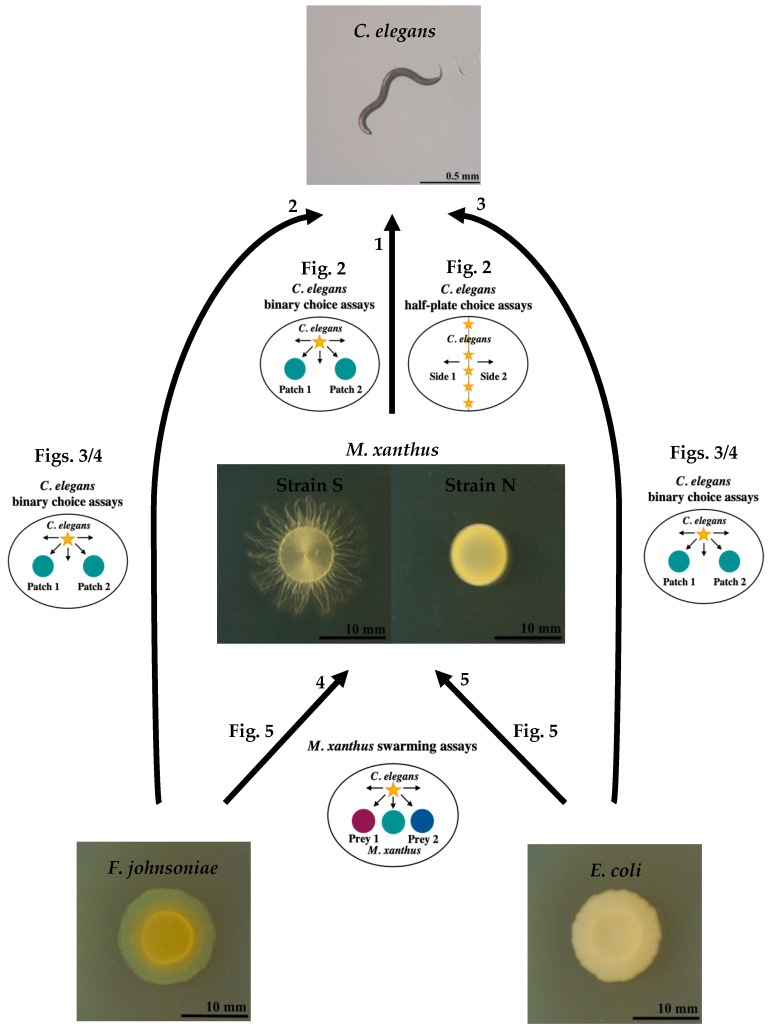
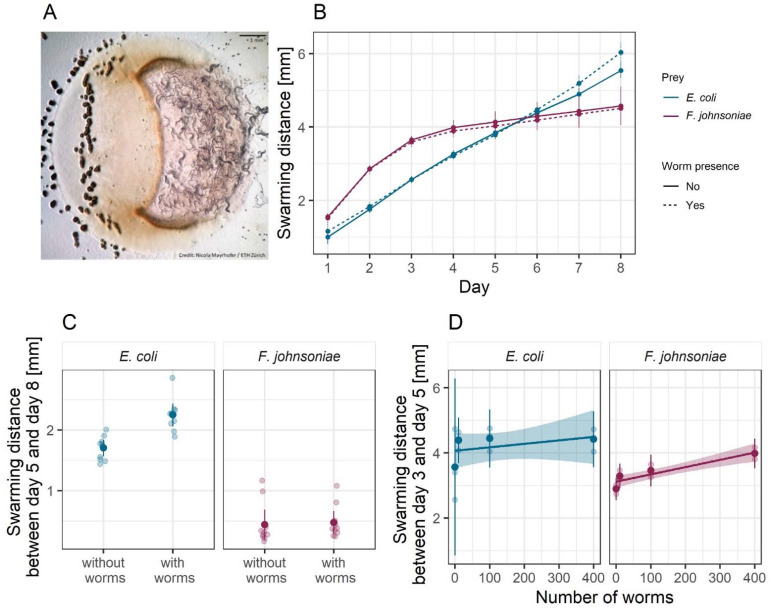
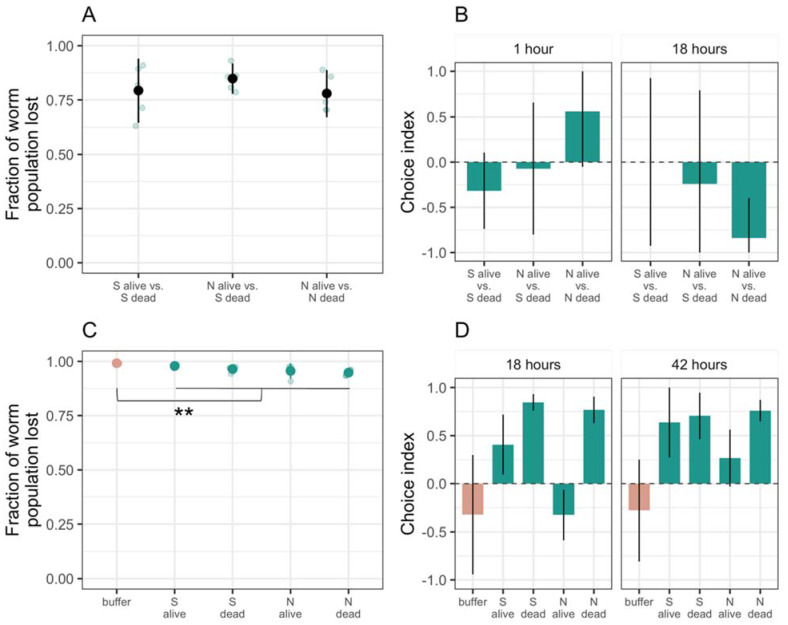
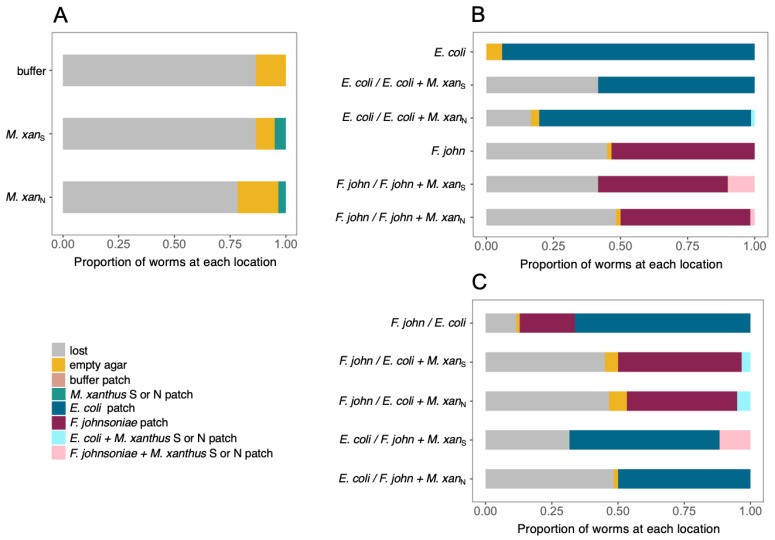
Theory and empirical studies in metazoans predict that apex predators should shape the behavior and ecology of mesopredators and prey at lower trophic levels. Despite the ecological importance of microbial communities, few studies of predatory microbes examine such behavioral res-ponses and the multiplicity of trophic interactions. Here, we sought to assemble a three-level microbial food chain and to test for behavioral interactions between the predatory nematode and the predatory social bacterium when cultured together with two basal prey bacteria that both predators can eat- and . We found that >90% of worms failed to interact with even when it was the only potential prey species available, whereas most worms were attracted to pure patches of and In addition, altered nematode predatory behavior on basal prey, repelling from two-species patches that would be attractive without , an effect similar to that of pathogens. The nematode also influenced the behavior of the bacterial predator: increased its predatory swarming rate in response to in a manner dependent both on basal-prey identity and on worm density. Our results suggest that is an unattractive prey for some soil nematodes and is actively avoided when other prey are available. Most broadly, we found that nematode and bacterial predators mutually influence one another's predatory behavior, with likely consequences for coevolution within complex microbial food webs.
后生动物的理论和实证研究预测,顶级捕食者应该会塑造较低营养级的中捕食者和猎物的行为及生态。尽管微生物群落具有生态重要性,但很少有关于捕食性微生物的研究考察此类行为反应以及营养相互作用的多样性。在此,我们试图构建一个三级微生物食物链,并测试捕食性线虫与捕食性群居细菌在与两种它们都能捕食的基础猎物细菌—— 和 一起培养时的行为相互作用。我们发现,即使 是唯一可用的潜在猎物物种,超过90%的线虫也未能与它相互作用,而大多数线虫被 和 的纯斑块所吸引。此外, 改变了线虫对基础猎物的捕食行为,将 从没有 时具有吸引力的双物种斑块中驱离,这种效应类似于 病原体的效应。线虫也影响了细菌捕食者的行为: 以一种既依赖于基础猎物种类又依赖于线虫密度的方式,响应 增加了其捕食性群体运动速率。我们的结果表明, 对一些土壤线虫来说是没有吸引力的猎物,当有其他猎物时会被主动避开。最广泛地说,我们发现线虫和细菌捕食者相互影响彼此的捕食行为,这可能对复杂微生物食物网中的共同进化产生影响。