Laboratory of Biochemical Neuroendocrinology Montreal Clinical Research Institute, University of Montreal, Montreal, QC H2W1R7, Canada.
Antonella Pasquato, Department of Industrial Engineering, University of Padova, Via Marzolo 9, 35131 Padova, Italy.
Viruses. 2021 Jun 25;13(7):1229. doi: 10.3390/v13071229.
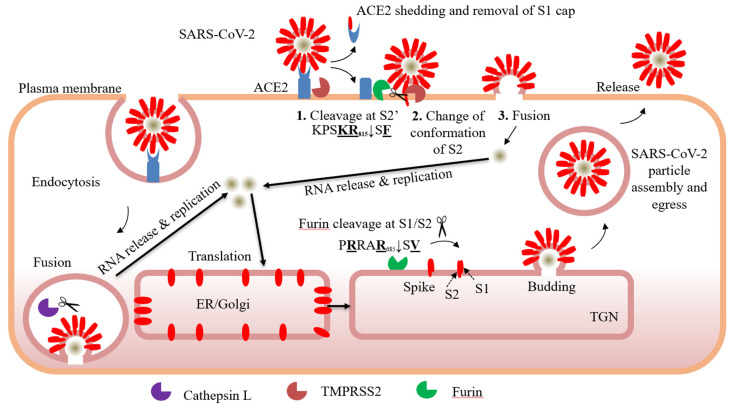
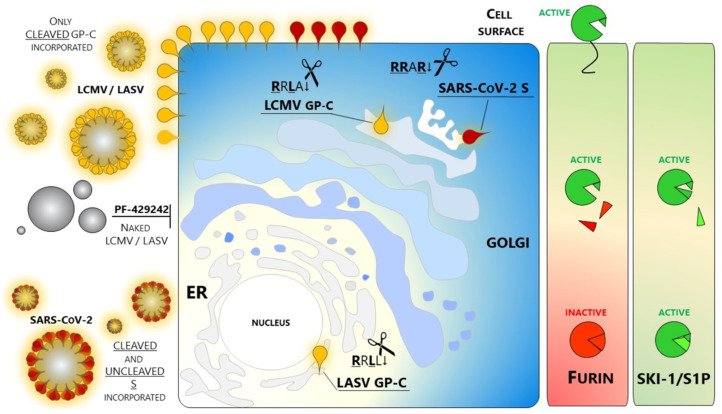
Inhibition of the binding of enveloped viruses surface glycoproteins to host cell receptor(s) is a major target of vaccines and constitutes an efficient strategy to block viral entry and infection of various host cells and tissues. Cellular entry usually requires the fusion of the viral envelope with host plasma membranes. Such entry mechanism is often preceded by "priming" and/or "activation" steps requiring limited proteolysis of the viral surface glycoprotein to expose a fusogenic domain for efficient membrane juxtapositions. The 9-membered family of Proprotein Convertases related to Subtilisin/Kexin (PCSK) serine proteases (PC1, PC2, Furin, PC4, PC5, PACE4, PC7, SKI-1/S1P, and PCSK9) participate in post-translational cleavages and/or regulation of multiple secretory proteins. The type-I membrane-bound Furin and SKI-1/S1P are the major convertases responsible for the processing of surface glycoproteins of enveloped viruses. has considerably contributed to define the role of SKI-1/S1P in the activation of arenaviruses causing hemorrhagic fever. Furin was recently implicated in the activation of the spike S-protein of SARS-CoV-2 and Furin-inhibitors are being tested as antivirals in COVID-19. Other members of the PCSK-family are also implicated in some viral infections, such as PCSK9 in Dengue. Herein, we summarize the various functions of the PCSKs and present arguments whereby their inhibition could represent a powerful arsenal to limit viral infections causing the present and future pandemics.
抑制包膜病毒表面糖蛋白与宿主细胞受体的结合是疫苗的主要靶点,也是阻止各种宿主细胞和组织中病毒进入和感染的有效策略。细胞进入通常需要病毒包膜与宿主质膜融合。这种进入机制通常需要“引发”和/或“激活”步骤,需要对病毒表面糖蛋白进行有限的蛋白水解,以暴露用于有效膜并列的融合结构域。与枯草杆菌蛋白酶/胰凝乳蛋白酶相关的 9 种前蛋白转化酶(PCSK)丝氨酸蛋白酶(PC1、PC2、Furin、PC4、PC5、PACE4、PC7、SKI-1/S1P 和 PCSK9)参与多种分泌蛋白的翻译后切割和/或调节。Ⅰ型跨膜结合的 Furin 和 SKI-1/S1P 是负责包膜病毒表面糖蛋白加工的主要转化酶。SKI-1/S1P 在引起出血热的沙粒病毒激活中的作用得到了充分的证实。Furin 最近被牵连到 SARS-CoV-2 的刺突 S 蛋白的激活中,并且正在研究 Furin 抑制剂作为 COVID-19 的抗病毒药物。PCSK 家族的其他成员也与一些病毒感染有关,如登革热中的 PCSK9。本文总结了 PCSKs 的各种功能,并提出了抑制 PCSKs 可能是限制当前和未来大流行引起的病毒感染的有力武器的论点。