Čižman Milan, Mioč Verica, Bajec Tom, Paragi Metka, Kastrin Tamara, Gonçalves José
Department of Infectious Diseases, University Medical Centre, 1000 Ljubljana, Slovenia.
Department for Public Health Microbiology, National Laboratory of Health, Environment and Food, 1000 Ljubljana, Slovenia.
Antibiotics (Basel). 2021 Jun 22;10(7):758. doi: 10.3390/antibiotics10070758.
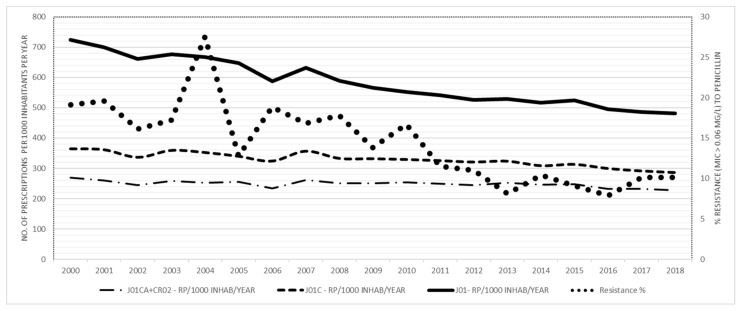
There is a lack of long-term studies that correlate different metrics of antibiotic consumption and resistance of invasive The present study aims to investigate the correlation between national outpatients total antibiotic, penicillin and broad spectrum penicillins consumption expressed in daily doses per 1000 inhabitants per day (DID) with the ATC/DDDs, WHO version of 2019 (new version) and 2018 (old version), number of prescriptions per 1000 inhabitants per year (RxIDs) and number of packages per 1000 inhabitant per day (PIDs) with the resistance of invasive in Slovenia in the period from 2000 to 2018. The prevalence of penicillin resistance of invasive decreased by 47.13%, from 19.1% to 10.1%. Decline of resistance showed the highest correlation (R = 0.86) between RxIDs followed by PID (R = 0.85) and resistance of . Higher correlation between total use of antibiotics expressed in DID WHO version 2019 (R = 0.80) than for WHO version 2018 (R = 0.78) was found. Very high (R = 0.84) correlation between use of β-lactams expressed in PID, and RxIDs (R = 0.82) and reasonable (R = 0.59) correlation expressed in DIDs version 2019 was shown as well. The consumption of broad -spectrum penicillins (J01CA and J01CR02) expressed in PID (R = 0.72) and RxIDs (0.57) correlated significantly with the resistance of as well. A new finding of this study is that RxIDs correlated better with the resistance of than total consumption of antibiotics expressed in DID and significant correlations exist between use of broad-spectrum penicillins expressed in PID and RxIDs.
目前缺乏将侵袭性感染的抗生素使用不同指标与耐药性相关联的长期研究。本研究旨在调查2000年至2018年期间,斯洛文尼亚每1000居民每天的日剂量(DID)表示的全国门诊患者总抗生素、青霉素和广谱青霉素消费量与2019年(新版本)和2018年(旧版本)世界卫生组织版本的ATC/DDDs、每年每1000居民的处方数(RxIDs)以及每天每1000居民的包装数(PIDs)与侵袭性感染的耐药性之间的相关性。侵袭性感染的青霉素耐药率从19.1%下降到10.1%,下降了47.13%。耐药性下降与RxIDs之间的相关性最高(R = 0.86),其次是PID(R = 0.85)与感染的耐药性。发现2019年世界卫生组织版本以DID表示的抗生素总使用量之间的相关性(R = 0.80)高于2018年世界卫生组织版本(R = 0.78)。以PID表示的β-内酰胺类药物使用量与RxIDs(R = 0.82)之间的相关性非常高(R = 0.84),2019年版本以DIDs表示的相关性也合理(R = 0.59)。以PID(R = 0.72)和RxIDs(0.57)表示的广谱青霉素(J01CA和J01CR02)消费量也与感染的耐药性显著相关。本研究的一个新发现是,RxIDs与感染的耐药性的相关性优于以DID表示的抗生素总消费量,并且以PID和RxIDs表示的广谱青霉素使用量之间存在显著相关性。