Chi Alexander, He Xia, Hou Lin, Nguyen Nam P, Zhu Guangying, Cameron Robert B, Lee Jay M
Department of Radiation Oncology, Beijing Chest Hospital, Capital Medical University, Beijing 101100, China.
Department of Radiation Oncology, Jiangsu Cancer Hospital, Nanjing Medical University, Nanjing 210009, China.
Cancers (Basel). 2021 Jun 11;13(12):2924. doi: 10.3390/cancers13122924.
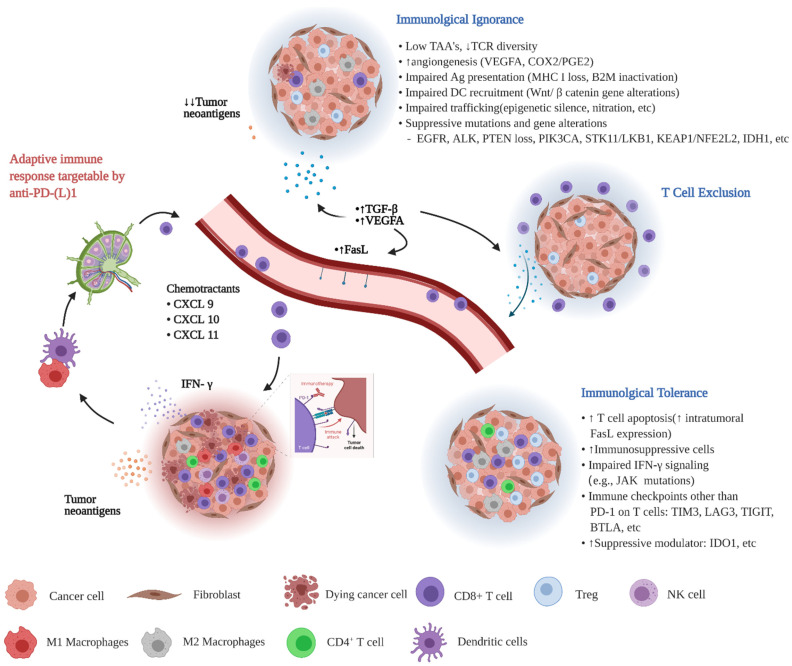
Immune checkpoint blockade (ICB) with checkpoint inhibitors has led to significant and durable response in a subset of patients with advanced stage EGFR and ALK wild-type non-small cell lung cancer (NSCLC). This has been consistently shown to be correlated with the unique characteristics of each patient's tumor immune micro-environment (TIME), including the composition and distribution of the tumor immune cell infiltrate; the expression of various checkpoints by tumor and immune cells, such as PD-L1; and the presence of various cytokines and chemokines. In this review, the classification of various types of TIME that are present in NSCLC and their correlation with response to ICB in NSCLC are discussed. This is conducted with a focus on the characteristics and identifiable biomarkers of different TIME subtypes that may also be used to predict NSCLC's clinical response to ICB. Finally, treatment strategies to augment response to ICB in NSCLC with unresponsive types of TIME are explored.
使用检查点抑制剂进行免疫检查点阻断(ICB)已在一部分晚期表皮生长因子受体(EGFR)和间变性淋巴瘤激酶(ALK)野生型非小细胞肺癌(NSCLC)患者中产生了显著且持久的反应。这一直被证明与每位患者肿瘤免疫微环境(TIME)的独特特征相关,包括肿瘤免疫细胞浸润的组成和分布;肿瘤细胞和免疫细胞上各种检查点的表达,如程序性死亡受体配体1(PD-L1);以及各种细胞因子和趋化因子的存在。在这篇综述中,讨论了NSCLC中存在的各种类型TIME的分类及其与NSCLC对ICB反应的相关性。重点关注不同TIME亚型的特征和可识别生物标志物,这些也可用于预测NSCLC对ICB的临床反应。最后,探讨了针对无反应性TIME类型增强NSCLC对ICB反应的治疗策略。