Kemmner Stephan, Holzmann-Littig Christopher, Sandberger Helene, Bachmann Quirin, Haberfellner Flora, Torrez Carlos, Schmaderer Christoph, Heemann Uwe, Renders Lutz, Assfalg Volker, El-Achkar Tarek M, Garimella Pranav S, Scherberich Jürgen, Steubl Dominik
Department of Nephrology, Klinikum rechts der Isar, Technical University of Munich, 81675 Munich, Germany.
Transplant Center, University Hospital Munich, Ludwig-Maximilians-University (LMU), 81377 Munich, Germany.
J Clin Med. 2021 Jun 11;10(12):2586. doi: 10.3390/jcm10122586.
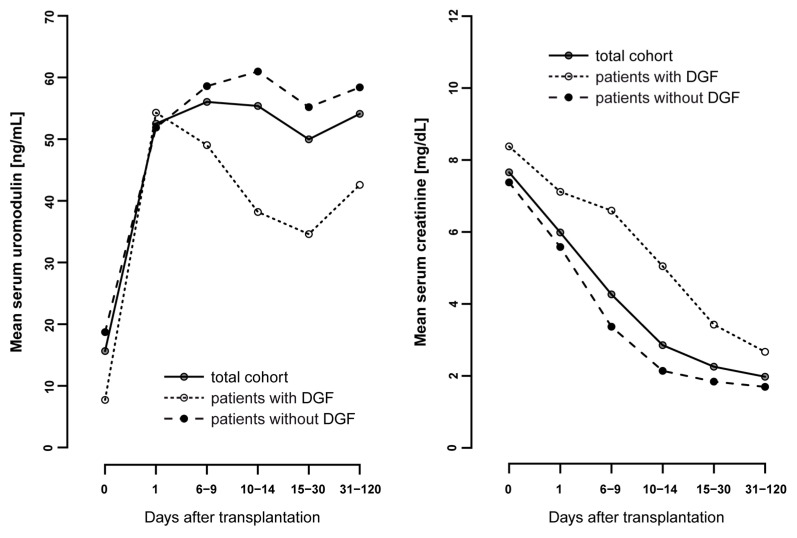
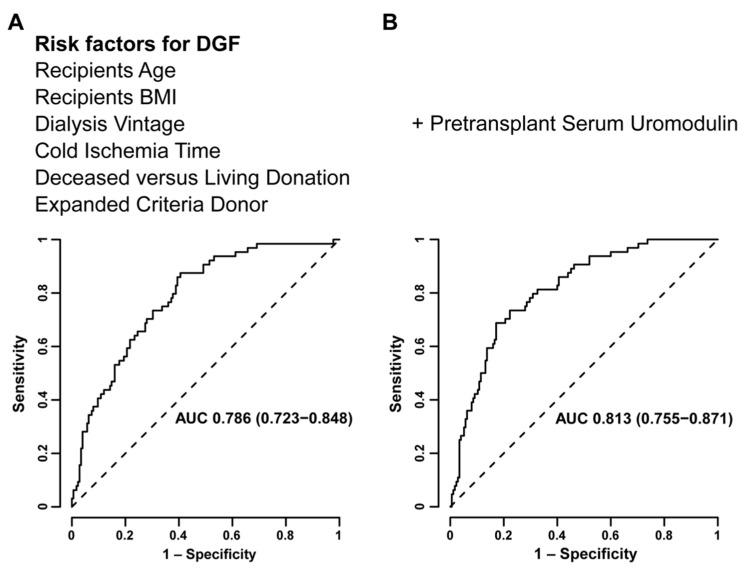
Delayed graft function (DGF) following kidney transplantation is associated with increased risk of graft failure, but biomarkers to predict DGF are scarce. We evaluated serum uromodulin (sUMOD), a potential marker for tubular integrity with immunomodulatory capacities, in kidney transplant recipients and its association with DGF. We included 239 kidney transplant recipients and measured sUMOD pretransplant and on postoperative Day 1 (POD1) as independent variables. The primary outcome was DGF, defined as need for dialysis within one week after transplantation. In total, 64 patients (27%) experienced DGF. In multivariable logistic regression analysis adjusting for recipient, donor and transplant associated risk factors each 10 ng/mL higher pretransplant sUMOD was associated with 47% lower odds for DGF (odds ratio (OR) 0.53, 95% confidence interval (95%-CI) 0.30-0.82). When categorizing pretransplant sUMOD into quartiles, the quartile with the lowest values had 4.4-fold higher odds for DGF compared to the highest quartile (OR 4.41, 95%-CI 1.54-13.93). Adding pretransplant sUMOD to a model containing established risk factors for DGF in multivariable receiver-operating-characteristics (ROC) curve analysis, the area-under-the-curve improved from 0.786 [95%-CI 0.723-0.848] to 0.813 [95%-CI 0.755-0.871, = 0.05]. SUMOD on POD1 was not associated with DGF. In conclusion, higher pretransplant sUMOD was independently associated with lower odds for DGF, potentially serving as a non-invasive marker to stratify patients according to their risk for developing DGF early in the setting of kidney transplantation.
肾移植后的移植肾功能延迟恢复(DGF)与移植失败风险增加相关,但预测DGF的生物标志物稀缺。我们评估了肾移植受者血清尿调节蛋白(sUMOD),这是一种具有免疫调节能力的肾小管完整性潜在标志物,并研究了其与DGF的关联。我们纳入了239名肾移植受者,测量移植前和术后第1天(POD1)的sUMOD作为自变量。主要结局是DGF,定义为移植后一周内需要透析。共有64例患者(27%)发生DGF。在多变量逻辑回归分析中,校正受者、供者和移植相关风险因素后,移植前sUMOD每升高10 ng/mL,DGF的发生几率降低47%(比值比(OR)0.53,95%置信区间(95%-CI)0.30-0.82)。将移植前sUMOD分为四分位数时,与最高四分位数相比,最低值四分位数发生DGF的几率高4.4倍(OR 4.41,95%-CI 1.54-13.93)。在多变量受试者工作特征(ROC)曲线分析中,将移植前sUMOD添加到包含已确立的DGF风险因素的模型中,曲线下面积从0.786 [95%-CI 0.723-0.848]提高到0.813 [95%-CI 0.755-0.871,P = 0.05]。POD1时的sUMOD与DGF无关。总之,移植前较高的sUMOD与较低的DGF发生几率独立相关,可能作为一种非侵入性标志物,在肾移植早期根据患者发生DGF的风险进行分层。