Mattogno Pier Paolo, D'Alessandris Quintino Giorgio, Chiloiro Sabrina, Bianchi Antonio, Giampietro Antonella, Pontecorvi Alfredo, De Marinis Laura, Olivi Alessandro, Anile Carmelo, Lauretti Liverana
Institute of Neurosurgery, Fondazione Policlinico Gemelli IRCCS, Università Cattolica del Sacro Cuore-Roma, Largo A. Gemelli 8, 00168 Rome, Italy.
Pituitary Unit, Department of Endocrinology and Metabolism, Fondazione Policlinico Gemelli IRCCS-Università Cattolica del Sacro Cuore-Roma, Largo A. Gemelli 8, 00168 Rome, Italy.
Cancers (Basel). 2021 Jun 29;13(13):3252. doi: 10.3390/cancers13133252.
Prolactinomas represent a unique challenge for endocrinologists and neurosurgeons. Considering recent innovations in surgical practice, the authors aimed to investigate the best management for prolactinomas.
A retrospective, cross-sectional and monocentric study was designed. Consecutive patients affected by prolactinomas were enrolled if treated with a first-line treatment with a dopamine agonist (DA) or trans-sphenoidal surgery (TSS). Patients carried giant prolactinomas, and those with a follow-up <12 months were excluded.
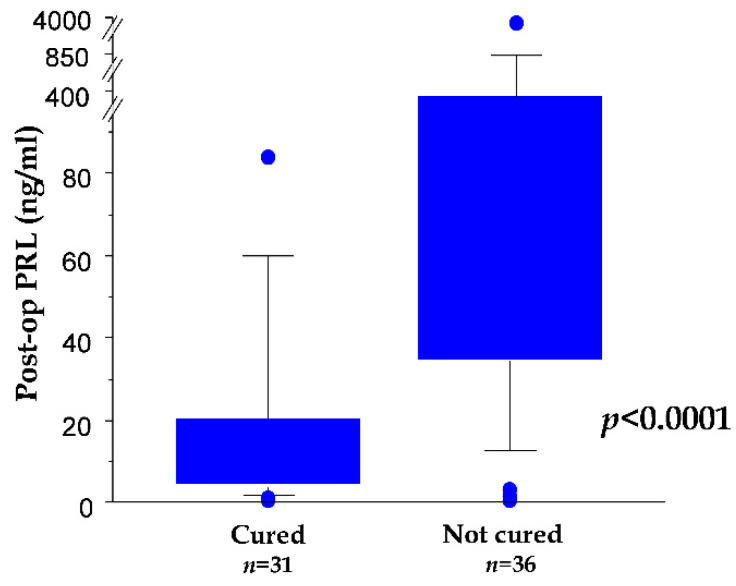
Two hundred and fifty-nine patients were enrolled. The first treatment was DA for 140 patients and TS for 119 cases. One hundred and forty-six of 249 patients (58.6%) needed a second therapy. The mean follow-up was 102.2 months (12-438 months). Surgery highly impacted on the cure rate-in particular, in females ( = 0.0021) and in microprolactinomas ( = 0.0020). Considering the multivariate analysis, the female gender and surgical treatment in the course of the clinical history were the only independent positive predictors of a cure at the end of 5 years follow-up ( = 0.0016, = 0.0005). The evaluation of serum prolactin (24 hours after TSS) revealed that 86.4% of patients with postoperative prolactin (PRL) ≤10 ng/mL were cured at the end of the follow-up ( < 0.0001).
According to our experience, surgery allows a high cure rate of prolactinomas, particularly in females with microadenoma, with a good safety profile. TSS for prolactinomas should be considered as a concrete option, during the multidisciplinary evaluation, in centers of reference for pituitary diseases.
泌乳素瘤对内分泌科医生和神经外科医生来说是一项独特的挑战。考虑到外科手术实践的最新创新,作者旨在研究泌乳素瘤的最佳治疗方法。
设计了一项回顾性、横断面单中心研究。如果连续的泌乳素瘤患者接受多巴胺激动剂(DA)或经蝶窦手术(TSS)的一线治疗,则纳入研究。患有巨大泌乳素瘤以及随访时间<12个月的患者被排除。
共纳入259例患者。首次治疗中,140例患者接受DA治疗,119例接受TSS治疗。249例患者中有146例(58.6%)需要二次治疗。平均随访时间为102.2个月(12 - 438个月)。手术对治愈率有很大影响,尤其是在女性患者(P = 0.0021)和微泌乳素瘤患者中(P = 0.0020)。多因素分析显示,女性性别和临床过程中的手术治疗是5年随访结束时治愈的唯一独立阳性预测因素(P = 0.0016,P = 0.0005)。血清泌乳素评估(TSS后24小时)显示,术后泌乳素(PRL)≤10 ng/mL的患者中,86.4%在随访结束时治愈(P < 0.0001)。
根据我们的经验,手术可使泌乳素瘤的治愈率较高,尤其是女性微腺瘤患者,且安全性良好。在垂体疾病参考中心进行多学科评估时,应将泌乳素瘤的TSS视为一种切实可行的选择。