Department of Tumor Biology, University Medical Center Hamburg-Eppendorf, 20246 Hamburg, Germany.
Alacris Theranostics GmbH, Max-Planck-Straße 3, 12489 Berlin, Germany.
Int J Mol Sci. 2021 Jun 29;22(13):6993. doi: 10.3390/ijms22136993.
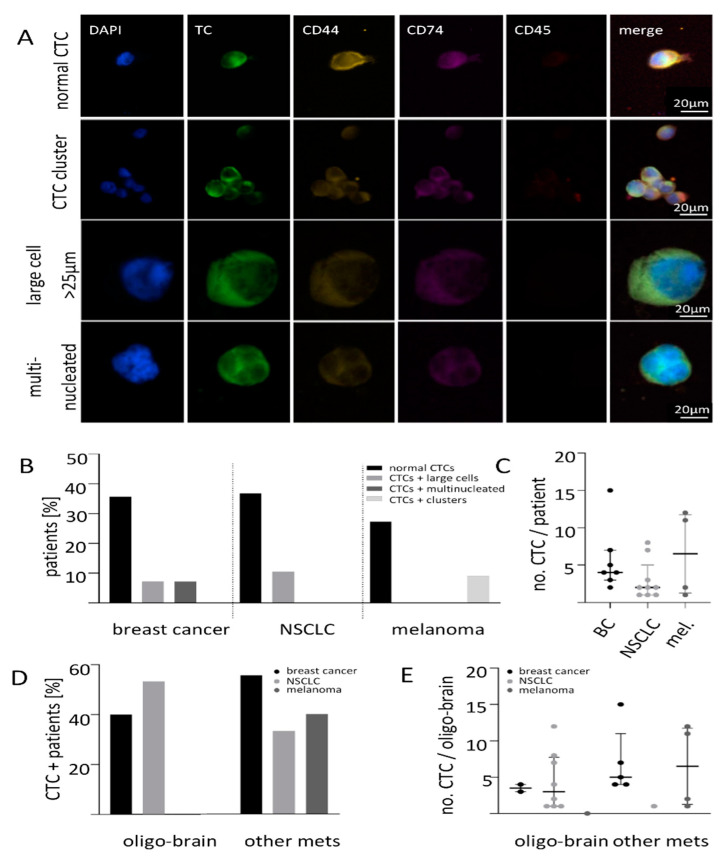
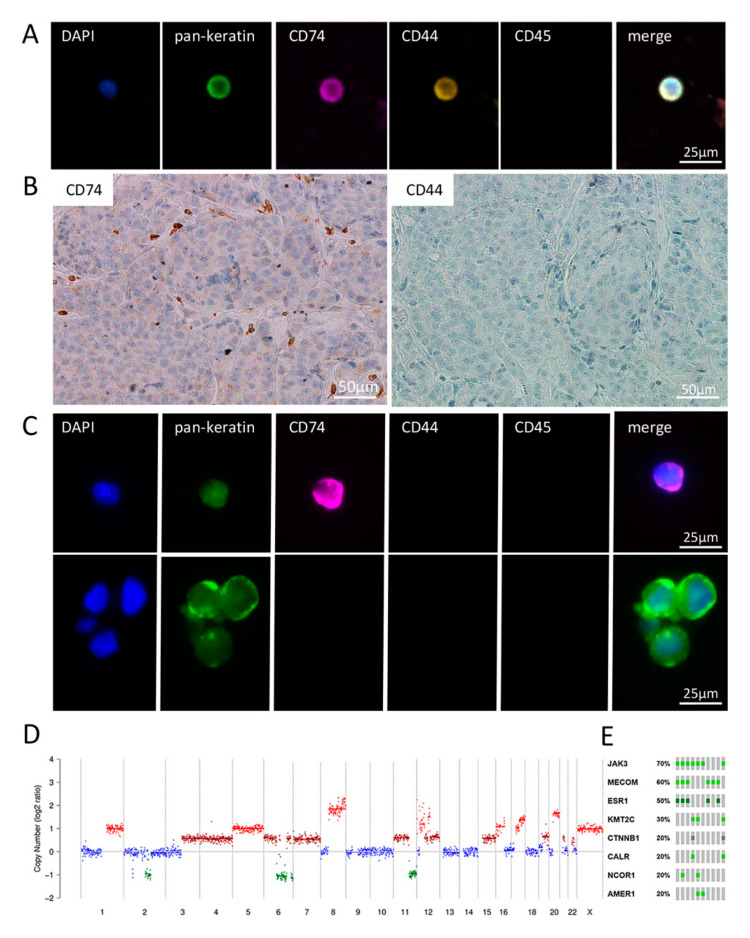
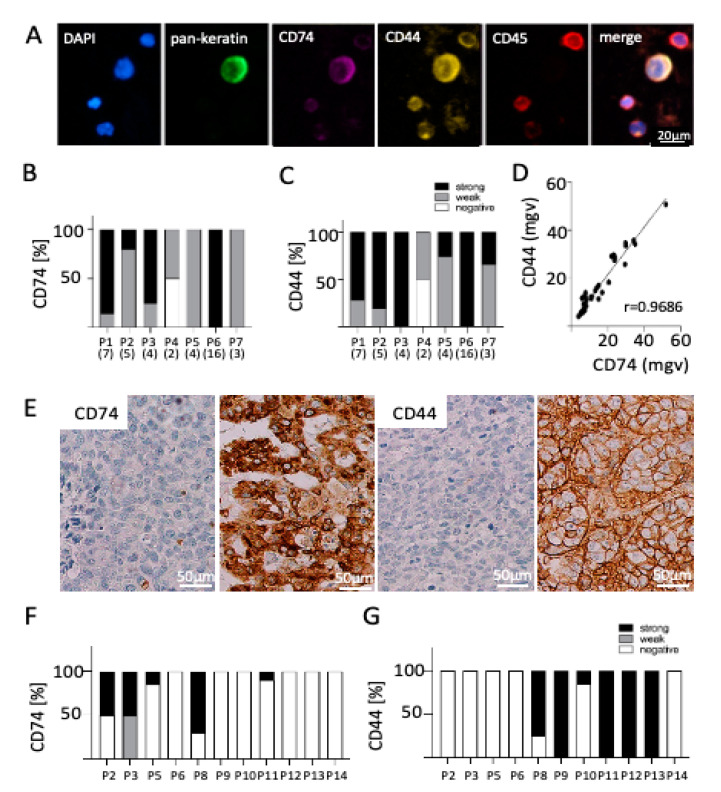
Up to 40% of advance lung, melanoma and breast cancer patients suffer from brain metastases (BM) with increasing incidence. Here, we assessed whether circulating tumor cells (CTCs) in peripheral blood can serve as a disease surrogate, focusing on CD44 and CD74 expression as prognostic markers for BM. We show that a size-based microfluidic approach in combination with a semi-automated cell recognition system are well suited for CTC detection in BM patients and allow further characterization of tumor cells potentially derived from BM. CTCs were found in 50% (7/14) of breast cancer, 50% (9/18) of non-small cell lung cancer (NSCLC) and 36% (4/11) of melanoma patients. The next-generation sequencing (NGS) analysis of nine single CTCs from one breast cancer patient revealed three different CNV profile groups as well as a resistance causing ERS1 mutation. CD44 and CD74 were expressed on most CTCs and their expression was strongly correlated, whereas matched breast cancer BM tissues were much less frequently expressing CD44 and CD74 (negative in 46% and 54%, respectively). Thus, plasticity of CD44 and CD74 expression during trafficking of CTCs in the circulation might be the result of adaptation strategies.
多达 40%的肺癌、黑色素瘤和乳腺癌的进展期患者患有脑转移(BM),且发病率不断上升。在这里,我们评估了外周血中的循环肿瘤细胞(CTC)是否可以作为疾病替代物,重点关注 CD44 和 CD74 表达作为 BM 的预后标志物。我们表明,基于大小的微流控方法与半自动细胞识别系统相结合,非常适合 BM 患者的 CTC 检测,并允许进一步对可能源自 BM 的肿瘤细胞进行特征描述。在 50%(7/14)的乳腺癌、50%(9/18)的非小细胞肺癌(NSCLC)和 36%(4/11)的黑色素瘤患者中发现了 CTC。对一名乳腺癌患者的 9 个单个 CTC 的下一代测序(NGS)分析显示,有三个不同的 CNV 谱群,以及一个导致 ERS1 突变的耐药性。大多数 CTC 上表达 CD44 和 CD74,且其表达呈强相关性,而匹配的乳腺癌 BM 组织则较少表达 CD44 和 CD74(分别为阴性 46%和 54%)。因此,CTC 在循环中转移过程中 CD44 和 CD74 表达的可塑性可能是适应策略的结果。