Zhao Yinlong, Ling Shukuan, Zhong Guohui, Li Yuheng, Li Jianwei, Du Ruikai, Jin Xiaoyan, Zhao Dingsheng, Liu Zizhong, Kan Guanghan, Chang Yan-Zhong, Li Yingxian
Key Laboratory of Molecular and Cellular Biology of Ministry of Education, College of Life Science, Hebei Normal University, Shijiazhuang, China.
State Key Laboratory of Space Medicine Fundamentals and Application, China Astronaut Research and Training Center, Beijing, China.
Front Physiol. 2021 Jun 15;12:678863. doi: 10.3389/fphys.2021.678863. eCollection 2021.
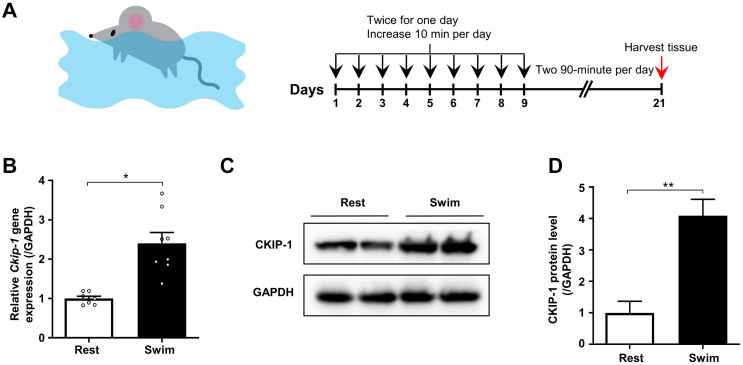
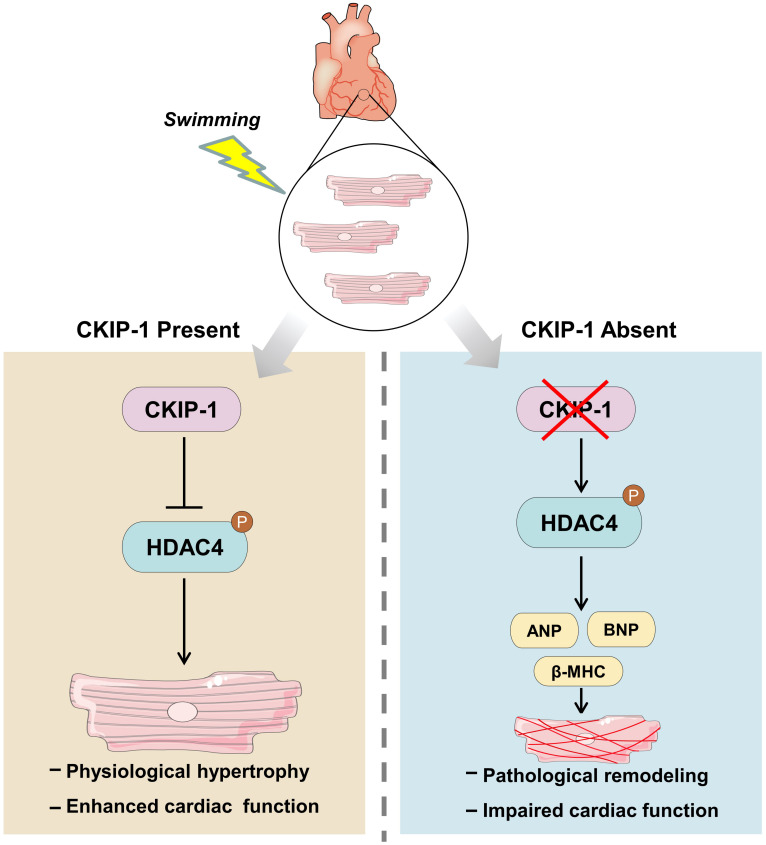
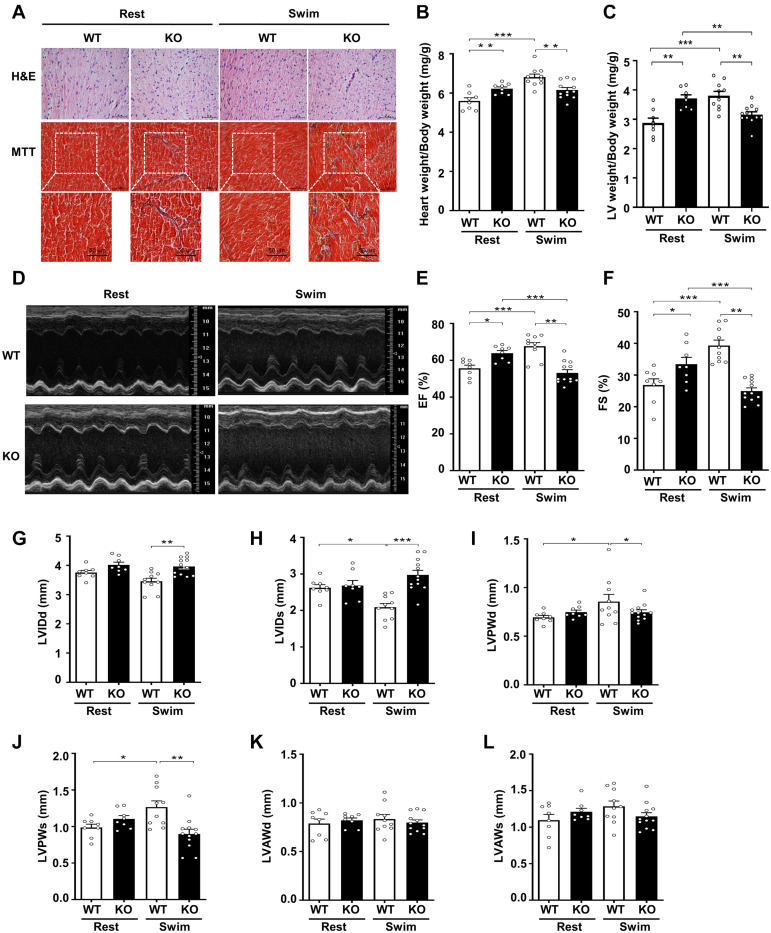
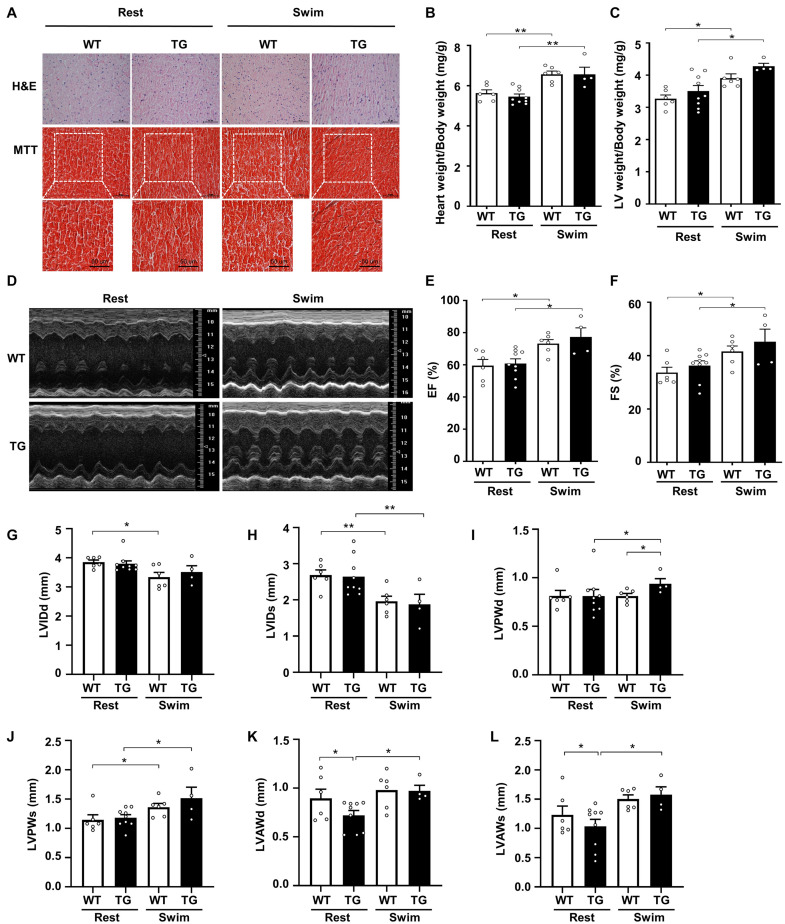
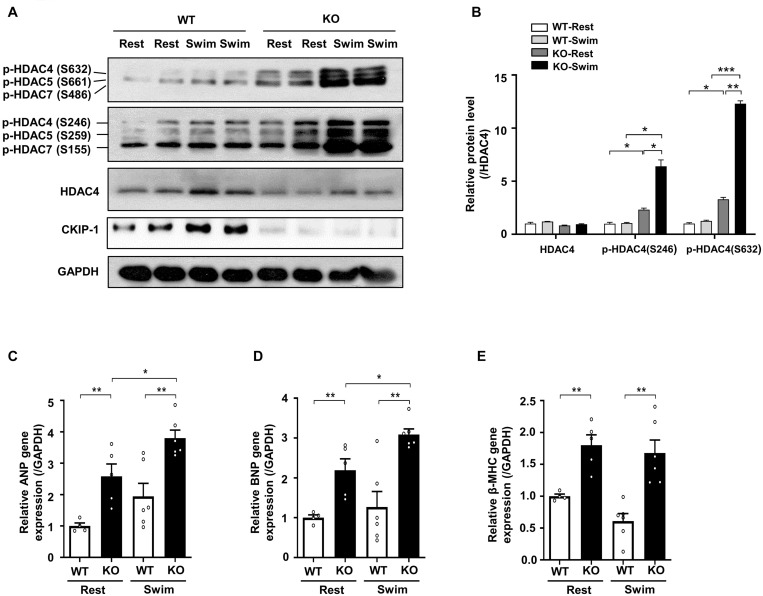
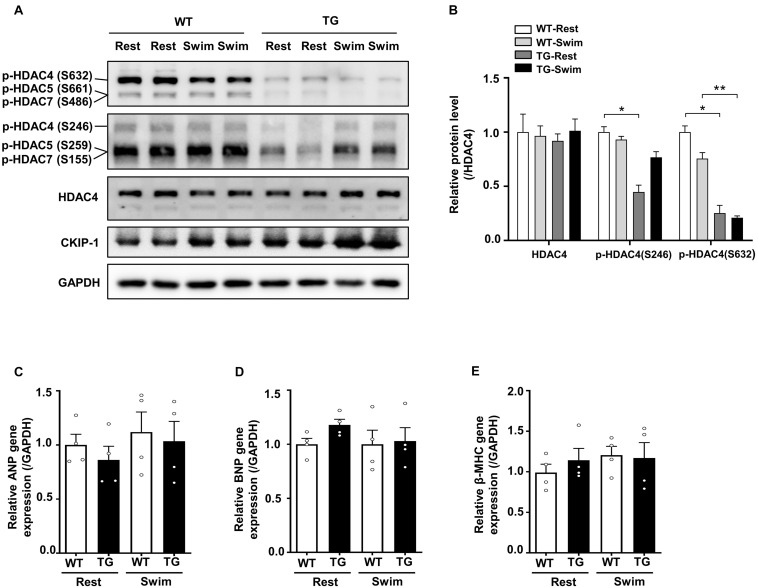
Different kinds of mechanical stimuli acting on the heart lead to different myocardial phenotypes. Physiological stress, such as exercise, leads to adaptive cardiac hypertrophy, which is characterized by a normal cardiac structure and improved cardiac function. Pathological stress, such as sustained cardiac pressure overload, causes maladaptive cardiac remodeling and, eventually, heart failure. Casein kinase-2 interacting protein-1 (CKIP-1) is an important regulator of pathological cardiac remodeling. However, the role of CKIP-1 in physiological cardiac hypertrophy is unknown. We subjected wild-type (WT) mice to a swimming exercise program for 21 days, which caused an increase in myocardial CKIP-1 protein and mRNA expression. We then subjected CKIP-1 knockout (KO) mice and myocardial-specific CKIP-1-overexpressing mice to the 21-day swimming exercise program. Histological and echocardiography analyses revealed that CKIP-1 KO mice underwent pathological cardiac remodeling after swimming, whereas the CKIP-1-overexpressing mice had a similar cardiac phenotype to the WT controls. Histone deacetylase 4 (HDAC4) is a key molecule in the signaling cascade associated with pathological hypertrophy; the phosphorylation levels of HDAC4 were markedly higher in CKIP-1 KO mouse hearts after the swimming exercise program. The phosphorylation levels of HDAC4 did not change after swimming in the hearts of CKIP-1-overexpressing or WT mice. Our results indicate that swimming, a mechanical stress that leads to physiological hypertrophy, triggers pathological cardiac remodeling in CKIP-1 KO mice. CKIP-1 is necessary for physiological cardiac hypertrophy , and for modulating the phosphorylation level of HDAC4 after physiological stress. Genetically engineering CKIP-1 expression affected heart health in response to exercise.
作用于心脏的不同类型机械刺激会导致不同的心肌表型。生理应激,如运动,会导致适应性心脏肥大,其特征是心脏结构正常且心脏功能改善。病理应激,如持续性心脏压力过载,会导致适应性不良的心脏重塑,并最终导致心力衰竭。酪蛋白激酶2相互作用蛋白1(CKIP-1)是病理性心脏重塑的重要调节因子。然而,CKIP-1在生理性心脏肥大中的作用尚不清楚。我们让野生型(WT)小鼠进行为期21天的游泳锻炼计划,这导致心肌CKIP-1蛋白和mRNA表达增加。然后,我们让CKIP-1基因敲除(KO)小鼠和心肌特异性CKIP-1过表达小鼠进行为期21天的游泳锻炼计划。组织学和超声心动图分析显示,CKIP-1 KO小鼠在游泳后发生了病理性心脏重塑,而CKIP-1过表达小鼠的心脏表型与WT对照组相似。组蛋白去乙酰化酶4(HDAC4)是与病理性肥大相关的信号级联反应中的关键分子;在游泳锻炼计划后,CKIP-1 KO小鼠心脏中HDAC4的磷酸化水平明显更高。在CKIP-1过表达或WT小鼠的心脏中,游泳后HDAC4的磷酸化水平没有变化。我们的结果表明,游泳这种导致生理性肥大的机械应激会在CKIP-1 KO小鼠中引发病理性心脏重塑。CKIP-1对于生理性心脏肥大以及在生理应激后调节HDAC4的磷酸化水平是必需的。基因工程改造CKIP-1的表达会影响运动对心脏健康的作用。