Dargel Susanne, Stenzel Martin, Stöver Brigitte, Schleußner Ekkehard, Wittschieber Daniel, Banaschak Sibylle, Mentzel Hans-Joachim
Sektion Kinderradiologie, Institut für Diagnostische und Interventionelle Radiologie, Universitätsklinikum, Am Klinikum 1, 07747, Jena, Deutschland.
Klinik für Geburtsmedizin, Department für Frauenheilkunde und Geburtsmedizin, Universitätsklinikum, Jena, Deutschland.
Radiologe. 2021 Oct;61(10):947-954. doi: 10.1007/s00117-021-00872-w. Epub 2021 Jul 2.
Diagnostic imaging plays a key role in the evaluation of non-accidental consequences of injuries in childhood. Fractures are the second most common consequence of child abuse, after skin lesions such as abrasions or bleeding. With the evidence of radiological criteria, non-accidental fractures can be differentiated from accidental fractures. Special types of fractures such as the classic metaphyseal lesion can only be differentiated if the image quality is high.
The goal of this prospective study was to assess adherence to guidelines and quality assurance of radiological diagnostics in the event of suspected abuse in Germany. For this purpose, the quantity and diagnostic quality in university and non-university hospitals as well as the existence of a pediatric radiology department were analyzed.
In all, 958 X‑ray examinations of 114 suspected abuse cases (46 girls, 68 boys) were evaluated; 42 cases from university, 42 from maximum care and 30 from regular care clinics with a median age of 6 months (3 weeks-3 years of age) were assessed as DICOM data by 3 pediatric radiologists in a consensus procedure with regard to adherence to guidelines and various quality parameters. An accompanying questionnaire was used to compare the theoretical knowledge with the respective practical implementation.
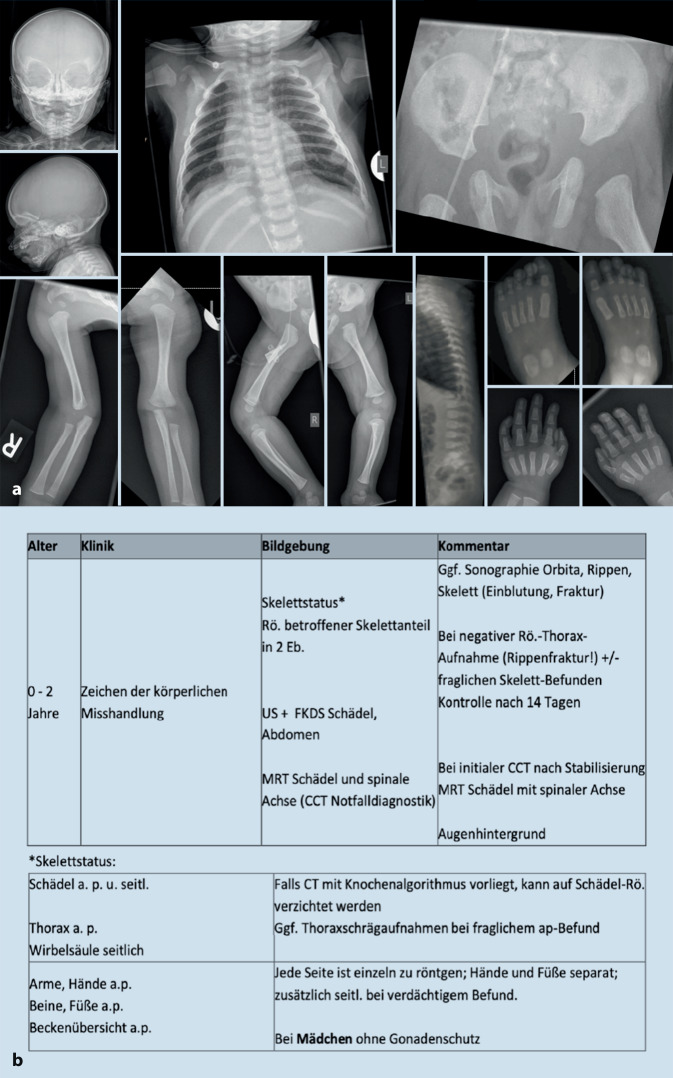
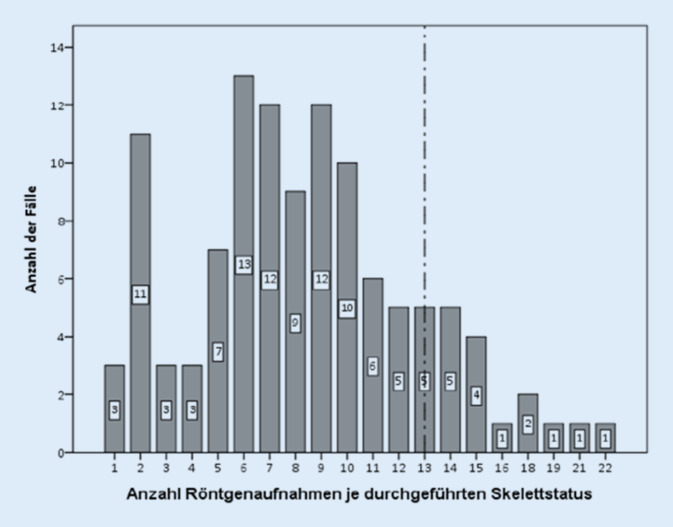
A mean of 8.4 X‑rays (range 1-22) were made per case. In 12 of 114 assessed cases (10%) there was a complete skeletal status according to the S1 guideline. A babygram was performed in 13 cases (10.5%). Departments with focus on pediatric radiology produced significantly more X‑rays per skeletal status than facilities without this specialization (p < 0.04). Significantly higher qualitative implementation was recorded in university hospitals (p < 0.001). Regardless of the type of institution, there was only marginal agreement between the questionnaire response and the available image material.
In Germany, a guideline-compliant procedure in the event of suspected child abuse is largely lacking. It remains to be seen whether this will change in the future with the broader implementation of child protection groups and the S3+ child protection guideline adopted in 2019 (AWMF register 027-069). The establishment of reference centers for a second diagnosis and recommendations for imaging technology can also improve the quality of care over the long term.
诊断成像在评估儿童期受伤的非意外后果中起着关键作用。骨折是儿童虐待的第二常见后果,仅次于擦伤或出血等皮肤损伤。有了放射学标准的证据,非意外骨折可以与意外骨折区分开来。只有在图像质量高的情况下,才能区分特殊类型的骨折,如经典的干骺端病变。
这项前瞻性研究的目的是评估德国在疑似虐待事件中放射诊断的指南遵循情况和质量保证。为此,分析了大学医院和非大学医院的检查数量和诊断质量以及儿科放射科的存在情况。
总共评估了114例疑似虐待病例(46名女孩,68名男孩)的958次X线检查;来自大学医院的42例、重症监护医院的42例和普通诊所的30例,中位年龄为6个月(3周 - 3岁),由3名儿科放射科医生以共识程序将其作为DICOM数据评估指南遵循情况和各种质量参数。使用一份随附问卷将理论知识与各自的实际执行情况进行比较。
每例平均进行8.4次X线检查(范围1 - 22次)。在114例评估病例中的12例(10%)中,根据S1指南有完整的骨骼状况检查。13例(10.5%)进行了婴儿全身X线摄影。专注于儿科放射学的科室每例骨骼状况检查所产生的X线检查明显多于没有这种专业设置的机构(p < 0.04)。大学医院在质量执行方面的记录明显更高(p < 0.001)。无论机构类型如何,问卷回答与可用图像材料之间只有很小的一致性。
在德国,在疑似虐待儿童的情况下,很大程度上缺乏符合指南的程序。随着儿童保护组织的更广泛实施以及2019年采用的S3 +儿童保护指南(AWMF登记号027 - 069),未来这种情况是否会改变还有待观察。建立二次诊断参考中心和成像技术建议也可以长期提高护理质量。