Martini Julia, Leopold Karolina, Pfeiffer Steffi, Berndt Christina, Boehme Anne, Roessner Veit, Fusar-Poli Paolo, Young Allan H, Correll Christoph U, Bauer Michael, Pfennig Andrea
Department of Psychiatry and Psychotherapy, Carl Gustav Carus University Hospital, Technische Universität Dresden, Fetscherstraße 74, 01307, Dresden, Germany.
Department of Psychiatry, Psychotherapy and Psychosomatics, Vivantes Klinikum Am Urban, Berlin, Germany.
Int J Bipolar Disord. 2021 Jul 2;9(1):23. doi: 10.1186/s40345-021-00227-3.
Early identification and intervention of individuals with risk factors for or subtle prodromal symptoms of bipolar disorders (BD) may improve the illness course and prevent adverse long-term consequences.
We examined sociodemographic, clinical and psychopathological characteristics of help-seeking adolescents and young adults who consulted the Early Detection and Intervention Center Dresden at the University of Dresden (Germany) and presented with or without pre-defined at-risk criteria for BD. The standardized diagnostic procedure for all help-seeking youth included a comprehensive psychiatric history and a structured clinical interview. When BD at-risk state was suspected, early detection instruments (EPIbipolar, BPSS-FP) were applied. Treatment recommendations were formulated in multi-professional case conferences.
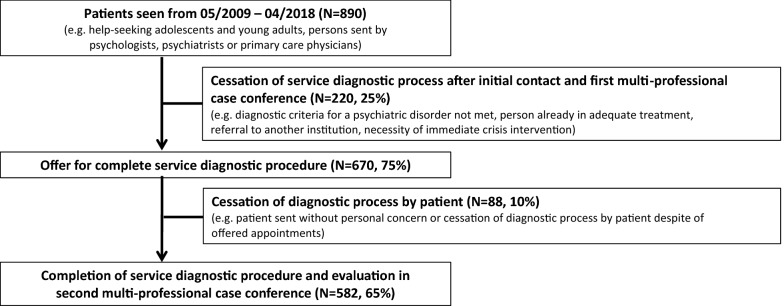
Out of 890 help-seeking persons between 05/2009 and 04/2018, 582 (65%) completed the diagnostic process. Of these, 24 (4%) had manifest BD and 125 (21%) fulfilled at-risk BD criteria (age = 23.9 ± 0.6 years, female = 62%). Of the pre-defined main risk factors, family history for BD was reported in 22% of the at-risk persons, (hypo-)mania risk state in 44%, and increasing cyclothymic mood swings with increased activity in 48%. The most common secondary risk factors were decreased psychosocial functioning (78%), lifetime diagnosis of depressive disorder (67%) and specific sleep/circadian rhythm disturbances (59%). Substance use was very common in subjects at-risk for BD (cannabis = 50%, alcohol = 33%) and highest in patients with BD (cannabis = 75%, alcohol = 40%). Psychiatric treatment history, including psychopharmacological therapy, was similar between the groups, while treatment recommendations differed, with more advice for psychotherapy and antidepressants in the at-risk group with a lifetime diagnosis of depression and more advice for specialized BD treatment including mood stabilizers in patients with BD.
This analysis on the phenomenology of different BD at-risk stages suggests that early detection of individuals presenting with suggested risk factors for the development of BD is feasible in help-seeking young people. Future research should further develop/test stage-specific prevention and early targeted intervention approaches that were described in a naturalistic setting.
对双相情感障碍(BD)有风险因素或轻微前驱症状的个体进行早期识别和干预,可能会改善病程并预防不良的长期后果。
我们研究了向德国德累斯顿大学德累斯顿早期检测与干预中心咨询的求助青少年和年轻人的社会人口学、临床和心理病理学特征,这些人有或没有预先定义的BD风险标准。所有求助青年的标准化诊断程序包括全面的精神病史和结构化临床访谈。当怀疑处于BD风险状态时,应用早期检测工具(EPIbipolar,BPSS-FP)。在多专业病例讨论会上制定治疗建议。
在2009年5月至2018年4月期间的890名求助者中,582人(65%)完成了诊断过程。其中,24人(4%)患有明显的BD,125人(21%)符合BD风险标准(年龄=23.9±0.6岁,女性=62%)。在预先定义的主要风险因素中,22%的风险人群报告有BD家族史,44%有(轻)躁狂风险状态,48%有随着活动增加循环性情绪波动加剧。最常见的次要风险因素是心理社会功能下降(78%)、终生诊断为抑郁症(67%)和特定的睡眠/昼夜节律紊乱(59%)。物质使用在BD风险人群中非常普遍(大麻=50%,酒精=33%),在BD患者中最高(大麻=75%,酒精=40%)。两组之间包括心理药物治疗在内的精神科治疗史相似,但治疗建议不同,对于终生诊断为抑郁症的风险组,更多建议进行心理治疗和使用抗抑郁药,对于BD患者,更多建议进行包括心境稳定剂在内的专门BD治疗。
这项对不同BD风险阶段现象学的分析表明,在求助的年轻人中,早期发现有BD发展潜在风险因素的个体是可行的。未来的研究应进一步开发/测试在自然环境中描述的针对特定阶段的预防和早期靶向干预方法。