
平衡和运动协调参数可以通过身体平衡训练来改善 2 型糖尿病患者的状况:一项非随机对照试验。
Balance and motion coordination parameters can be improved in patients with type 2 diabetes with physical balance training: non-randomized controlled trial.
机构信息
Department of Orthopedics and Rehabilitation, Medical University of Warsaw, Warsaw, Poland.
Międzyleski Specialist Hospital, Str. Bursztynowa 2, 04-749, Warsaw, Poland.
出版信息
BMC Endocr Disord. 2021 Jul 3;21(1):143. doi: 10.1186/s12902-021-00804-8.
BACKGROUND
Type 2 diabetes (T2D) is a cause of multiple complications, including retinopathy and peripheral neuropathy. These complications are well understood and believed to contribute to gait instability. Poor balance control and increased falling risk have also been reported in people with diabetic peripheral neuropathy (DPN). Patients with DPN have increased risk of falling due to decreased proprioceptive feedback. Effective balance training should improve postural control in patients with DPN. For this purpose further evaluation was conducted and balance training was designed.
METHODS
The goal of our study was to determine values of proprioception, balance, muscle coordination and strength in patients with T2D and analyze whether biofeedback balance training with use of the Biodex Balance System could improve these parameters. To assess the fall risk the general stability index (GSI), the index of frontal-posterior (FPI) and medial-lateral (MLI) stability were evaluated. 37 patients with diagnosed type 2 diabetes mellitus were recruited to this study. Their results were compared with control group consisting of 41 healthy participants who were homogenic to the study group in terms of age and body mass index (BMI).
RESULTS
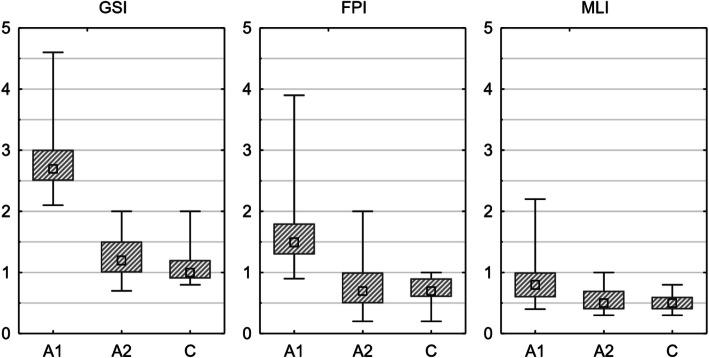
There were statistically significant differences between patients with diabetes compared to healthy subjects in GSI (2.79 vs 1.1), FPI (1.66 vs 0.7), MLI (0.88 vs 0.52) and risk of falling (5.18 vs 2.72) p < 0.05. There were also statistically significant changes before and after training in all stability indices (GSI: 2.79 vs 1.26, FPI: 1.66 vs 0.77, MLI: 0.88 vs 0.54 accordingly) p < 0.05 and risk of falling (5.18 vs 3.87) p < 0.05 in the study group who had undergone training with biofeedback.
CONCLUSIONS
This study found that there is a decreased balance and motor coordination and an increased risk of falling in patients with type 2 diabetes. These parameters improved in patients who have undergone training programme with biofeedback. Furthermore, an age-dependent deprivation of static balance was observed along with an increased risk of falling as a result of increasing BMI.
背景
2 型糖尿病(T2D)是多种并发症的病因,包括视网膜病变和周围神经病变。这些并发症已经得到了很好的理解,并被认为是导致步态不稳定的原因。糖尿病周围神经病变(DPN)患者也存在平衡控制不佳和跌倒风险增加的情况。DPN 患者由于本体感觉反馈减少而跌倒风险增加。有效的平衡训练应该可以改善 DPN 患者的姿势控制。为此,我们进行了进一步的评估,并设计了平衡训练。
方法
我们的研究目的是确定 T2D 患者的本体感觉、平衡、肌肉协调性和力量值,并分析使用 Biodex 平衡系统进行生物反馈平衡训练是否可以改善这些参数。为了评估跌倒风险,评估了总体稳定性指数(GSI)、额-后向(FPI)和内-外侧(MLI)稳定性指数。我们招募了 37 名确诊为 2 型糖尿病的患者参加这项研究。将他们的结果与由 41 名健康参与者组成的对照组进行比较,这些健康参与者在年龄和体重指数(BMI)方面与研究组同质。
结果
与健康受试者相比,糖尿病患者的 GSI(2.79 比 1.1)、FPI(1.66 比 0.7)、MLI(0.88 比 0.52)和跌倒风险(5.18 比 2.72)存在统计学显著差异,p<0.05。在接受生物反馈训练后,所有稳定性指数(GSI:2.79 比 1.26、FPI:1.66 比 0.77、MLI:0.88 比 0.54)和跌倒风险(5.18 比 3.87)也存在统计学显著变化,p<0.05。
结论
本研究发现,2 型糖尿病患者的平衡和运动协调性下降,跌倒风险增加。接受生物反馈训练的患者这些参数得到了改善。此外,随着年龄的增长,静态平衡也会受到影响,BMI 的增加会增加跌倒的风险。


 Zotero 插件