Department of Preventive Medicine, College of Medicine, University of Tennessee Health Science Center, Memphis, TN, 38163, USA.
College of Medicine, University of Tennessee Health Science Center, Memphis, 38163, TN, USA.
Curr Osteoporos Rep. 2022 Oct;20(5):240-248. doi: 10.1007/s11914-022-00744-9. Epub 2022 Aug 30.
Weight loss is recommended for improving glycemic control and reducing cardiovascular risk factors in persons with diabetes. However, both diabetes and weight loss have been associated with detrimental skeletal health. This review aims to summarize recent study findings on the effects of lifestyle interventions for weight loss on skeletal health among persons with type 2 diabetes (T2D).
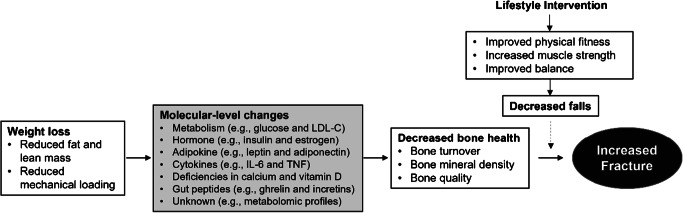
A few large-scale observational studies have demonstrated an increased fragility fracture risk associated with weight loss among persons with T2D. Randomized control trials in persons with T2D also have shown that intentional lifestyle interventions for weight loss are associated with a greater decrease in bone mineral density (BMD) and an increase in the risk of fracture. The biological mechanisms underlying the compromised bone health during lifestyle interventions for weight loss are complex and not yet conclusive. However, there is evidence to suggest that bone loss and increased fracture risk during intentional weight loss may be mitigated by some intervention approaches, such as high protein intake, calcium supplementation, and resistance and balance training. There is still a lack of studies investigating the effects of different interventions for weight loss on skeletal health among persons with T2D. However, certain types of diet and physical activity intervention combined with bone monitoring and fracture risk prediction may help achieve weight loss goals and maintain skeletal health among persons with T2D during intentional weight loss.
减轻体重有益于改善糖尿病患者的血糖控制和减少心血管危险因素。然而,糖尿病和体重减轻均与骨骼健康不良有关。本综述旨在总结近期关于 2 型糖尿病(T2D)患者通过生活方式干预减轻体重对骨骼健康影响的研究结果。
几项大规模观察性研究表明,T2D 患者体重减轻与脆性骨折风险增加相关。T2D 患者的随机对照试验也表明,旨在减轻体重的生活方式干预与骨密度(BMD)下降更大以及骨折风险增加相关。生活方式干预减轻体重时骨骼健康受损的潜在生物学机制很复杂,目前尚无定论。然而,有证据表明,通过某些干预方法,如高蛋白摄入、钙补充以及抗阻和平衡训练,可能减轻有意减轻体重时的骨丢失和骨折风险增加。目前仍缺乏研究不同干预方法减轻 T2D 患者体重对骨骼健康影响的研究。然而,某些类型的饮食和体力活动干预结合骨骼监测和骨折风险预测,可能有助于实现 T2D 患者在有意减轻体重期间的减重目标和维持骨骼健康。