Godel Michel, Andrews Derek S, Amaral David G, Ozonoff Sally, Young Gregory S, Lee Joshua K, Wu Nordahl Christine, Schaer Marie
Department of Psychiatry, University of Geneva School of Medicine, Geneva, Switzerland.
Department of Psychiatry and Behavioral Sciences, The Medical Investigation of Neurodevelopmental Disorders (MIND) Institute, UC Davis School of Medicine, University of California, Davis, Sacramento, CA, United States.
Front Neurosci. 2021 Jun 17;15:669194. doi: 10.3389/fnins.2021.669194. eCollection 2021.
Recent neuroimaging studies have highlighted differences in cerebral maturation in individuals with autism spectrum disorder (ASD) in comparison to typical development. For instance, the contrast of the gray-white matter boundary is decreased in adults with ASD. To determine how gray-white matter boundary integrity relates to early ASD phenotypes, we used a regional structural MRI index of gray-white matter contrast (GWC) on a sample of toddlers with a hereditary high risk for ASD.
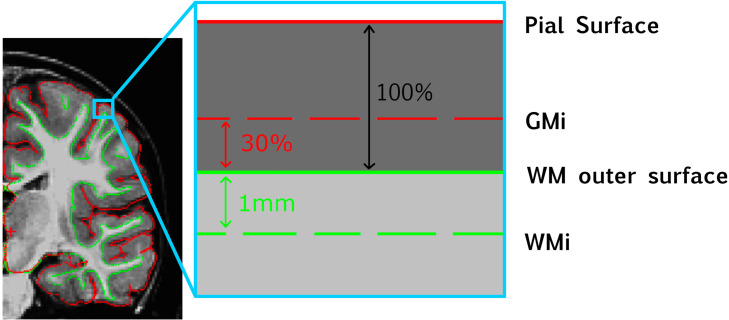
We used a surface-based approach to compute vertex-wise GWC in a longitudinal cohort of toddlers at high-risk for ASD imaged twice between 12 and 24 months ( = 20). A full clinical assessment of ASD-related symptoms was performed in conjunction with imaging and again at 3 years of age for diagnostic outcome. Three outcome groups were defined (ASD, = 9; typical development, = 8; non-typical development, = 3).
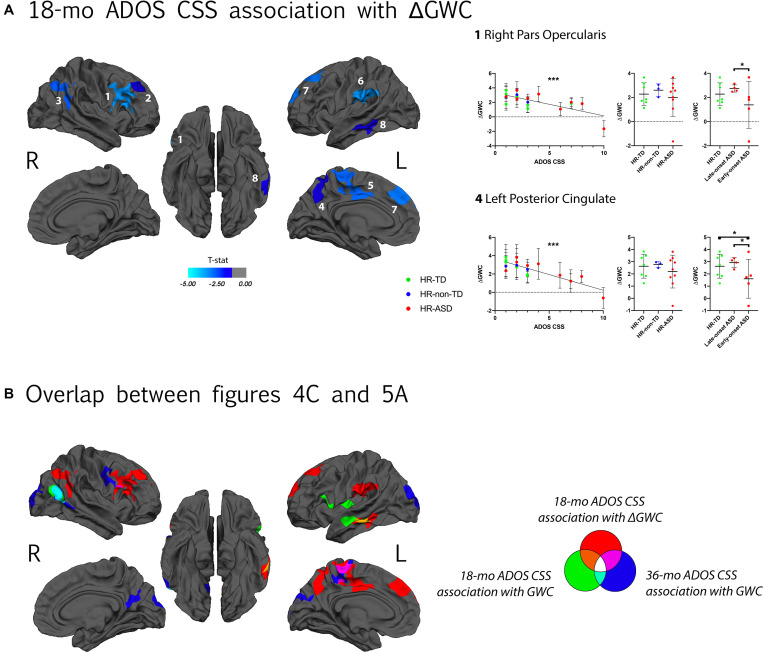
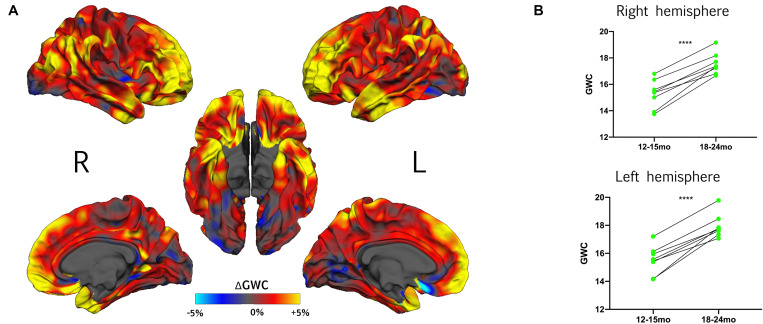
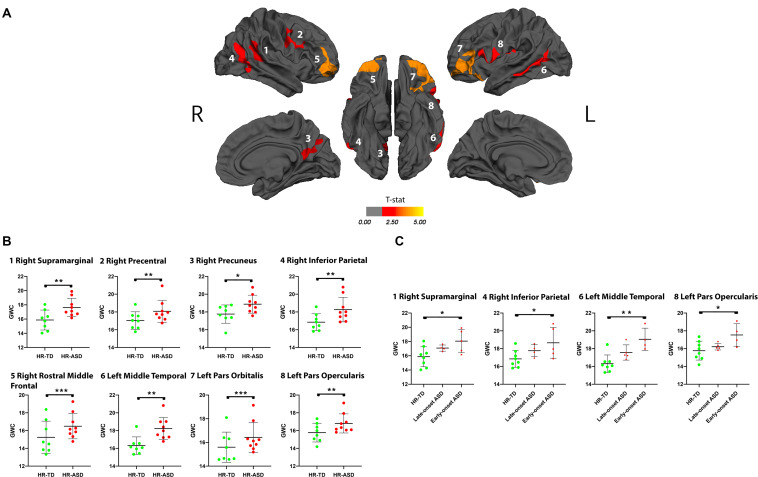
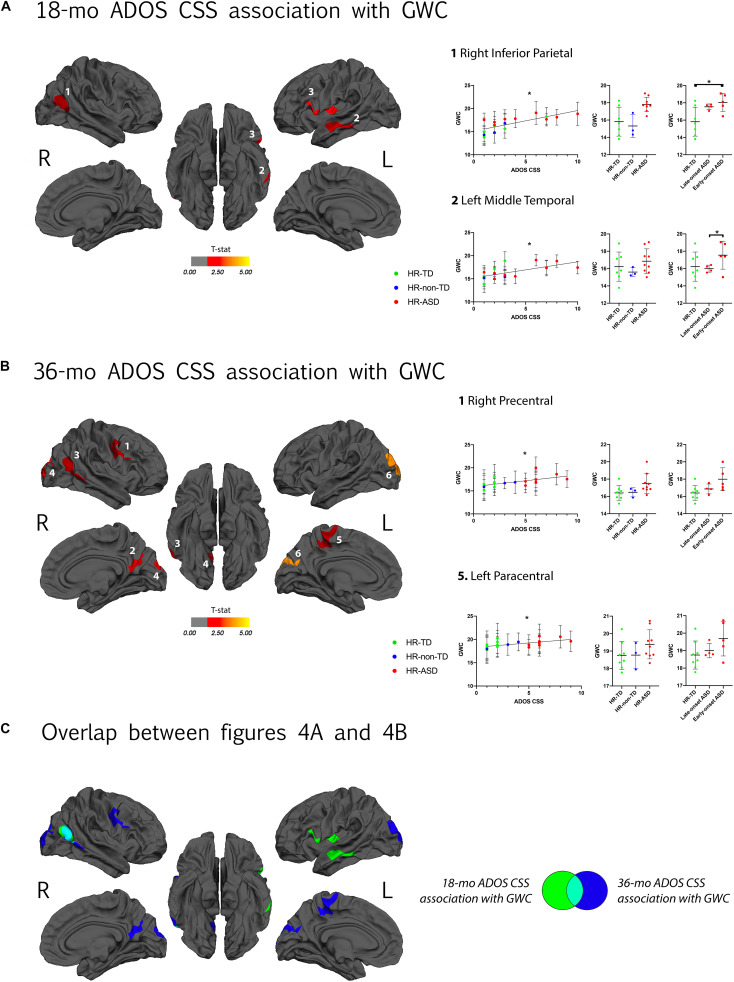
ASD diagnostic outcome at age 3 was associated with widespread increases in GWC between age 12 and 24 months. Many cortical regions were affected, including regions implicated in social processing and language acquisition. In parallel, we found that early onset of ASD symptoms (i.e., prior to 18-months) was specifically associated with slower GWC rates of change during the second year of life. These alterations were found in areas mainly belonging to the central executive network.
Our study is the first to measure maturational changes in GWC in toddlers who developed autism, but given the limited size of our sample results should be considered exploratory and warrant further replication in independent and larger samples.
These preliminary results suggest that ASD is linked to early alterations of the gray-white matter boundary in widespread brain regions. Early onset of ASD diagnosis constitutes an independent clinical parameter associated with a specific corresponding neurobiological developmental trajectory. Altered neural migration and/or altered myelination processes potentially explain these findings.
最近的神经影像学研究突出了自闭症谱系障碍(ASD)个体与典型发育个体在大脑成熟方面的差异。例如,ASD 成人的灰白质边界对比度降低。为了确定灰白质边界完整性与早期 ASD 表型之间的关系,我们对一组具有 ASD 遗传高风险的幼儿样本使用了区域结构 MRI 灰白质对比度(GWC)指数。
我们采用基于表面的方法,在一个纵向队列的 ASD 高风险幼儿中计算逐顶点的 GWC,这些幼儿在 12 至 24 个月之间接受了两次成像(n = 20)。在成像时同时进行了 ASD 相关症状的全面临床评估,并在 3 岁时再次进行以确定诊断结果。定义了三个结果组(ASD,n = 9;典型发育,n = 8;非典型发育,n = 3)。
3 岁时的 ASD 诊断结果与 12 至 24 个月之间 GWC 的广泛增加有关。许多皮质区域受到影响,包括涉及社会处理和语言习得的区域。同时,我们发现 ASD 症状的早发(即 18 个月之前)与生命第二年中 GWC 的变化率较慢特别相关。这些改变出现在主要属于中央执行网络的区域。
我们的研究是首次测量患自闭症幼儿的 GWC 成熟变化,但鉴于我们样本规模有限,结果应被视为探索性的,需要在独立且更大的样本中进一步重复验证。
这些初步结果表明,ASD 与广泛脑区的灰白质边界早期改变有关。ASD 诊断的早发构成一个独立的临床参数,与特定的相应神经生物学发育轨迹相关。神经迁移改变和/或髓鞘形成过程改变可能解释了这些发现。