Luo Xiu-Ying, Zhong Ze, Chong Ai-Guo, Zhang Wei-Wei, Wu Xin-Dong
Department of Cardiology, The Second Affiliated Hospital (Jiande Branch), Zhejiang University School of Medicine, Hangzhou, China.
Front Physiol. 2021 Jun 17;12:645041. doi: 10.3389/fphys.2021.645041. eCollection 2021.
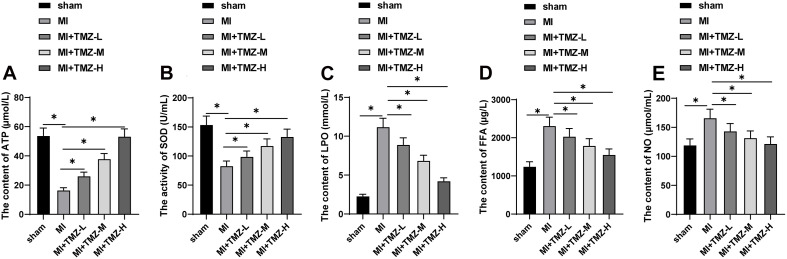
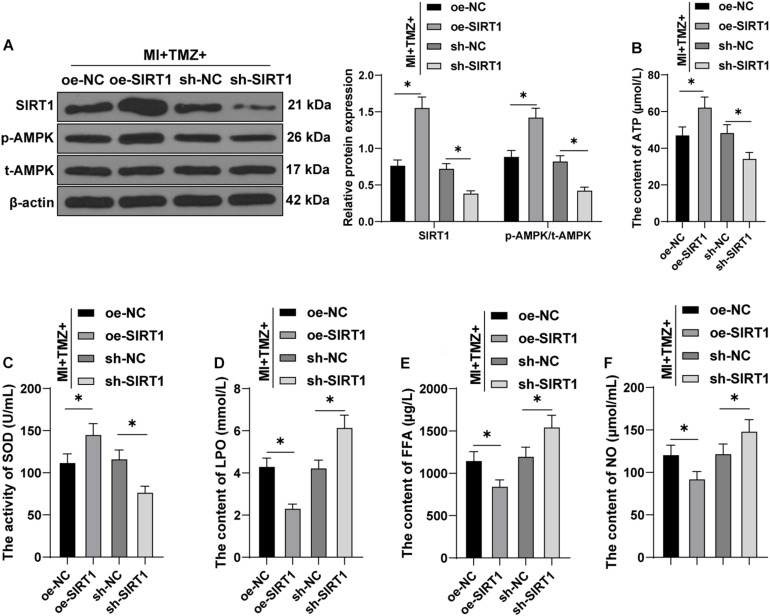
Myocardial energy metabolism (MEM) is an important factor of myocardial injury. Trimetazidine (TMZ) provides protection against myocardial ischemia/reperfusion injury. The current study set out to evaluate the effect and mechanism of TMZ on MEM disorder induced by myocardial infarction (MI). Firstly, a MI mouse model was established by coronary artery ligation, which was then treated with different concentrations of TMZ (5, 10, and 20 mg kg day). The results suggested that TMZ reduced the heart/weight ratio in a concentration-dependent manner. TMZ also reduced the levels of Bax and cleaved caspase-3 and promoted Bcl-2 expression. In addition, TMZ augmented adenosine triphosphate (ATP) production and superoxide dismutase (SOD) activity induced by MI and decreased the levels of lipid peroxide (LPO), free fatty acids (FFA), and nitric oxide (NO) in a concentration-dependent manner (all < 0.05). Furthermore, an HO-induced cell injury model was established and treated with different concentrations of TMZ (1, 5, and 10 μM). The results showed that SIRT1 overexpression promoted ATP production and reactive oxygen species (ROS) activity and reduced the levels of LPO, FFA, and NO in H9C2 cardiomyocytes treated with HO and TMZ. Silencing SIRT1 suppressed ATP production and ROS activity and increased the levels of LPO, FFA, and NO (all < 0.05). TMZ activated the SIRT1-AMPK pathway by increasing SIRT1 expression and AMPK phosphorylation. In conclusion, TMZ inhibited MI-induced myocardial apoptosis and MEM disorder by activating the SIRT1-AMPK pathway.
心肌能量代谢(MEM)是心肌损伤的一个重要因素。曲美他嗪(TMZ)可提供针对心肌缺血/再灌注损伤的保护作用。当前研究旨在评估TMZ对心肌梗死(MI)所致MEM紊乱的影响及机制。首先,通过冠状动脉结扎建立MI小鼠模型,随后用不同浓度的TMZ(5、10和20毫克/千克/天)进行治疗。结果表明,TMZ以浓度依赖性方式降低心脏/体重比。TMZ还降低了Bax和裂解型半胱天冬酶-3的水平,并促进了Bcl-2表达。此外,TMZ增加了MI诱导的三磷酸腺苷(ATP)生成和超氧化物歧化酶(SOD)活性,并以浓度依赖性方式降低了脂质过氧化物(LPO)、游离脂肪酸(FFA)和一氧化氮(NO)的水平(均P<0.05)。此外,建立了过氧化氢(HO)诱导的细胞损伤模型,并用不同浓度的TMZ(1、5和10微摩尔)进行治疗。结果显示,沉默沉默信息调节因子1(SIRT1)抑制了HO和TMZ处理的H9C2心肌细胞中的ATP生成和活性氧(ROS)活性,并增加了LPO、FFA和NO的水平(均P<0.05)。TMZ通过增加SIRT1表达和AMP激活的蛋白激酶(AMPK)磷酸化来激活SIRT1-AMPK通路。总之,TMZ通过激活SIRT1-AMPK通路抑制MI诱导的心肌细胞凋亡和MEM紊乱。