Zhou Jiayue, Wu Jing, Zheng Sifan, Chen Xiangjun, Zhou Daizhan, Shentu Xingchao
The Eye Center, Second Affiliated Hospital of School of Medicine, Zhejiang University, Hangzhou, China.
Zhejiang Provincial Key Lab of Ophthalmology, Second Affiliated Hospital of School of Medicine, Zhejiang University, Hangzhou, China.
Front Physiol. 2021 Jun 17;12:683056. doi: 10.3389/fphys.2021.683056. eCollection 2021.
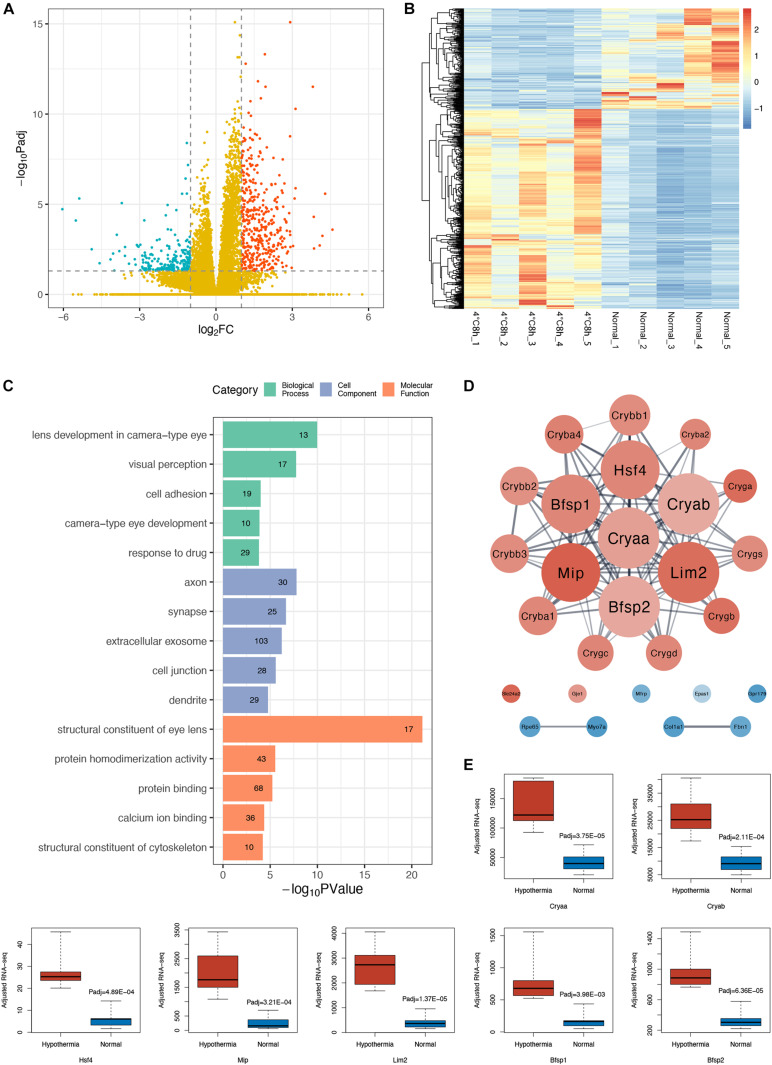
Cold cataract is the reversible opacification of the lens when the temperature decreases. However, we observed that when temperature of the rats' lens was maintained at a lower temperature for a prolonged time, the opacification of lens was only partly reversible. To review the potential molecular mechanism of the irreversible part of opacification under cold stimulation, we applied comparative transcriptomic and proteomic analysis to systematically investigate the molecular changes that occurred in the lens capsules of rats under low temperature treatments. The RNA sequencing based transcriptomic analysis showed a significant up-regulation of genes related to the lens structure and development in the Hypothermia Group. Hub genes were small heat shock proteins (sHSPs). Besides the same findings as the transcriptomic results, the liquid chromatography-tandem mass spectrometry based proteomic analysis also revealed the up-regulation of the apoptotic process. To further analyze the regulatory mechanism in this process, we subsequently performed integrated analysis and identified the down-regulation of Notch3/Hes1 and PI3K/Akt/Xiap signaling axis. Our research revealed the activation of the apoptotic process in rats' lens under cold stimulation, and the sHSP related heat shock response as a potential protective factor through our transcriptomic and proteomic data.
冷性白内障是指温度降低时晶状体发生的可逆性混浊。然而,我们观察到,当大鼠晶状体的温度长时间维持在较低水平时,晶状体混浊仅部分可逆。为了探究冷刺激下混浊不可逆部分的潜在分子机制,我们应用比较转录组学和蛋白质组学分析,系统地研究了低温处理下大鼠晶状体囊膜中发生的分子变化。基于RNA测序的转录组分析显示,低温组中与晶状体结构和发育相关的基因显著上调。枢纽基因是小分子热休克蛋白(sHSPs)。除了与转录组结果相同的发现外,基于液相色谱-串联质谱的蛋白质组分析还揭示了凋亡过程的上调。为了进一步分析该过程中的调控机制,我们随后进行了综合分析,确定了Notch3/Hes1和PI3K/Akt/Xiap信号轴的下调。我们的研究通过转录组学和蛋白质组学数据揭示了冷刺激下大鼠晶状体中凋亡过程的激活,以及与sHSP相关的热休克反应作为一种潜在的保护因素。