Beck Alison K, Kelly Peter J, Deane Frank P, Baker Amanda L, Hides Leanne, Manning Victoria, Shakeshaft Anthony, Neale Joanne, Kelly John F, Gray Rebecca M, Argent Angela, McGlaughlin Ryan, Chao Ryan, Martini Marcos
Faculty of the Arts, Social Sciences and Humanities, School of Psychology, University of Wollongong, Wollongong, NSW, Australia.
Illawarra Health and Medical Research Institute, University of Wollongong, Wollongong, NSW, Australia.
Front Psychiatry. 2021 Jun 18;12:677637. doi: 10.3389/fpsyt.2021.677637. eCollection 2021.
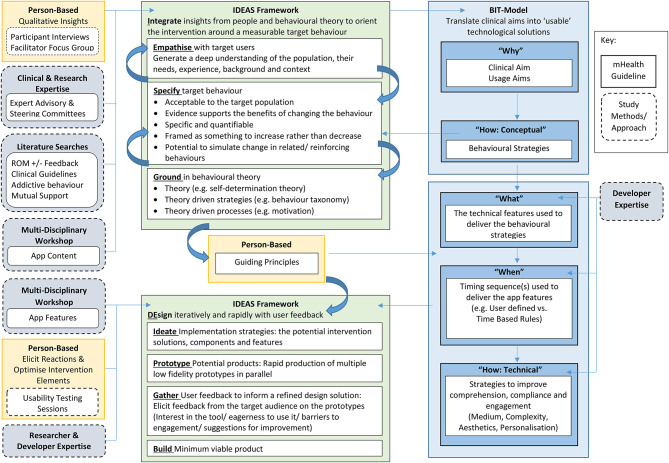
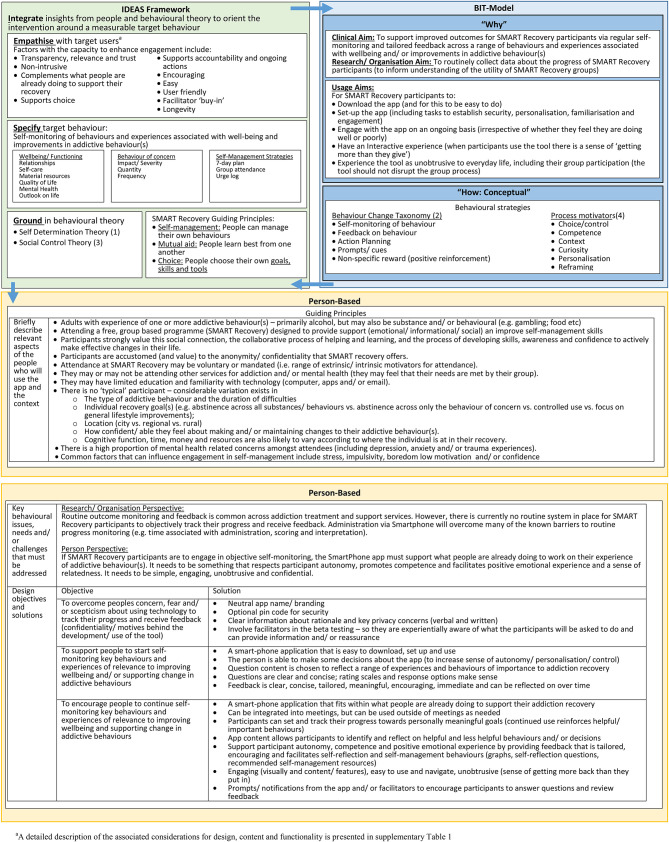
Routine outcome monitoring (ROM) has been implemented across a range of addiction treatment services, settings and organisations. Mutual support groups are a notable exception. Innovative solutions are needed. SMART Track is a purpose built smartphone app designed to capture ROM data and provide tailored feedback to adults attending Australian SMART Recovery groups for addictive behaviour(s). Details regarding the formative stage of app development is essential, but often neglected. Improved consideration of the end-user is vital for curtailing app attrition and enhancing engagement. This paper provides a pragmatic example of how principles embedded in published frameworks can be operationalised to address these priorities during the design and development of the SMART Track app. Three published frameworks for creating digital health technologies ("Person-Based Approach," "BIT" Model and IDEAS framework) were integrated and applied across two stages of research to inform the development, design and content of SMART Track. These frameworks were chosen to ensure that SMART Track was informed by the needs and preferences of the end-user ("Person-Based"); best practise recommendations for mHealth development ("BIT" Model) and a collaborative, iterative development process between the multi-disciplinary research team, app developers and end-users (IDEAS framework). Stage one of the research process generated in-depth knowledge to inform app development, including a comprehensive set of aims (clinical, research/organisation, and usage); clear articulation of the target behaviour (self-monitoring of recovery related behaviours and experiences); relevant theory (self-determination and social control); appropriate behavioural strategies (e.g., behaviour change taxonomy and process motivators) and key factors that may influence engagement (e.g., transparency, relevance and trust). These findings were synthesised into guiding principles that were applied during stage two in an iterative approach to app design, content and development. This paper contributes new knowledge on important person-centred and theoretical considerations that underpin a novel ROM and feedback app for people with addictive behaviour(s). Although person-centred design and best-practise recommendations were employed, further research is needed to determine whether this leads to improved usage outcomes. Pilot Trial: http://anzctr.org.au/Trial/Registration/TrialReview.aspx?id=377336.
常规结果监测(ROM)已在一系列成瘾治疗服务、场所和组织中实施。互助小组是一个显著的例外。需要创新的解决方案。SMART Track是一款专门设计的智能手机应用程序,旨在收集ROM数据,并为参加澳大利亚SMART Recovery成瘾行为小组的成年人提供量身定制的反馈。关于应用程序开发形成阶段的详细信息至关重要,但往往被忽视。更好地考虑最终用户对于减少应用程序流失和提高参与度至关重要。本文提供了一个务实的例子,说明如何将已发表框架中蕴含的原则应用于SMART Track应用程序设计和开发过程中,以解决这些优先事项。将三个已发表的创建数字健康技术的框架(“以人为本的方法”、“BIT”模型和IDEAS框架)整合并应用于两个研究阶段,为SMART Track的开发、设计和内容提供信息。选择这些框架是为了确保SMART Track能够依据最终用户的需求和偏好(“以人为本”)、移动健康开发的最佳实践建议(“BIT”模型)以及多学科研究团队、应用程序开发者和最终用户之间的协作、迭代开发过程(IDEAS框架)。研究过程的第一阶段产生了深入的知识,为应用程序开发提供信息,包括一整套目标(临床、研究/组织和使用方面);对目标行为的清晰阐述(对与康复相关行为和经历的自我监测);相关理论(自我决定和社会控制);适当的行为策略(如行为改变分类法和过程激励因素)以及可能影响参与度的关键因素(如透明度、相关性和信任)。这些发现被综合成指导原则,并在第二阶段以迭代方式应用于应用程序设计、内容和开发。本文为一种针对成瘾行为患者的新型ROM和反馈应用程序,贡献了关于重要的以人为本和理论考量的新知识。尽管采用了以人为本的设计和最佳实践建议,但仍需要进一步研究以确定这是否会带来更好的使用效果。试点试验:http://anzctr.org.au/Trial/Registration/TrialReview.aspx?id=377336 。